
[Paper Review] Dual Attention U-Net with Feature Infusion: Pushing the Boundaries of Multiclass Defect Segmentation
This paper proposes DAU-FI Net, a dual attention U-Net with feature infusion that enhances multiclass defect segmentation in data-scarce scenarios. By integrating multiscale depth-wise separable convolutions, spatial-channel squeeze-and-excitation attention, attention gates, and Gabor/Sobel/Canny filter-based feature injection guided by semantic masks, the model achieves state-of-the-art mean IoU of 95.6% on a sewer-culvert defect dataset and 98.8% on a benchmark, surpassing prior methods by 8.9% and 12.6% respectively, with only 1.46M parameters.
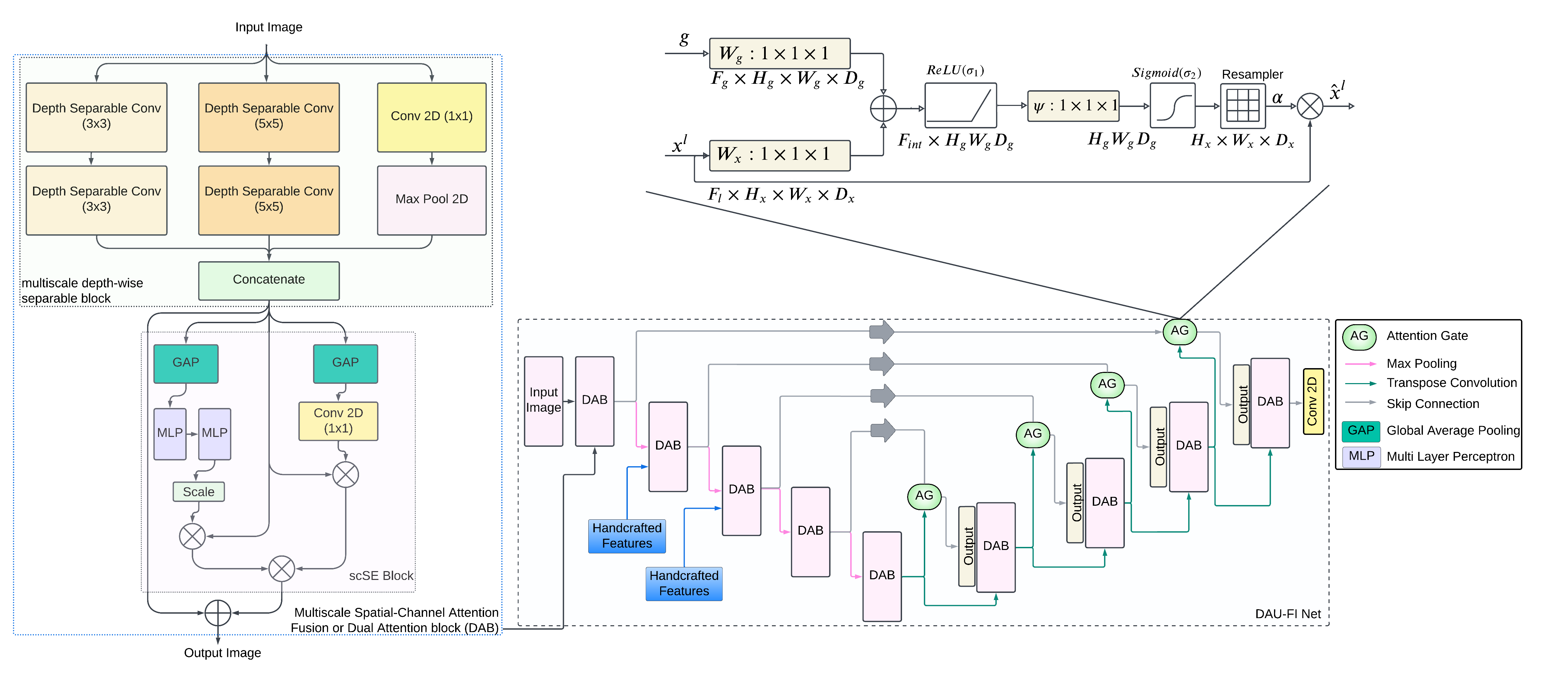
The proposed architecture, Dual Attentive U-Net with Feature Infusion (DAU-FI Net), addresses challenges in semantic segmentation, particularly on multiclass imbalanced datasets with limited samples. DAU-FI Net integrates multiscale spatial-channel attention mechanisms and feature injection to enhance precision in object localization. The core employs a multiscale depth-separable convolution block, capturing localized patterns across scales. This block is complemented by a spatial-channel squeeze and excitation (scSE) attention unit, modeling inter-dependencies between channels and spatial regions in feature maps. Additionally, additive attention gates refine segmentation by connecting encoder-decoder pathways. To augment the model, engineered features using Gabor filters for textural analysis, Sobel and Canny filters for edge detection are injected guided by semantic masks to expand the feature space strategically. Comprehensive experiments on a challenging sewer pipe and culvert defect dataset and a benchmark dataset validate DAU-FI Net's capabilities. Ablation studies highlight incremental benefits from attention blocks and feature injection. DAU-FI Net achieves state-of-the-art mean Intersection over Union (IoU) of 95.6% and 98.8% on the defect test set and benchmark respectively, surpassing prior methods by 8.9% and 12.6%, respectively. Ablation studies highlight incremental benefits from attention blocks and feature injection. The proposed architecture provides a robust solution, advancing semantic segmentation for multiclass problems with limited training data. Our sewer-culvert defects dataset, featuring pixel-level annotations, opens avenues for further research in this crucial domain. Overall, this work delivers key innovations in architecture, attention, and feature engineering to elevate semantic segmentation efficacy.
Motivation & Objective
- Address the challenge of multiclass semantic segmentation on small, imbalanced datasets common in real-world infrastructure inspection.
- Improve precision in defect localization and segmentation under data scarcity, especially for rare defect classes.
- Enhance feature representation by integrating domain-specific engineered features (Gabor, Sobel, Canny) with deep learning via semantic mask-guided injection.
- Optimize model efficiency and performance through attention mechanisms and architectural innovations, minimizing parameter count while maximizing accuracy.
- Establish a new benchmark with a novel, pixel-annotated sewer-culvert defect dataset to enable future research in automated infrastructure inspection.
Proposed method
- Proposes a Dual Attentive U-Net with Feature Infusion (DAU-FI Net) that combines encoder-decoder U-Net architecture with multiscale depth-wise separable convolutions for hierarchical feature learning.
- Introduces a concurrent spatial-channel squeeze-and-excitation (scSE) attention unit to model interdependencies between channels and spatial regions in feature maps, enhancing representation quality.
- Employs additive attention gates on skip connections between encoder and decoder pathways to refine feature fusion and improve localization accuracy.
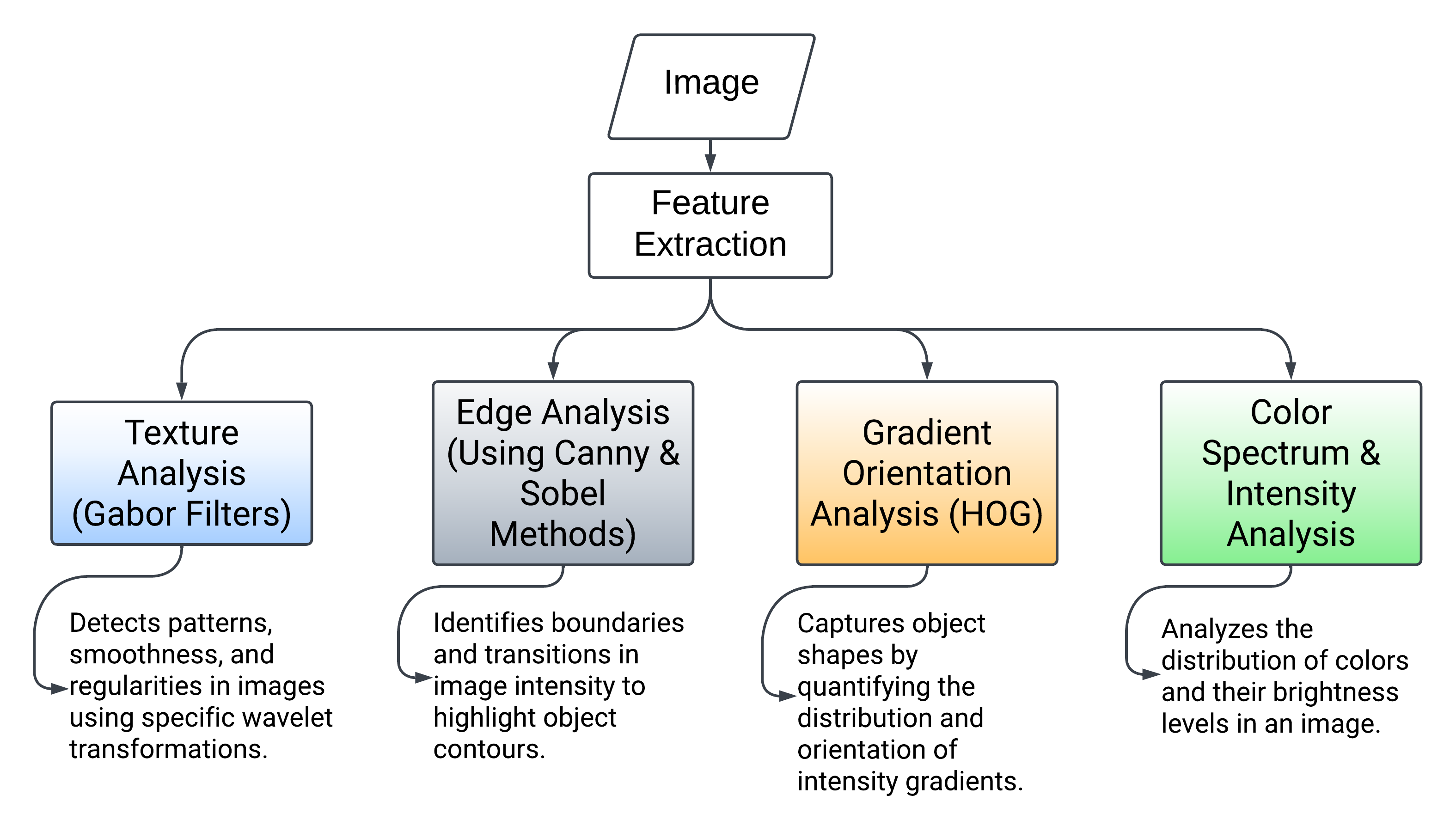
- Incorporates engineered features from Gabor, Sobel, and Canny filters, injected into the network based on predicted semantic masks to enrich feature space without increasing model complexity.
- Uses a multiscale depth-separable convolution block with 3×3, 5×5, and 1×1 kernels to capture multi-scale local patterns efficiently.
- Applies a hybrid training strategy that leverages both raw image data and engineered feature maps, with feature injection dynamically guided by attention masks to preserve spatial and semantic fidelity.
Experimental results
Research questions
- RQ1Can a dual attention mechanism that models both spatial and channel dependencies simultaneously improve segmentation accuracy on multiclass, imbalanced datasets?
- RQ2To what extent does injecting handcrafted features (Gabor, Sobel, Canny) guided by semantic masks enhance deep learning performance in low-data regimes?
- RQ3How does the integration of attention gates in skip connections affect feature fusion and localization precision in U-Net-based architectures?
- RQ4What is the optimal architectural configuration combining attention blocks, feature injection, and depth-wise separable convolutions for multiclass defect segmentation?
- RQ5Can a lightweight model with only 1.46 million parameters achieve state-of-the-art performance on complex real-world defect segmentation tasks?
Key findings
- DAU-FI Net achieves a state-of-the-art mean Intersection over Union (IoU) of 95.6% on the custom sewer-culvert defect dataset, outperforming prior methods by 8.9 percentage points.
- On the benchmark cell nuclei dataset, DAU-FI Net achieves a mean IoU of 98.8%, surpassing the previous SOTA by 12.6 percentage points.
- The ablation study confirms that each component—dual attention, feature injection, and attention gates—contributes incrementally to performance gains, with the full model (configuration P6) yielding the best results.
- The model achieves high accuracy with only 1.46 million parameters, indicating strong parameter efficiency and suitability for real-time or edge deployment.
- Visual comparisons show that DAU-FI Net detects defects even when they are missing from ground truth, indicating robust generalization and learning beyond annotation limits.
- The curated sewer-culvert defect dataset with pixel-level annotations is publicly released, enabling future benchmarking and research in automated infrastructure inspection.
Read this paper
Open the full text in the Nubint reader and ask about any passage as you read.
Read this paper on NubintThis review was generated by AI from the original paper. Please check the paper before citing it.