
[Paper Review] Dual Box Embeddings for the Description Logic EL++
This paper proposes Box²EL, a novel ontology embedding method for the Description Logic EL++ that represents both concepts and roles as axis-aligned hyperrectangles (boxes), using a bumping mechanism to model inter-concept relationships. It achieves state-of-the-art performance in subsumption prediction, role assertion prediction, and approximating deductive reasoning by faithfully modeling complex logical constructs, including one-to-many, many-to-one, and many-to-many relations and role inclusion axioms.
OWL ontologies, whose formal semantics are rooted in Description Logic (DL), have been widely used for knowledge representation. Similar to Knowledge Graphs (KGs), ontologies are often incomplete, and maintaining and constructing them has proved challenging. While classical deductive reasoning algorithms use the precise formal semantics of an ontology to predict missing facts, recent years have witnessed growing interest in inductive reasoning techniques that can derive probable facts from an ontology. Similar to KGs, a promising approach is to learn ontology embeddings in a latent vector space, while additionally ensuring they adhere to the semantics of the underlying DL. While a variety of approaches have been proposed, current ontology embedding methods suffer from several shortcomings, especially that they all fail to faithfully model one-to-many, many-to-one, and many-to-many relations and role inclusion axioms. To address this problem and improve ontology completion performance, we propose a novel ontology embedding method named Box$^2$EL for the DL EL++, which represents both concepts and roles as boxes (i.e., axis-aligned hyperrectangles), and models inter-concept relationships using a bumping mechanism. We theoretically prove the soundness of Box$^2$EL and conduct an extensive experimental evaluation, achieving state-of-the-art results across a variety of datasets on the tasks of subsumption prediction, role assertion prediction, and approximating deductive reasoning.
Motivation & Objective
- Address the limitations of existing ontology embedding methods in faithfully modeling one-to-many, many-to-one, and many-to-many relationships in EL++ ontologies.
- Overcome the shortcomings of prior approaches that rely on TransE-style translation for role modeling, which fails to capture role inclusion axioms and complex role semantics.
- Develop a method that preserves the formal semantics of EL++ while enabling inductive reasoning for ontology completion tasks.
- Improve performance on subsumption prediction, role assertion prediction, and approximating deductive reasoning in incomplete ontologies.
- Theoretically prove the soundness of the proposed embedding method with respect to EL++ semantics.
Proposed method
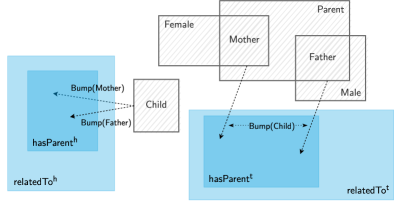
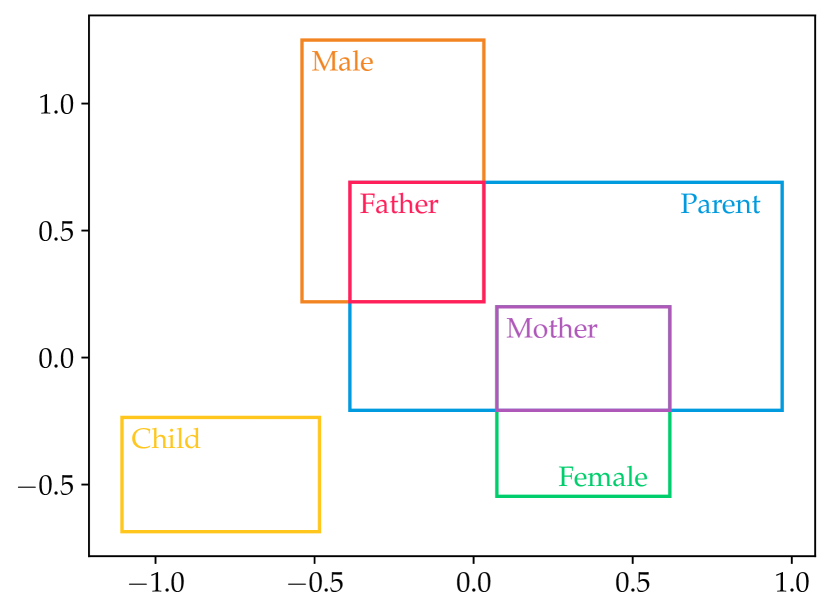
- Represent concepts and roles as axis-aligned hyperrectangles (boxes) in a latent vector space, enabling precise geometric modeling of logical constructs.
- Introduce a bumping mechanism to model inter-concept relationships, particularly for concept conjunction and subsumption, by adjusting box boundaries based on logical dependencies.
- Use box-based representations for roles, replacing TransE-style vector translations to better capture asymmetric and non-bijective role relationships.
- Formally prove the soundness of Box²EL by showing that its embedding semantics correctly reflect the entailment relations of EL++.
- Train the model end-to-end using a differentiable loss function that optimizes for subsumption and role assertion prediction, with negative sampling to improve generalization.
- Leverage the box representation to approximate deductive reasoning by learning embeddings that align with logically implied axioms in the ontology.
Experimental results
Research questions
- RQ1Can a box-based embedding method effectively model complex logical constructs in EL++, including role inclusion axioms and multi-directional relationships?
- RQ2How does Box²EL compare to state-of-the-art methods in subsumption prediction, role assertion prediction, and approximating deductive reasoning?
- RQ3To what extent does the bumping mechanism improve the modeling of concept conjunction and subsumption compared to ball-based or translation-based methods?
- RQ4Does the use of box representations for roles lead to better performance on tasks involving non-bijective or many-to-many relations?
- RQ5Can Box²EL preserve the formal semantics of EL++ while still enabling effective inductive reasoning on incomplete ontologies?
Key findings
- Box²EL achieves state-of-the-art performance on subsumption prediction across multiple datasets, outperforming baselines such as ELEm, EmEL++, BoxEL, and ELBE.
- On the yeast and human PPI datasets, Box²EL significantly improves Hits@100 and mean rank in role assertion prediction, with AUC scores close to 1.0 and gains over ELBE on the yeast dataset.
- In approximating deductive reasoning, Box²EL achieves the highest Hits@100 and lowest median and mean ranks across all three ontologies (GALEN, GO, Anatomy), indicating superior alignment with logically implied axioms.
- The model demonstrates strong performance on complex reasoning tasks, including those involving complex concepts and role inclusion axioms, which previous methods fail to model faithfully.
- Empirical results show that Box²EL outperforms ELBE and BoxEL—methods with similar concept representations—highlighting the advantage of box-based role modeling with bump vectors.
- Theoretical soundness proof confirms that Box²EL correctly represents the semantics of EL++, ensuring that all predictions are logically consistent with the ontology's formal structure.
Read this paper
Open the full text in the Nubint reader and ask about any passage as you read.
Read this paper on NubintThis review was generated by AI from the original paper. Please check the paper before citing it.