
[Paper Review] Dual Memory Units with Uncertainty Regulation for Weakly Supervised Video Anomaly Detection
This paper proposes a novel Uncertainty Regulated Dual Memory Units (UR-DMU) model for weakly supervised video anomaly detection, leveraging dual memory banks for normal and abnormal prototypes and a normal data uncertainty learning scheme to reduce false alarms. By integrating a Global and Local Multi-Head Self Attention module and a dual memory separation loss, the method achieves state-of-the-art performance on UCF-Crime and XD-Violence, with an AUC of 94.02% and AP of 82.85% on XD-Violence, significantly outperforming prior methods.
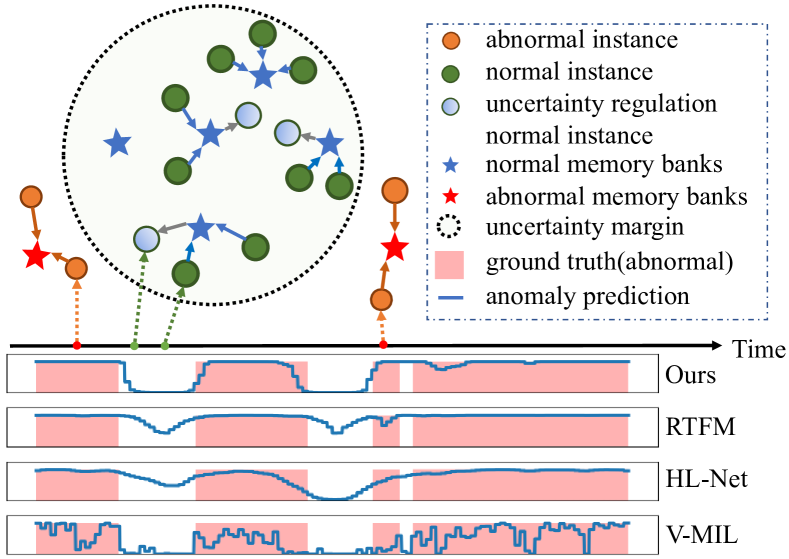
Learning discriminative features for effectively separating abnormal events from normality is crucial for weakly supervised video anomaly detection (WS-VAD) tasks. Existing approaches, both video and segment-level label oriented, mainly focus on extracting representations for anomaly data while neglecting the implication of normal data. We observe that such a scheme is sub-optimal, i.e., for better distinguishing anomaly one needs to understand what is a normal state, and may yield a higher false alarm rate. To address this issue, we propose an Uncertainty Regulated Dual Memory Units (UR-DMU) model to learn both the representations of normal data and discriminative features of abnormal data. To be specific, inspired by the traditional global and local structure on graph convolutional networks, we introduce a Global and Local Multi-Head Self Attention (GL-MHSA) module for the Transformer network to obtain more expressive embeddings for capturing associations in videos. Then, we use two memory banks, one additional abnormal memory for tackling hard samples, to store and separate abnormal and normal prototypes and maximize the margins between the two representations. Finally, we propose an uncertainty learning scheme to learn the normal data latent space, that is robust to noise from camera switching, object changing, scene transforming, etc. Extensive experiments on XD-Violence and UCF-Crime datasets demonstrate that our method outperforms the state-of-the-art methods by a sizable margin.
Motivation & Objective
- To address the high false alarm rate in weakly supervised video anomaly detection (WS-VAD) by improving the modeling of normal data patterns.
- To overcome the limitation of existing methods that focus only on learning discriminative features for anomalies while neglecting normal data representation.
- To enhance robustness against noise from camera switching, object changes, and scene transitions in normal video data.
- To develop a more effective memory mechanism that separates normal and abnormal prototypes using dual memory banks.
- To improve anomaly detection performance by learning a latent normal space that is robust to noise through uncertainty modeling.
Proposed method
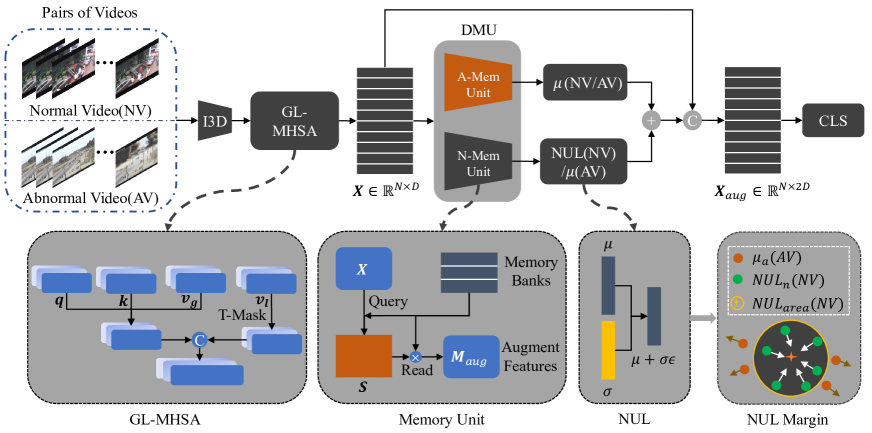
- Introduces a Global and Local Multi-Head Self Attention (GL-MHSA) module to capture both long-range and local temporal dependencies in video sequences for more expressive feature embeddings.
- Employs two memory banks—one for normal prototypes and one for abnormal prototypes—using video-level labels to store and separate representative features.
- Designs a dual memory separation loss to maximize the margin between normal and abnormal memory representations, enhancing discriminative capability.
- Proposes a Normal Data Uncertainty Learning (NUL) scheme that models normal features as a Gaussian distribution with learnable mean and variance, improving robustness to noise.
- Uses a feature magnitude-based paradigm to guide the selection of positive instances, aligning with RTFM’s effective strategy for anomaly detection.
- Combines GL-MHSA, dual memory units, and NUL within a unified framework to jointly optimize feature learning, memory representation, and uncertainty modeling.
Experimental results
Research questions
- RQ1Can modeling the latent structure of normal data improve anomaly detection performance and reduce false alarms in weakly supervised video anomaly detection?
- RQ2Does using dual memory banks for normal and abnormal prototypes lead to better separation of normal and anomalous patterns than a single memory bank?
- RQ3Can uncertainty modeling of normal features enhance robustness to noise from camera switching, object changes, and scene transitions?
- RQ4How effective is the GL-MHSA module in capturing both global and local temporal dependencies for anomaly video representation?
- RQ5What is the contribution of each loss component (triplet, dual memory, KL, disentanglement) to the overall detection performance?
Key findings
- The full UR-DMU model achieves an AUC of 94.02% and AP of 82.85% on the XD-Violence dataset, outperforming state-of-the-art methods.
- On UCF-Crime, the model achieves an AUC of 86.97% and AP of 37.25%, demonstrating strong performance across diverse datasets.
- The ablation study shows that adding the DMU module improves AUC and AP while reducing the false alarm rate (FAR) from 4.86% to 1.05%.
- The NUL module alone improves AUC and AP by 2.37 percentage points and 2.20 points respectively, highlighting its effectiveness in normal space regularization.
- The GL-MHSA module contributes significantly to feature representation, with the full model achieving the highest performance across all ablation settings.
- Qualitative results show that the proposed method produces more precise anomaly localization with lower false alarm rates than RTFM, especially in complex scenes with smooth transitions.
Read this paper
Open the full text in the Nubint reader and ask about any passage as you read.
Read this paper on NubintThis review was generated by AI from the original paper. Please check the paper before citing it.