
[Paper Review] Dual-path Mamba: Short and Long-term Bidirectional Selective Structured State Space Models for Speech Separation
The paper introduces DPMamba, a dual-path, bidirectional selective state-space model for single-channel speech separation that matches or surpasses transformer-based SOTA models with far fewer parameters and lower memory usage, achieving a new SI-SNRi record on WSJ0-2mix.
Transformers have been the most successful architecture for various speech modeling tasks, including speech separation. However, the self-attention mechanism in transformers with quadratic complexity is inefficient in computation and memory. Recent models incorporate new layers and modules along with transformers for better performance but also introduce extra model complexity. In this work, we replace transformers with Mamba, a selective state space model, for speech separation. We propose dual-path Mamba, which models short-term and long-term forward and backward dependency of speech signals using selective state spaces. Our experimental results on the WSJ0-2mix data show that our dual-path Mamba models of comparably smaller sizes outperform state-of-the-art RNN model DPRNN, CNN model WaveSplit, and transformer model Sepformer. Code: https://github.com/xi-j/Mamba-TasNet
Motivation & Objective
- Motivate efficient long-sequence speech separation beyond transformer architectures.
- Propose a dual-path Mamba architecture that handles short-term and long-term dependencies.
- Incorporate bidirectional Mamba blocks to utilize forward and backward context.
- Benchmark across model sizes against CNN, RNN, Transformer, and Hybrid SOTA methods on WSJ0-2mix.
Proposed method
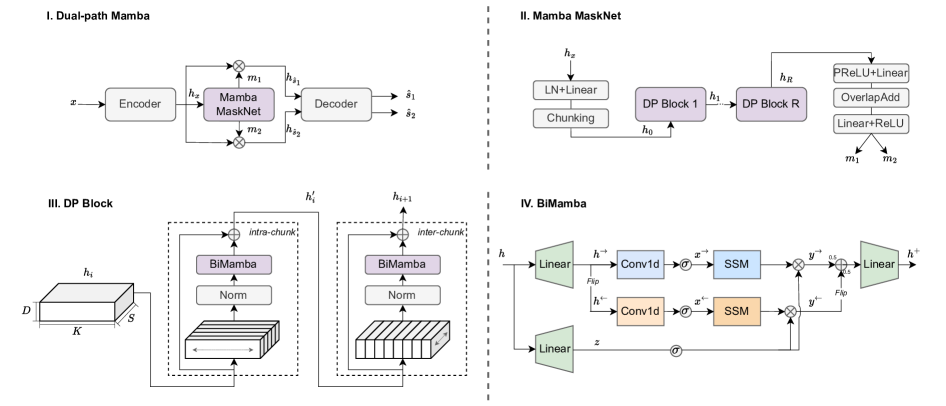
- Replace transformer layers with Mamba selective state-space models in a dual-path, chunked framework.
- Split long speech into chunks and apply intra-chunk and inter-chunk Mamba processing.
- Use bidirectional BiMamba within forward and backward streams and gate outputs with a learned mechanism.
- Train with data augmentation and RMSNorm, using an encoder–masker–decoder pipeline.
- Provide four model sizes (XS, S, M, L) to evaluate performance vs. parameter count.
Experimental results
Research questions
- RQ1Can a selective state-space model (Mamba) achieve competitive or superior performance to transformer-based speech separation models on WSJ0-2mix?
- RQ2Does a dual-path, bidirectional Mamba architecture offer advantages in modeling short-term and long-term dependencies for single-channel speech separation?
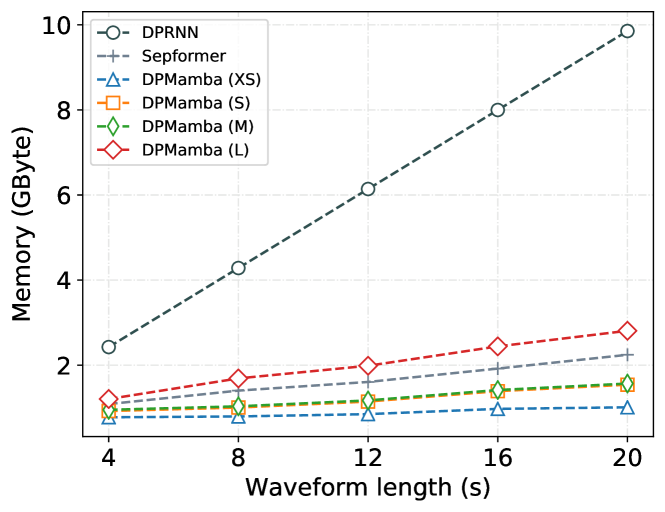
- RQ3What is the trade-off between model size, memory usage, and separation performance for DPMamba compared to SOTA models?
- RQ4Do ablations (bidirectionality, dynamic mixing, normalization) significantly affect performance?
Key findings
- DPMamba (L) achieves SI-SNRi of 24.4 dB and SDRi of 24.6 dB with 59.8M parameters, setting a new SOTA on WSJ0-2mix among reported results.
- DPMamba (M) matches Sepformer performance with about 60% of the parameters; DPMamba (S) outperforms VSUNOS with a larger stride; DPMamba XS outperforms DPRNN with reduced memory.
- Across sizes, all DPMamba variants outperform or match SOTA within their parameter budgets and Memory efficiency; DPMamba (L) outperforms Mossformer2 (L) in SI-SNRi by 0.3 dB.
- Ablation studies show backward SSMs provide a >3 dB gain over unidirectional models; dynamic mixing during training yields +1.3 dB SI-SNRi and +1.2 dB SDRi.
Read this paper
Open the full text in the Nubint reader and ask about any passage as you read.
Read this paper on NubintThis review was generated by AI from the original paper. Please check the paper before citing it.