
[Paper Review] Duolando: Follower GPT with Off-Policy Reinforcement Learning for Dance Accompaniment
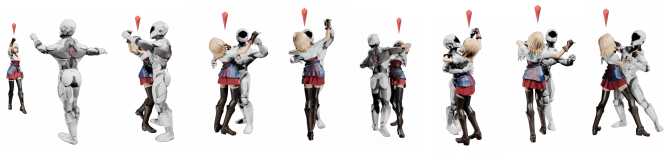
Duolando introduces a GPT-based follower model for duet dance accompaniment, using VQ-VAE tokenization and an off-policy RL fine-tuning regime to generate synchronized follower motions conditioned on music and leader moves. It also provides the DD100 duet dance mocap dataset and a new interaction benchmark.
We introduce a novel task within the field of 3D dance generation, termed dance accompaniment, which necessitates the generation of responsive movements from a dance partner, the "follower", synchronized with the lead dancer's movements and the underlying musical rhythm. Unlike existing solo or group dance generation tasks, a duet dance scenario entails a heightened degree of interaction between the two participants, requiring delicate coordination in both pose and position. To support this task, we first build a large-scale and diverse duet interactive dance dataset, DD100, by recording about 117 minutes of professional dancers' performances. To address the challenges inherent in this task, we propose a GPT-based model, Duolando, which autoregressively predicts the subsequent tokenized motion conditioned on the coordinated information of the music, the leader's and the follower's movements. To further enhance the GPT's capabilities of generating stable results on unseen conditions (music and leader motions), we devise an off-policy reinforcement learning strategy that allows the model to explore viable trajectories from out-of-distribution samplings, guided by human-defined rewards. Based on the collected dataset and proposed method, we establish a benchmark with several carefully designed metrics.
Motivation & Objective
- Introduce a novel task of dance accompaniment to generate follower movements synchronized with a lead dancer and music.
- Create a large-scale duet dance mocap dataset (DD100) for training and evaluation.
- Develop a GPT-based follower model (Duolando) that accounts for leader motion, music, and follower history.
- Apply off-policy reinforcement learning to improve robustness on out-of-distribution music and leader patterns.
- Establish a benchmark with metrics for motion quality, interaction, and rhythm alignment.
Proposed method
- Quantize motion and relative translation into discrete tokens using four motion VQ-VAEs (upper body, lower body, left hand, right hand) and a relative translation VQ-VAE.
- Train an interaction-coordinated GPT that autoregressively predicts follower motion tokens conditioned on music, leader tokens, and previous follower tokens, with a look-ahead mechanism (LAT) for future conditioning.
- Incorporate a look-ahead attention mechanism with a 10-by-10 block-wise lower-triangular attention mask to fuse 10 input modalities (music, leader z, follower z, and tr).
- Introduce off-policy reinforcement learning to align token probabilities with a learned Q-like value via a sigmoid mapping to expected future rewards (sigma(Q(s,a))).
- Define step-wise rewards to reduce skating artifacts, including a velocity-based lower-body decoding branch to compute synchronization error and guide RL rewards.
Experimental results
Research questions
- RQ1Can a GPT-based follower generate stable, beat-aligned motion conditioned on a lead dancer and music?
- RQ2Does off-policy RL improve generalization to unseen music and leader motions compared with supervised training alone?
- RQ3How does explicit modeling of relative translation and interaction coordination affect follower dynamics and contact with the leader?
- RQ4What is the impact of look-ahead conditioning on synchronization and motion fluency?
Key findings
- Duolando with RL and interaction coordination achieves improved interaction and rhythmic alignment versus solo baselines and ablations.
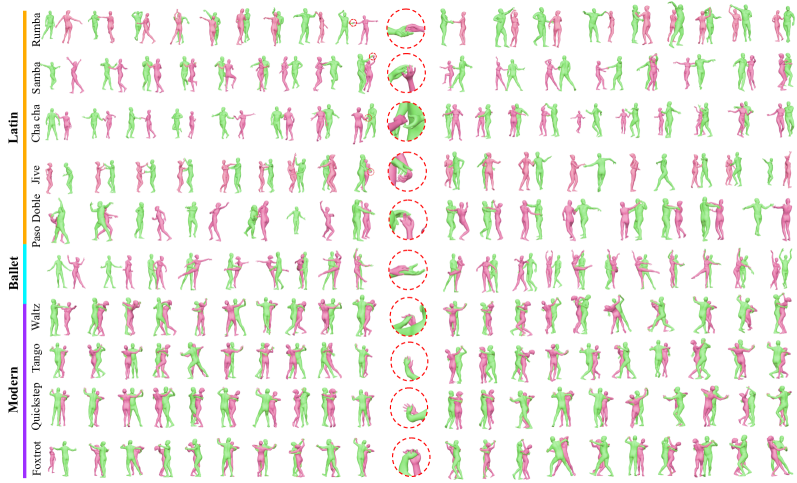
- The DD100 dataset provides diverse, multi-genre duet mocap data (10 genres, ~1.95 hours) used for training and benchmarking.
- Quantitative metrics show Duolando variants outperform solo methods on interaction and rhythm metrics (Beat Echo Degree and BAS) and have competitive motion quality (FID and diversity) on kinematic and graphical features.
- Ablations show removing relative translation or RL degrades performance, while look-ahead and interaction coordination components contribute to higher-quality, synchronized follower motion.
- RL fine-tuning based on explicit rewards helps mitigate skating artifacts under out-of-distribution conditions.
Read this paper
Open the full text in the Nubint reader and ask about any passage as you read.
Read this paper on NubintThis review was generated by AI from the original paper. Please check the paper before citing it.