
[Paper Review] Dynamic Field of View Reduction Related to Subjective Sickness Measures in an HMD-based Data Analysis Task
The paper tests radical, health-state–driven FoV reduction in an HMD task to curb cybersickness; results show no significant sickness reduction or presence change, but increased exploration with a drastic FoV shift.
Various factors influence the degree of cybersickness a user can suffer in an immersive virtual environment, some of which can be controlled without adapting the virtual environment itself. When using HMDs, one example is the size of the field of view. However, the degree to which factors like this can be manipulated without affecting the user negatively in other ways is limited. Another prominent characteristic of cybersickness is that it affects individuals very differently. Therefore, to account for both the possible disruptive nature of alleviating factors and the high interpersonal variance, a promising approach may be to intervene only in cases where users experience discomfort symptoms, and only as much as necessary. Thus, we conducted a first experiment, where the field of view was decreased when people feel uncomfortable, to evaluate the possible positive impact on sickness and negative influence on presence. While we found no significant evidence for any of these possible effects, interesting further results and observations were made.
Motivation & Objective
- Explore whether dynamic, health-driven FoV reduction can reduce cybersickness without harming presence in an HMD-based data analysis task.
- Assess feasibility and user perception when applying substantial FoV reductions based on self-reported well-being.
- Investigate correlations between subjective sickness measures, presence, and task performance under dynamic FoV conditions.
Proposed method
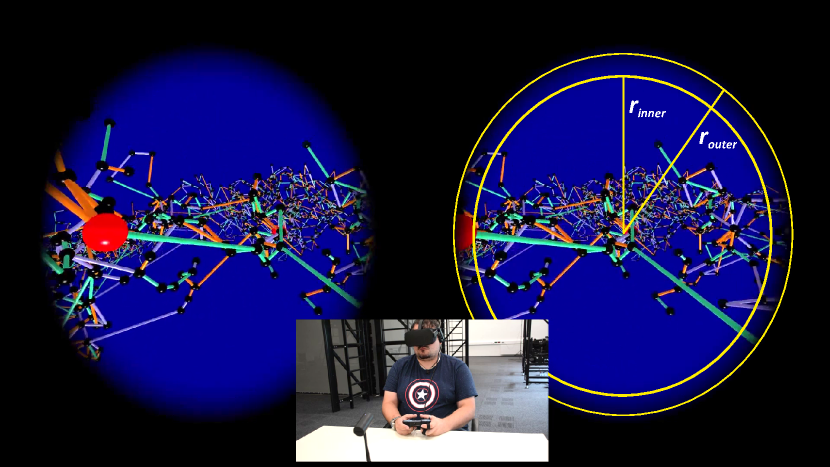
- Implement a full-screen black shader-based FoV reduction with adjustable inner and outer radii to create a dynamic field with screen-space transparency.
- Use a seated desk VR task (graph traversal) with 4 DoF gamepad control; study group experiences dynamic FoV changes based on self-reported health, control group does not.
- Collect health/well-being ratings after each task and a priori/posterior SSQ alongside presence measures after the session.
- Compare study vs control groups using independent-samples t-tests with Welch adjustments where variances differ.
- Record task performance metrics, travel distance, and head/virtual rotations to assess behavioral changes under FoV manipulation.
Experimental results
Research questions
- RQ1Does health-driven FoV reduction reduce cybersickness measures compared to a control condition without FoV changes?
- RQ2Does dynamic FoV reduction affect presence or task performance compared to a standard FoV?
- RQ3Do participants notice or feel disturbed by the dynamic FoV reduction?
Key findings
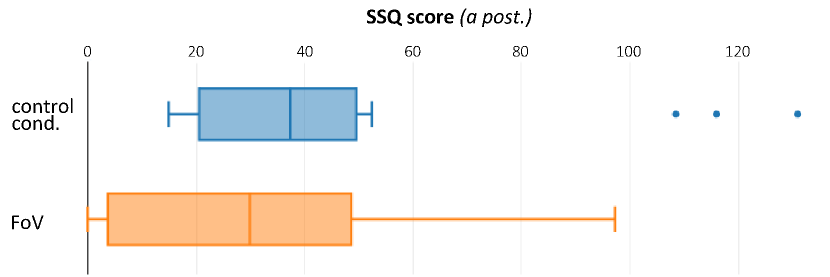
- No significant difference between study and control groups for SSQ scores, subjective sickness measures, presence, or task performance.
- The study group traveled a significantly longer distance and looked around more than the control group.
- Head rotation differed between groups with greater rotation in the study group, while other rotation measures showed no significant change.
- Several subjective indicators (e.g., naturalness of interaction) differed for the control group, suggesting some side effects unrelated to sickness reduction.
- Subjective health/vulnerability correlated with sickness measures, while age or VR experience did not show consistent correlations.
Read this paper
Open the full text in the Nubint reader and ask about any passage as you read.
Read this paper on NubintThis review was generated by AI from the original paper. Please check the paper before citing it.