
[Paper Review] Dynamical Population of Comet Reservoirs
This paper reviews the dynamical formation of the Oort cloud and scattered disk, the two primary reservoirs of comets. It shows that ~5% of material from the primordial planetesimal disk was captured into the Oort cloud via gravitational scattering by giant planets, with external perturbations from the Galactic tide and passing stars maintaining the supply of long-period comets. The Oort cloud's structure is highly sensitive to the Sun's birth environment and galactic dynamical history, and upcoming surveys like LSST will provide critical new constraints on reservoir populations.
The Oort cloud and the scattered disk are the two primary reservoirs for long-period and short-period comets, respectively. In this review, we assess the known observational constraints on these reservoirs' properties and their formation. In addition, we discuss how the early orbital evolution of the giant planets generated the modern scattered disk from the early, massive planetesimal disk and how $\sim$5\% of this material was captured into the Oort cloud. We review how the Sun's birth environment and dynamical history within the Milky Way alters the formation and modern structure of the Oort cloud. Finally, we assess how the coming decade's anticipated observing campaigns may provide new insights into the formation and properties of the Oort cloud and scattered disk.
Motivation & Objective
- To assess observational constraints on the Oort cloud and scattered disk, the two main reservoirs of comets.
- To explain how the early orbital evolution of giant planets generated the modern scattered disk from a massive primordial planetesimal disk.
- To examine how the Sun's birth environment and galactic dynamical history shaped the Oort cloud's current structure and population.
- To evaluate how upcoming observational campaigns will improve understanding of comet reservoir formation and properties.
Proposed method
- Numerical simulations of giant planet migration and gravitational scattering of planetesimals in the early solar system.
- Modeling of stellar flybys and Galactic tide perturbations on distant heliocentric orbits to assess Oort cloud formation and evolution.
- Analysis of inverse semimajor axis distributions of long-period comets to infer reservoir properties and dynamical history.
- Use of comet magnitude-to-size conversion and observational data to estimate reservoir population sizes.
- Integration of future survey capabilities (e.g., LSST) into dynamical models to predict observational constraints.
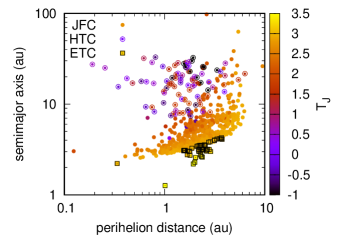
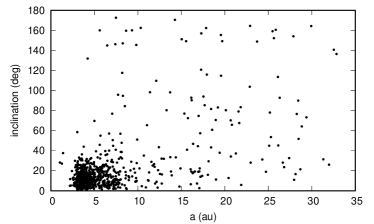
- Comparison of simulated reservoir populations with observed comet inclinations, periods, and perihelion distances.
Experimental results
Research questions
- RQ1How did the early orbital evolution of the giant planets lead to the formation of the modern scattered disk?
- RQ2What fraction of the primordial planetesimal disk was captured into the Oort cloud, and what mechanisms enabled this capture?
- RQ3How do external perturbations from the Galactic tide and passing stars shape the Oort cloud’s structure and replenish the long-period comet population?
- RQ4To what extent does the Sun’s dynamical history in the Milky Way, including its birth cluster and radial migration, affect the Oort cloud’s current configuration?
- RQ5How will upcoming surveys like LSST and stellar occultation campaigns improve constraints on the scattered disk and Oort cloud populations?
Key findings
- Approximately 5% of the primordial planetesimal disk was captured into the Oort cloud during the first billion years of the solar system’s history.
- The Oort cloud’s isotropic structure and continuous supply of long-period comets are maintained by secular perturbations from the Galactic tide and passing stars.
- The scattered disk is dynamically unstable and likely formed from the gravitational scattering of planetesimals by the giant planets, with simulations suggesting ~10 times more bodies in the Oort cloud than in the scattered disk.
- Observational estimates suggest the Oort cloud may contain 7–8 × 10¹¹ comet-sized bodies, implying a population 50–1000 times larger than current scattered disk estimates, though this ratio depends on uncertain magnitude-to-size conversions.
- The inner edge of the Oort cloud is highly stochastic and sensitive to the closest stellar flybys in the Sun’s history, with some models suggesting up to 10¹² comet-sized bodies may exist beyond ~5000 au.
- Upcoming surveys such as the Vera C. Rubin Observatory (LSST) are expected to increase the inventory of trans-Neptunian objects and long-period comets by orders of magnitude, enabling new constraints on reservoir populations and dynamics.
Read this paper
Open the full text in the Nubint reader and ask about any passage as you read.
Read this paper on NubintThis review was generated by AI from the original paper. Please check the paper before citing it.