
[Paper Review] Dynamical Tests of a Deep-Learning Weather Prediction Model
This study evaluates the Pangu-weather deep-learning model through four canonical dynamical experiments—tropical heating, extratropical cyclogenesis, geostrophic adjustment, and hurricane development—demonstrating that it produces physically realistic signal propagation and structural evolution. The model exhibits key atmospheric dynamics such as the Matsuno–Gill response, extratropical wave radiation, and moisture-dependent hurricane intensification, indicating it encodes realistic physics beyond mere pattern matching.
Global deep-learning weather prediction models have recently been shown to produce forecasts that rival those from physics-based models run at operational centers. It is unclear whether these models have encoded atmospheric dynamics, or simply pattern matching that produces the smallest forecast error. Answering this question is crucial to establishing the utility of these models as tools for basic science. Here we subject one such model, Pangu-weather, to a set of four classical dynamical experiments that do not resemble the model training data. Localized perturbations to the model output and the initial conditions are added to steady time-averaged conditions, to assess the propagation speed and structural evolution of signals away from the local source. Perturbing the model physics by adding a steady tropical heat source results in a classical Matsuno--Gill response near the heating, and planetary waves that radiate into the extratropics. A localized disturbance on the winter-averaged North Pacific jet stream produces realistic extratropical cyclones and fronts, including the spontaneous emergence of polar lows. Perturbing the 500hPa height field alone yields adjustment from a state of rest to one of wind--pressure balance over ~6 hours. Localized subtropical low pressure systems produce Atlantic hurricanes, provided the initial amplitude exceeds about 5 hPa, and setting the initial humidity to zero eliminates hurricane development. We conclude that the model encodes realistic physics in all experiments, and suggest it can be used as a tool for rapidly testing ideas before using expensive physics-based models.
Motivation & Objective
- To assess whether deep-learning weather models like Pangu-weather encode real atmospheric dynamics or merely mimic patterns in training data.
- To test if the model can reproduce known physical responses to localized perturbations outside its training distribution.
- To evaluate the model’s utility as a rapid tool for scientific hypothesis testing in atmospheric dynamics.
- To determine whether the model’s behavior aligns qualitatively with theoretical and observational expectations in idealized experiments.
- To explore the potential of deep-learning models to accelerate basic research in meteorology before costly physics-based model runs.
Proposed method
- Conduct four idealized dynamical experiments using climatological, time-averaged initial conditions to avoid direct training data overlap.
- Apply localized perturbations to initial conditions or model output, including steady tropical heating, jet stream disturbances, 500 hPa height anomalies, and surface low-pressure systems.
- Use the Pangu-weather model’s 1h, 3h, 6h, and 24h forecast heads to simulate evolution over time, leveraging its vision-transformer architecture trained on ERA5 reanalysis data.
- Analyze signal propagation speed, structural evolution, and response patterns (e.g., wave radiation, cyclogenesis, adjustment to balance) against theoretical expectations.
- Perform sensitivity tests, such as setting initial water vapor to zero, to assess conditional dependencies like moist convection.
- Compare qualitative outcomes to established atmospheric theory and observations without direct quantitative benchmarking against physics-based models.
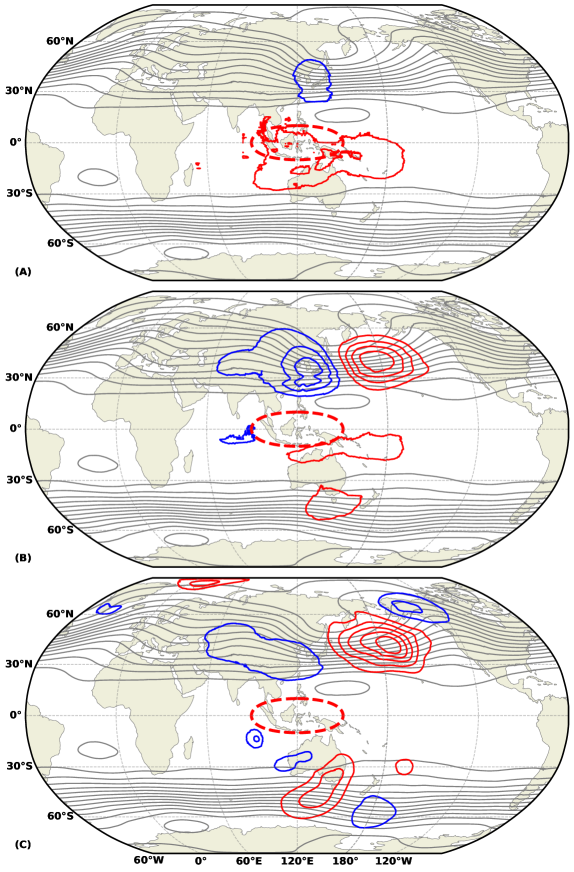
Experimental results
Research questions
- RQ1Does the Pangu-weather model produce a physically realistic Matsuno–Gill response when subjected to steady tropical heating?
- RQ2Can the model generate extratropical cyclones and polar lows from a localized disturbance on a winter-averaged jet stream?
- RQ3Does the model exhibit geostrophic adjustment when initialized with an unbalanced 500 hPa height anomaly?
- RQ4Does the model reproduce the observed threshold for tropical cyclone development based on initial vortex amplitude and moisture content?
- RQ5Do the model’s responses to localized perturbations align qualitatively with known atmospheric dynamics and observational behavior?
Key findings
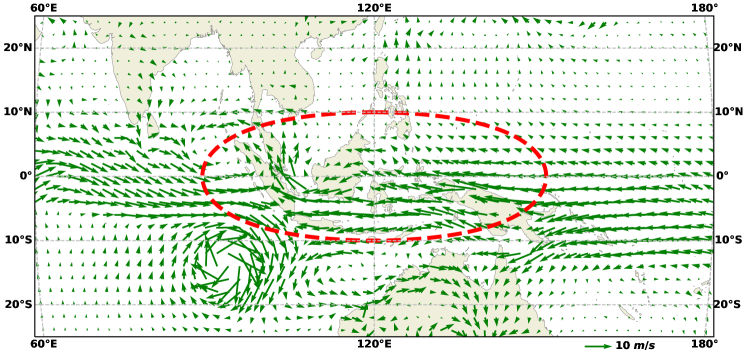
- Steady tropical heating produces a Matsuno–Gill response in the tropics and planetary waves that radiate into the extratropics, consistent with linear wave theory.
- A localized disturbance on the winter-averaged North Pacific jet stream leads to the spontaneous development of extratropical cyclones and polar lows, indicating realistic baroclinic instability.
- An initial 500 hPa height anomaly triggers adjustment to geostrophic balance over approximately 6 hours, with divergent flow transitioning to rotational flow.
- Atlantic hurricanes form only when the initial surface low-pressure amplitude exceeds ~5 hPa, and development ceases when initial water vapor is set to zero.
- The model’s response to perturbations shows signal propagation and structural evolution that are qualitatively consistent with known atmospheric dynamics across multiple timescales.
- The model’s behavior suggests it has encoded physical constraints beyond pattern matching, as evidenced by its ability to reproduce complex, non-linear atmospheric responses from localized inputs.
Better researchstarts right now
From reading papers to final review, dramatically reduce your research time.
No credit card · Free plan available
This review was created by AI and reviewed by human editors.