
[Paper Review] E2EC: An End-to-End Contour-based Method for High-Quality High-Speed Instance Segmentation
E2EC proposes an end-to-end, contour-based instance segmentation method that replaces handcrafted contour initialization with a learnable architecture, uses multi-direction alignment for label sampling, and introduces dynamic matching loss to improve boundary quality. It achieves state-of-the-art performance with 36.5 AP det and 34.0 AP msk on COCO, while maintaining real-time inference at 36 fps on 512×512 images.
Contour-based instance segmentation methods have developed rapidly recently but feature rough and hand-crafted front-end contour initialization, which restricts the model performance, and an empirical and fixed backend predicted-label vertex pairing, which contributes to the learning difficulty. In this paper, we introduce a novel contour-based method, named E2EC, for high-quality instance segmentation. Firstly, E2EC applies a novel learnable contour initialization architecture instead of hand-crafted contour initialization. This consists of a contour initialization module for constructing more explicit learning goals and a global contour deformation module for taking advantage of all of the vertices' features better. Secondly, we propose a novel label sampling scheme, named multi-direction alignment, to reduce the learning difficulty. Thirdly, to improve the quality of the boundary details, we dynamically match the most appropriate predicted-ground truth vertex pairs and propose the corresponding loss function named dynamic matching loss. The experiments showed that E2EC can achieve a state-of-the-art performance on the KITTI INStance (KINS) dataset, the Semantic Boundaries Dataset (SBD), the Cityscapes and the COCO dataset. E2EC is also efficient for use in real-time applications, with an inference speed of 36 fps for 512*512 images on an NVIDIA A6000 GPU. Code will be released at https://github.com/zhang-tao-whu/e2ec.
Motivation & Objective
- To address the limitations of existing contour-based instance segmentation methods, which rely on handcrafted initial contours and fixed vertex pairing, leading to high training difficulty and poor boundary quality.
- To reduce learning difficulty by introducing a multi-direction alignment (MDA) label sampling scheme that enables more flexible and optimal predicted-ground truth vertex matching.
- To improve boundary detail quality through a dynamic matching loss (DML) function that adaptively pairs predicted and ground-truth vertices during training.
- To achieve high accuracy and real-time inference speed by integrating a global contour deformation module that leverages features from all vertices, not just local neighbors.
- To establish a strong, generalizable baseline for contour-based instance segmentation that can be easily adapted to other methods.
Proposed method
- E2EC replaces handcrafted initial contours with a learnable contour initialization architecture that regresses the full initial contour directly from center point features, avoiding fixed ray-based or shape-based initialization.
- It introduces a global contour deformation module that refines the initial contour using features from all vertices and the center point, enabling better global context utilization compared to local aggregation.
- The multi-direction alignment (MDA) scheme dynamically samples labels across multiple directions to reduce training difficulty and improve convergence by avoiding suboptimal vertex pairings.
- A dynamic matching loss (DML) function is proposed to automatically identify the most appropriate predicted-ground-truth vertex pairs during training, enhancing boundary detail learning.
- The model is trained end-to-end, integrating detection and segmentation in a single pipeline, eliminating the need for separate detector training.
- The method uses a lightweight DLA-34 backbone and achieves high speed without sacrificing accuracy, enabling real-time inference.
Experimental results
Research questions
- RQ1Can a learnable contour initialization architecture significantly reduce training difficulty and improve initial contour quality compared to handcrafted shapes?
- RQ2Does multi-direction alignment (MDA) lead to faster convergence and better performance by enabling more flexible label sampling in contour-based instance segmentation?
- RQ3Can a dynamic matching loss function that adapts vertex pairings during training improve boundary detail accuracy and segmentation quality?
- RQ4Can an end-to-end, contour-based method achieve state-of-the-art performance while maintaining real-time inference speed on standard benchmarks?
- RQ5How does E2EC compare to existing one-stage and two-stage instance segmentation models in terms of accuracy, speed, and boundary quality?
Key findings
- E2EC achieves 36.5 AP det, 34.0 AP msk, and 33.3 AP bdy on the COCO dataset, outperforming Deep Snake by 3.7 AP det, 2.7 AP msk, and 3.1 AP bdy.
- On the SBD dataset, E2EC achieves 4.8 AP msk and 8.3 AP bdy higher than Deep Snake, with AP${}_{75}^{msk}$ 9.1 points higher, demonstrating superior boundary detail learning.
- On Cityscapes, E2EC achieves 32.9 AP msk on the test set (1.2 higher than Deep Snake) and 39.0 AP msk on the validation set with multi-component detection, outperforming PANet by 1.1 AP msk.
- E2EC achieves 33.8 AP msk on COCO at 30.1 fps, outperforming Deep Snake by 3.5 AP msk, while maintaining high speed.
- A faster variant, E2EC*, achieves 31.7 AP msk at 54.3 fps—nearly twice the speed of Deep Snake—while still outperforming it by 1.4 AP msk.
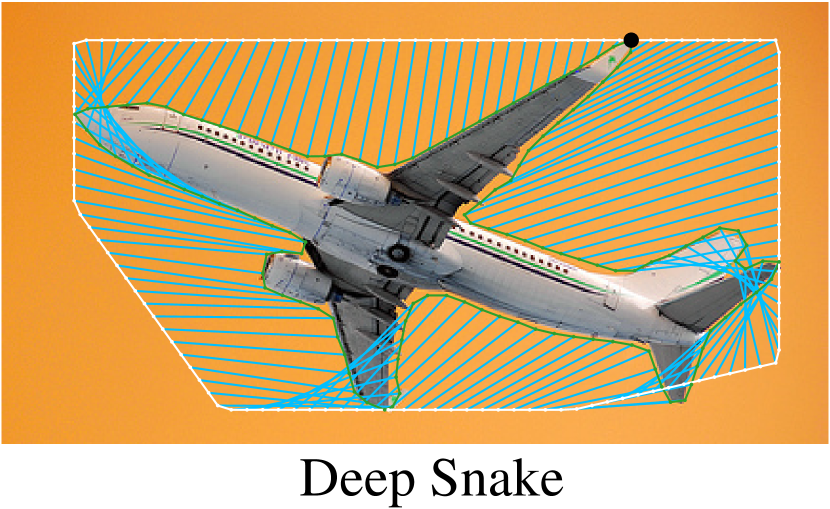
- The dynamic matching loss and global deformation module significantly improve boundary quality, as evidenced by higher AP bdy and visual results showing accurate segmentation of fine details like tires and mirrors.

Read this paper
Open the full text in the Nubint reader and ask about any passage as you read.
Read this paper on NubintThis review was generated by AI from the original paper. Please check the paper before citing it.