
[Paper Review] EAGLES: Efficient Accelerated 3D Gaussians with Lightweight EncodingS
EAGLES proposes a lightweight, quantized encoding scheme for 3D Gaussian splatting that reduces memory usage by 10–20× while accelerating training and rendering, achieving state-of-the-art reconstruction quality. It combines attribute quantization (color, rotation, opacity), progressive coarse-to-fine training, and controlled densification to enable efficient, real-time novel view synthesis on consumer hardware.
Recently, 3D Gaussian splatting (3D-GS) has gained popularity in novel-view scene synthesis. It addresses the challenges of lengthy training times and slow rendering speeds associated with Neural Radiance Fields (NeRFs). Through rapid, differentiable rasterization of 3D Gaussians, 3D-GS achieves real-time rendering and accelerated training. They, however, demand substantial memory resources for both training and storage, as they require millions of Gaussians in their point cloud representation for each scene. We present a technique utilizing quantized embeddings to significantly reduce per-point memory storage requirements and a coarse-to-fine training strategy for a faster and more stable optimization of the Gaussian point clouds. Our approach develops a pruning stage which results in scene representations with fewer Gaussians, leading to faster training times and rendering speeds for real-time rendering of high resolution scenes. We reduce storage memory by more than an order of magnitude all while preserving the reconstruction quality. We validate the effectiveness of our approach on a variety of datasets and scenes preserving the visual quality while consuming 10-20x lesser memory and faster training/inference speed. Project page and code is available https://efficientgaussian.github.io
Motivation & Objective
- Address the high memory and computational cost of 3D Gaussian splatting, which limits deployment on consumer hardware.
- Reduce storage and runtime GPU memory usage for 3D Gaussian scene representations without sacrificing reconstruction quality.
- Improve training stability and convergence speed through progressive coarse-to-fine training and controlled densification.
- Enable real-time rendering and efficient inference on low-memory systems by minimizing Gaussian point count and optimizing attribute representations.
- Achieve memory efficiency through latent quantization of color (SH), rotation (covariance), and opacity attributes.
Proposed method
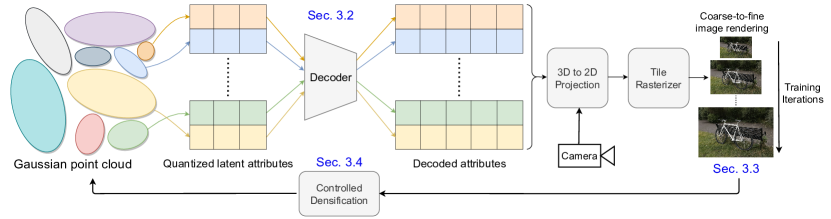
- Apply vector quantization to compress spherical harmonic (SH) coefficients for color and covariance matrices for rotation, reducing per-Gaussian memory footprint.
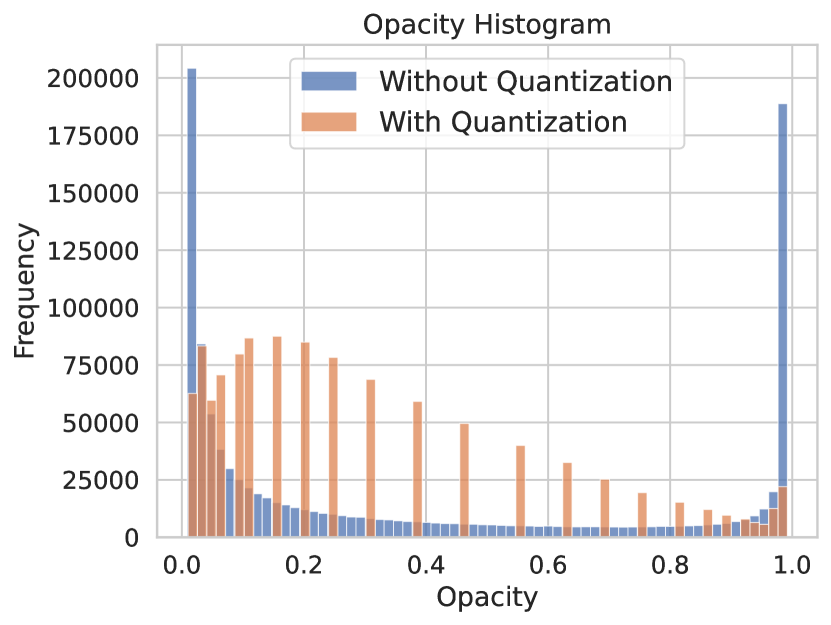
- Quantize opacity coefficients into discrete latent codes to improve optimization and reduce visual artifacts like floaters.
- Implement a coarse-to-fine training strategy using progressive image scaling via downsampling, mean filtering, or Gaussian filtering to stabilize optimization.
- Control the frequency of densification (cloning and splitting) to reduce the total number of Gaussians while maintaining reconstruction fidelity.
- Use a latent codebook to represent quantized attributes, decoding them back to floating-point values during forward/backward passes for differentiable optimization.
- Integrate progressive scaling with a schedule that gradually increases resolution from 30% to 100% over 70% of training iterations.
Experimental results
Research questions
- RQ1Can attribute quantization of 3D Gaussians significantly reduce memory usage without degrading visual quality?
- RQ2How does progressive coarse-to-fine training affect optimization stability and convergence speed in 3D Gaussian splatting?
- RQ3What is the impact of reducing densification frequency on the number of Gaussians and rendering performance?
- RQ4Which image filtering strategy (downsampling, Gaussian, mean) best balances memory savings and reconstruction quality in progressive training?
- RQ5Can the combination of quantization, progressive training, and controlled densification enable real-time rendering on consumer-grade GPUs?
Key findings
- EAGLES reduces memory consumption by 10–20× across all scenes, with storage memory dropping from 43MB (3D-GS) to as low as 21MB (Gaussian 15×15 filter).
- Training time is reduced by up to 25% compared to 3D-GS, with the fastest training at 9m49s using downsampling-based progressive scaling.
- Rendering FPS increases from 211 (3D-GS) to 321 (Gaussian 15×15 filter), demonstrating improved inference speed.
- The method maintains PSNR within 0.2dB of 3D-GS across all scenes, with the best PSNR of 23.41dB achieved using downsampling or 5×5 Gaussian filtering.
- Peak GPU memory usage is reduced from 17.4GB (3D-GS) to 10GB during training on the Bicycle scene, enabling deployment on 12GB consumer GPUs.
- The ablation study confirms that all components—quantization, progressive training, and densification control—contribute significantly to memory and speed improvements.
Read this paper
Open the full text in the Nubint reader and ask about any passage as you read.
Read this paper on NubintThis review was generated by AI from the original paper. Please check the paper before citing it.