
[Paper Review] ECACL: A Holistic Framework for Semi-Supervised Domain Adaptation
This paper proposes ECACL, a holistic semi-supervised domain adaptation framework that unifies multiple complementary domain alignment techniques—class-level alignment via prototypical and triplet losses, RandAugment-based data augmentation, and consistency learning with dual augmentations—resulting in state-of-the-art performance, achieving 81.1% mean accuracy on VisDA2017 (1-shot) and 53.4% on DomainNet (1-shot), significantly improving over prior methods.
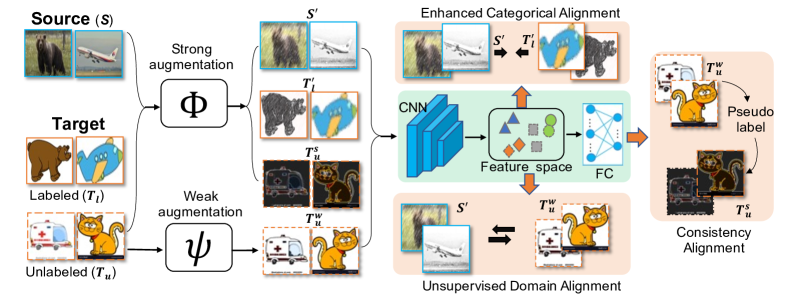
This paper studies Semi-Supervised Domain Adaptation (SSDA), a practical yet under-investigated research topic that aims to learn a model of good performance using unlabeled samples and a few labeled samples in the target domain, with the help of labeled samples from a source domain. Several SSDA methods have been proposed recently, which however fail to fully exploit the value of the few labeled target samples. In this paper, we propose Enhanced Categorical Alignment and Consistency Learning (ECACL), a holistic SSDA framework that incorporates multiple mutually complementary domain alignment techniques. ECACL includes two categorical domain alignment techniques that achieve class-level alignment, a strong data augmentation based technique that enhances the model's generalizability and a consistency learning based technique that forces the model to be robust with image perturbations. These techniques are applied on one or multiple of the three inputs (labeled source, unlabeled target, and labeled target) and align the domains from different perspectives. ECACL unifies them together and achieves fairly comprehensive domain alignments that are much better than the existing methods: For example, ECACL raises the state-of-the-art accuracy from 68.4 to 81.1 on VisDA2017 and from 45.5 to 53.4 on DomainNet for the 1-shot setting. Our code is available at \url{https://github.com/kailigo/pacl}.
Motivation & Objective
- To address the under-explored problem of semi-supervised domain adaptation (SSDA), where only a few labeled target samples (landmarks) are available alongside abundant source-labeled and unlabeled target data.
- To overcome the limitation of existing SSDA methods that underutilize the informative potential of these scarce labeled target samples by diluting their contribution in the loss function.
- To design a unified framework that integrates multiple complementary domain alignment techniques to achieve comprehensive, multi-perspective alignment across source and target domains.
- To improve model generalization and robustness by combining strong data augmentation (RandAugment) and consistency learning on unlabeled target samples.
Proposed method
- ECACL employs prototypical loss to align source features with class-specific target prototypes computed from labeled target landmarks, enabling class-level domain alignment.
- It applies triplet loss to push source features closer to landmarks of the same class and farther from those of different classes, enhancing discriminative feature learning.
- RandAugment is applied to both labeled source samples and target landmarks to generate highly perturbed augmentations, increasing the difficulty and robustness of categorical alignment.
- Consistency learning is enforced by generating pseudo-labels from lightly augmented versions of unlabeled target images and using them as targets for strongly augmented counterparts, improving robustness to input perturbations.
- The framework integrates these techniques across multiple inputs (source-labeled, target-labeled, and unlabeled target), enabling holistic domain alignment from diverse perspectives.
- ECACL is designed as a plug-and-play module, compatible with various existing unsupervised domain adaptation (UDA) methods such as MME, HAFN, and SAFN, enhancing their performance without architectural changes.
Experimental results
Research questions
- RQ1Can the integration of multiple complementary domain alignment techniques significantly improve performance in semi-supervised domain adaptation with only a few labeled target samples?
- RQ2How effectively can class-level alignment using target landmarks be leveraged to reduce domain shift when combined with strong data augmentation and consistency learning?
- RQ3To what extent does RandAugment-based augmentation improve model generalization in low-shot labeled target scenarios compared to standard augmentation strategies?
- RQ4Does consistency learning with dual augmentations (light and strong) enhance model robustness and facilitate label propagation in SSDA?
- RQ5Can ECACL be flexibly integrated with existing UDA methods to achieve consistent performance gains across different benchmarks and backbone architectures?
Key findings
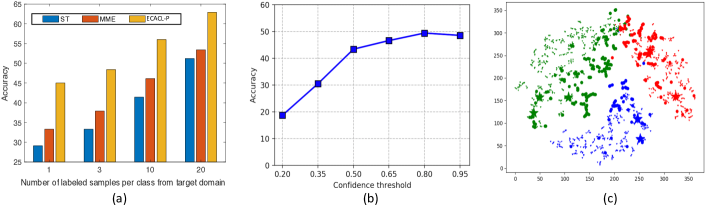
- ECACL achieves a new state-of-the-art mean accuracy of 81.1% on the VisDA2017 dataset under the 1-shot setting, improving from the prior SOTA of 68.4%.
- On the DomainNet benchmark, ECACL achieves 53.4% mean accuracy in the 1-shot setting, a significant improvement over the previous SOTA of 45.5%.
- In the 3-shot setting, ECACL achieves 85.3% mean accuracy on VisDA2017 and 83.3% on DomainNet, demonstrating strong generalization across shot settings.
- Ablation studies confirm that each component—prototypical loss, triplet loss, RandAugment, and consistency learning—contributes meaningfully to performance, with the full ECACL framework yielding the best results.
- The framework is highly flexible and boosts performance across multiple UDA baselines, including MME, HAFN, and SAFN, when integrated as a plug-in module.
- The results demonstrate that even minimal labeled target data (landmarks) can be maximally exploited when combined with multi-perspective alignment and robust training strategies.
Read this paper
Open the full text in the Nubint reader and ask about any passage as you read.
Read this paper on NubintThis review was generated by AI from the original paper. Please check the paper before citing it.