
[Paper Review] EDGAR: An Autonomous Driving Research Platform -- From Feature Development to Real-World Application
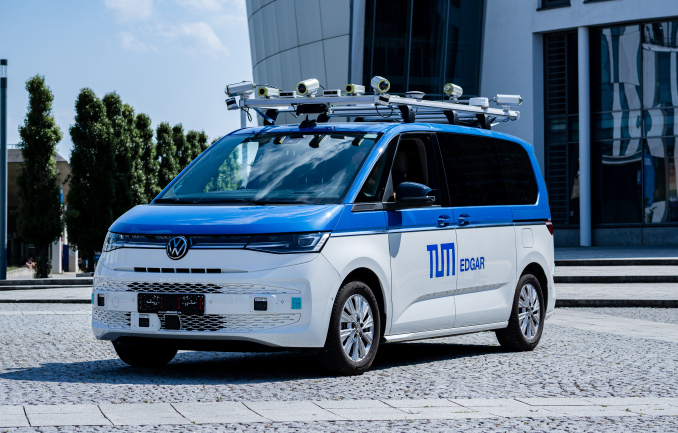
The paper presents EDGAR, an autonomous driving research vehicle with a digital twin and a holistic workflow from feature development to real-world testing, including HiL and data center support.
While current research and development of autonomous driving primarily focuses on developing new features and algorithms, the transfer from isolated software components into an entire software stack has been covered sparsely. Besides that, due to the complexity of autonomous software stacks and public road traffic, the optimal validation of entire stacks is an open research problem. Our paper targets these two aspects. We present our autonomous research vehicle EDGAR and its digital twin, a detailed virtual duplication of the vehicle. While the vehicle's setup is closely related to the state of the art, its virtual duplication is a valuable contribution as it is crucial for a consistent validation process from simulation to real-world tests. In addition, different development teams can work with the same model, making integration and testing of the software stacks much easier, significantly accelerating the development process. The real and virtual vehicles are embedded in a comprehensive development environment, which is also introduced. All parameters of the digital twin are provided open-source at https://github.com/TUMFTM/edgar_digital_twin.
Motivation & Objective
- Motivate the need for end-to-end validation of autonomous driving software stacks beyond isolated components.
- Introduce a research vehicle (EDGAR) with a multi-sensor setup and heterogeneous computing platforms to support diverse research topics.
- Present a comprehensive digital twin that ensures consistency between simulation and real-world tests and is open-source.
- Describe the holistic workflow from feature development to real-world application and back to simulation for continuous improvement.
Proposed method
- Describe the EDGAR hardware platform, including sensor suite, computing architectures (x86 and ARM), networking, and HiL integration.
- Define and implement a digital twin comprising vehicle dynamics models and sensor/network replication for consistent testing.
- Establish a HiL simulator that mirrors real-vehicle interfaces to enable virtual validation and synthetic data generation.
- Provide an open-source repository with digital-twin parameters to facilitate reproducible research and cross-team collaboration.
Experimental results
Research questions
- RQ1How can a digital twin ensure consistency between autonomous vehicle simulation and real-world testing?
- RQ2What is a practical workflow to move features from development through HiL validation to deployment on a real autonomous vehicle?
- RQ3How can multi-sensor data and multi-architecture computing platforms be orchestrated within a unified development and testing environment?
- RQ4What benefits does a holistic data-center and HiL setup provide for scalable AV software development and testing?
- RQ5Can synthetic data from HiL simulations reduce real-world data collection while maintaining validity?
Key findings
- The EDGAR platform couples a multi-sensor autonomous vehicle with a detailed digital twin to enable consistent simulation-to-reality validation.
- Two HPC platforms (x86 and ARM) are deployed to compare performance for autonomous driving software stacks.
- An open-source digital twin repository provides vehicle dynamics and sensor/network replication for reproducible testing.
- A HiL simulator mirrors the real vehicle interfaces and allows synthetic data generation for perception algorithm development.
- A comprehensive data center supports large-scale data handling and software log management to accelerate development.
![Figure 2: Milestones of AV research vehicles: VaMoRs [ 4 ] , Stanley [ 5 ] , Boss [ 6 ] , MB S-Class [ 7 ]](https://ar5iv.labs.arxiv.org/html/2309.15492/assets/x2.png)
Better researchstarts right now
From reading papers to final review, dramatically reduce your research time.
No credit card · Free plan available
This review was created by AI and reviewed by human editors.