
[Paper Review] Edge Directionality Improves Learning on Heterophilic Graphs
Dir-GNN extends any MPNN to directed graphs by separating in- and out-edge aggregations, boosting performance on heterophilic graphs while preserving results on homophilic graphs. It matches the Directed Weisfeiler-Lehman expressivity and achieves state-of-the-art on several directed heterophilic benchmarks.
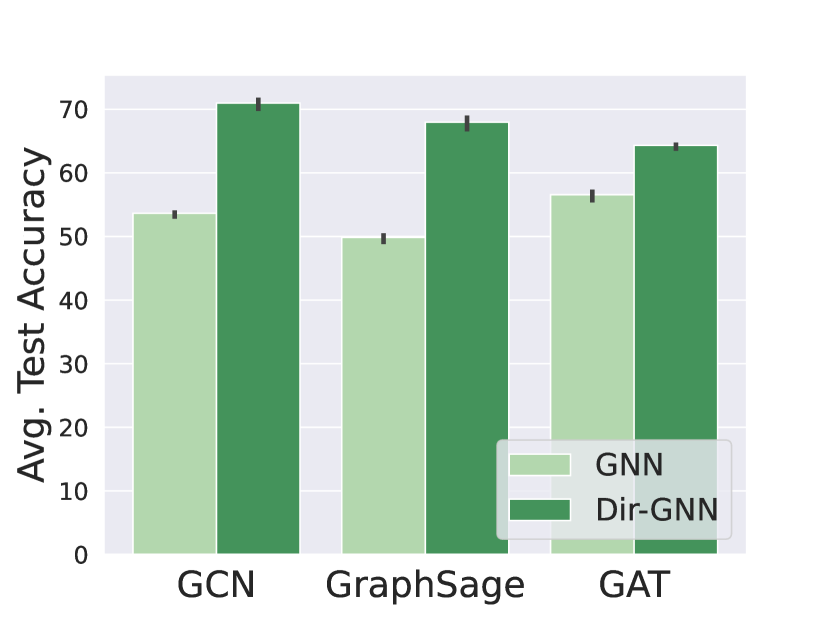
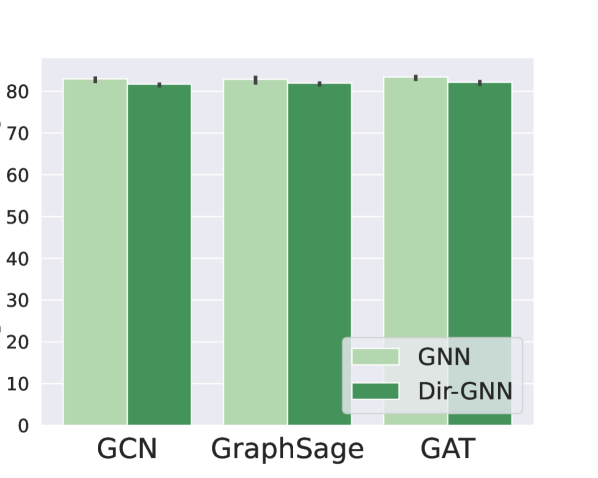
Graph Neural Networks (GNNs) have become the de-facto standard tool for modeling relational data. However, while many real-world graphs are directed, the majority of today's GNN models discard this information altogether by simply making the graph undirected. The reasons for this are historical: 1) many early variants of spectral GNNs explicitly required undirected graphs, and 2) the first benchmarks on homophilic graphs did not find significant gain from using direction. In this paper, we show that in heterophilic settings, treating the graph as directed increases the effective homophily of the graph, suggesting a potential gain from the correct use of directionality information. To this end, we introduce Directed Graph Neural Network (Dir-GNN), a novel general framework for deep learning on directed graphs. Dir-GNN can be used to extend any Message Passing Neural Network (MPNN) to account for edge directionality information by performing separate aggregations of the incoming and outgoing edges. We prove that Dir-GNN matches the expressivity of the Directed Weisfeiler-Lehman test, exceeding that of conventional MPNNs. In extensive experiments, we validate that while our framework leaves performance unchanged on homophilic datasets, it leads to large gains over base models such as GCN, GAT and GraphSage on heterophilic benchmarks, outperforming much more complex methods and achieving new state-of-the-art results.
Motivation & Objective
- Motivate the need to utilize edge directionality in graphs, especially in heterophilic settings.
- Introduce Dir-GNN as a generic framework to extend any MPNN to directed graphs by dual in- and out-aggregation.
- Theoretically analyze the expressive power of Dir-GNN and compare it with directed WL tests.
- Empirically validate Dir-GNN on heterophilic and homophilic datasets, showing improvements on heterophilic benchmarks and stability on homophilic ones.
Proposed method
- Extend MPNNs to directed graphs by performing separate aggregations over in- and out-neighbors with possibly independent parameters.
- Use two message-passing matrices S_→ and S_← with normalization S_→ = D_→^{-1/2} A D_←^{-1/2} and S_← = S_→^T.
- Incorporate a learnable α to weight the contribution of the two directions.
- Show Dir-GNN is as expressive as the Directed WL test under injectivity conditions, and strictly more expressive than MPNN-U or MPNN-D.
- Demonstrate that Dir-GCN, Dir-SAGE, and Dir-GAT maintain similar per-layer complexity while increasing parameter count due to separate direction weights.
Experimental results
Research questions
- RQ1Does edge directionality increase the effective homophily of graphs, especially in heterophilic settings?
- RQ2Can a generic Dir-GNN framework extend any MPNN to directed graphs with enhanced performance?
- RQ3Is Dir-GNN as expressive as the directed Weisfeiler-Lehman test and more expressive than traditional MPNNs?
- RQ4Do Dir-GNN extensions improve accuracy on heterophilic benchmarks without harming homophilic benchmarks?
Key findings
- Using directed graphs increases effective homophily in heterophilic graphs with negligible effect on homophilic graphs.
- Dir-GNN extends MPNNs by dual in- and out-aggregations, leading to more homophilic aggregations in practice.
- Dir-GNN achieves state-of-the-art results on five directed heterophilic benchmarks (Chameleon, Squirrel, Arxiv-Year, Snap-Patents, Roman-Empire).
- Dir-GNN outperforms more complex heterophily-specific methods on directed heterophilic datasets and maintains performance on homophilic datasets.
- The framework is theoretically as expressive as the Directed Weisfeiler-Lehman test and strictly more expressive than standard MPNNs.
Read this paper
Open the full text in the Nubint reader and ask about any passage as you read.
Read this paper on NubintThis review was generated by AI from the original paper. Please check the paper before citing it.