
[Paper Review] Edge Intelligence for Autonomous Driving in 6G Wireless System: Design Challenges and Solutions
This paper proposes a two-tier edge intelligence (EI) framework for 6G-enabled autonomous driving, where deep neural network models are split between vehicles and edge servers to enable low-latency, privacy-preserving inference. By using multi-task learning (MTL) for real-time offloading decisions and neural network segmentation for joint inference, the system reduces latency by over 99% and improves accuracy under poor data conditions compared to baseline methods.
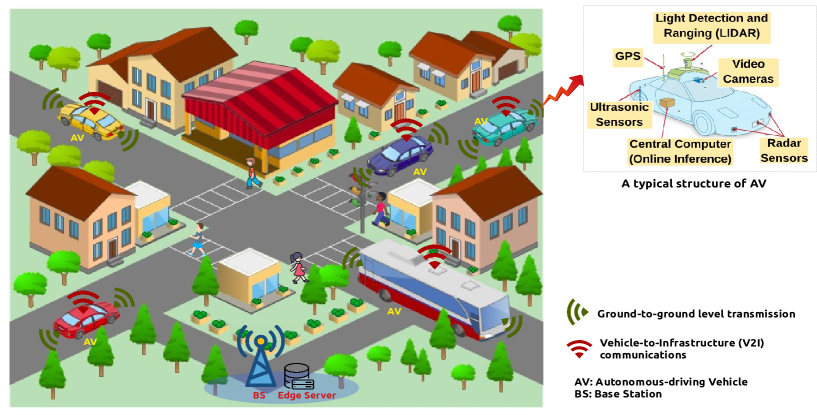
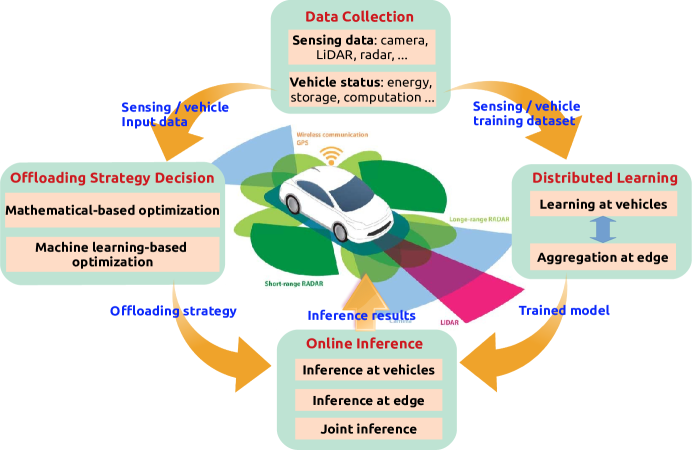
In a level-5 autonomous driving system, the autonomous driving vehicles (AVs) are expected to sense the surroundings via analyzing a large amount of data captured by a variety of onboard sensors in near-real-time. As a result, enormous computing costs will be introduced to the AVs for processing the tasks with the deployed machine learning (ML) model, while the inference accuracy may not be guaranteed. In this context, the advent of edge intelligence (EI) and sixth-generation (6G) wireless networking are expected to pave the way to more reliable and safer autonomous driving by providing multi-access edge computing (MEC) together with ML to AVs in close proximity. To realize this goal, we propose a two-tier EI-empowered autonomous driving framework. In the autonomous-vehicles tier, the autonomous vehicles are deployed with the shallow layers by splitting the trained deep neural network model. In the edge-intelligence tier, an edge server is implemented with the remaining layers (also deep layers) and an appropriately trained multi-task learning (MTL) model. In particular, obtaining the optimal offloading strategy (including the binary offloading decision and the computational resources allocation) can be formulated as a mixed-integer nonlinear programming (MINLP) problem, which is solved via MTL in near-real-time with high accuracy. On another note, an edge-vehicle joint inference is proposed through neural network segmentation to achieve efficient online inference with data privacy-preserving and less communication delay. Experiments demonstrate the effectiveness of the proposed framework, and open research topics are finally listed.
Motivation & Objective
- To address the high computational cost and unreliable inference accuracy in level-5 autonomous driving systems due to on-board processing of large sensor data.
- To enable low-latency, high-accuracy inference in autonomous vehicles (AVs) by offloading part of the deep learning workload to edge servers via multi-access edge computing (MEC).
- To preserve data privacy and reduce communication delay through neural network segmentation and joint inference between vehicles and edge servers.
- To solve the mixed-integer nonlinear programming (MINLP) problem of offloading decisions and resource allocation efficiently using multi-task learning (MTL).
- To evaluate the framework’s performance under varying data quality and vehicle load conditions, demonstrating robustness and scalability.
Proposed method
- The framework splits a pre-trained deep neural network (DNN) model into shallow layers on the vehicle and deep remaining layers on the edge server.
- A multi-task learning (MTL) model is deployed at the edge server to jointly predict optimal offloading decisions and computational resource allocation in near real time.
- Neural network segmentation enables efficient online inference by routing intermediate feature maps between vehicles and edge servers, minimizing communication overhead.
- The offloading strategy problem is formulated as a mixed-integer nonlinear programming (MINLP) problem, solved via MTL to achieve sub-millisecond response times.
- The system supports privacy-preserving inference by keeping raw sensor data on the vehicle and transmitting only intermediate features.
- A case study evaluates the framework under varying data quality (bad data ratio η) and number of AVs (2–8), comparing MTL, sBB, and vehicle-only inference.
Experimental results
Research questions
- RQ1How can edge intelligence in 6G wireless systems enable low-latency, high-accuracy inference for autonomous vehicles under real-time constraints?
- RQ2What is the optimal trade-off between computational offloading and communication delay in a multi-vehicle autonomous driving environment?
- RQ3How can data privacy be preserved while enabling collaborative inference between vehicles and edge servers?
- RQ4To what extent does multi-task learning improve the efficiency and accuracy of offloading decision-making compared to traditional optimization methods?
- RQ5How does the system perform under degraded input data (e.g., blurry images) and varying vehicle density?
Key findings
- The MTL-based offloading strategy reduced solution time to less than one-thousandth of the sBB algorithm, achieving near real-time performance.
- When the bad data ratio (η) exceeded 0.3, edge inference outperformed vehicle-only inference by reducing the weighted-sum cost due to improved accuracy from deeper DNN layers.
- The MSE of the MTL model was less than half that of the sBB algorithm, indicating superior accuracy in offloading decision prediction.
- For η < 0.3, vehicle-only inference was more competitive due to lower latency and high accuracy, but edge inference became essential as data quality degraded.
- The framework maintained low communication delay and high inference accuracy across 2 to 8 AVs, demonstrating scalability.
- The joint inference via neural network segmentation enabled privacy-preserving, dynamic, and efficient online inference with reduced latency.
Read this paper
Open the full text in the Nubint reader and ask about any passage as you read.
Read this paper on NubintThis review was generated by AI from the original paper. Please check the paper before citing it.