
[Paper Review] EdgeVision: Towards Collaborative Video Analytics on Distributed Edges for Performance Maximization
EdgeVision proposes a multiagent deep reinforcement learning (MARL) framework that enables collaborative video analytics across distributed edge nodes to minimize end-to-end delay and maximize system performance. By using an attention-augmented actor-critic MARL algorithm, edge nodes jointly optimize video preprocessing, model selection, and request dispatching, achieving 33.6%–86.4% higher overall rewards than state-of-the-art baselines in real-world experiments.
Deep Neural Network (DNN)-based video analytics significantly improves recognition accuracy in computer vision applications. Deploying DNN models at edge nodes, closer to end users, reduces inference delay and minimizes bandwidth costs. However, these resource-constrained edge nodes may experience substantial delays under heavy workloads, leading to imbalanced workload distribution. While previous efforts focused on optimizing hierarchical device-edge-cloud architectures or centralized clusters for video analytics, we propose addressing these challenges through collaborative distributed and autonomous edge nodes. Despite the intricate control involved, we introduce EdgeVision, a Multiagent Reinforcement Learning (MARL)- based framework for collaborative video analytics on distributed edges. EdgeVision enables edge nodes to autonomously learn policies for video preprocessing, model selection, and request dispatching. Our approach utilizes an actor-critic-based MARL algorithm enhanced with an attention mechanism to learn optimal policies. To validate EdgeVision, we construct a multi-edge testbed and conduct experiments with real-world datasets. Results demonstrate a performance enhancement of 33.6% to 86.4% compared to baseline methods.
Motivation & Objective
- To address the performance bottleneck caused by limited processing capacity on individual edge nodes in video analytics workloads.
- To enable dynamic collaboration among multiple geographically distributed edge nodes to balance workloads and improve resource utilization.
- To jointly optimize video preprocessing, model selection, and request dispatching across edge nodes to minimize overall system cost.
- To design a decentralized, scalable decision-making mechanism that allows autonomous edge nodes to collaboratively learn optimal policies.
- To evaluate the effectiveness of attention mechanisms and inter-agent state sharing in improving MARL performance for edge video analytics.
Proposed method
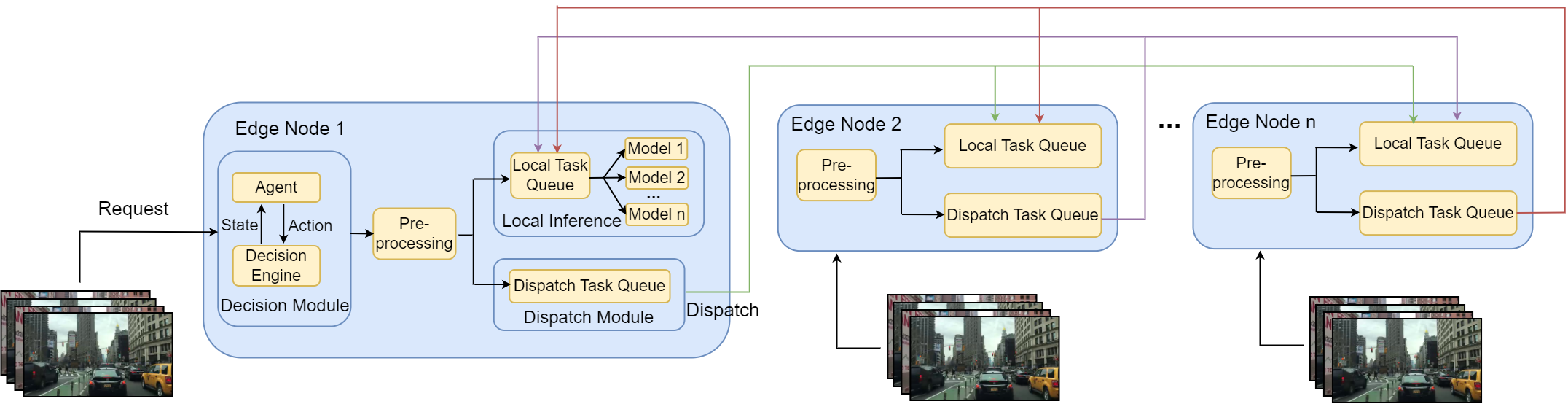
- Each edge node is modeled as an autonomous agent that observes its local state and collaborates with others using a multiagent reinforcement learning (MARL) framework.
- An actor-critic MARL algorithm is designed with a centralized critic that incorporates state information from all agents to improve policy learning.
- An attention mechanism is integrated into the critic network to dynamically weigh the importance of information from other agents, improving decision accuracy.
- The system jointly optimizes three control actions: video frame resolution, DNN model selection, and inference request routing to edge nodes.
- The reward function balances inference accuracy, end-to-end delay, and video frame drop rate, with a configurable penalty weight for trade-off control.
- A real-world multi-edge-node testbed is implemented using real datasets to evaluate the method under realistic network and workload conditions.
Experimental results
Research questions
- RQ1How can multiple edge nodes collaboratively optimize video analytics pipelines to reduce end-to-end delay and improve system performance?
- RQ2What is the impact of inter-agent state sharing and attention mechanisms on the performance of MARL in distributed video analytics?
- RQ3How does the proposed MARL-based approach compare to centralized or heuristic-based request dispatching and model selection strategies?
- RQ4To what extent can collaborative edge processing reduce video frame drop rates under high workloads?
- RQ5How does the system perform under varying trade-offs between accuracy, delay, and resource cost, as controlled by the penalty weight in the reward function?
Key findings
- EdgeVision improves overall system rewards by 33.6% to 86.4% compared to the most competitive baseline methods across different penalty weight settings.
- The ablation study shows that removing inter-agent state information (W/O Other’s State) degrades performance the most, proving its necessity for effective collaboration.
- The attention mechanism improves rewards by 13.2% to 30.0% compared to a non-attentive variant, demonstrating its role in filtering relevant information from other agents.
- EdgeVision achieves the lowest overall delay (15.2%–32.1% better than baselines) and video frame drop percentage (18.7%–45.3% lower), indicating superior scheduling efficiency.
- Under high penalty weights (ω=15), EdgeVision maintains the best balance between accuracy and delay, outperforming even methods that prioritize high-accuracy models.
- The method achieves the highest inference accuracy when penalty weight is low (ω=0.2), showing its adaptability to different optimization objectives.

Read this paper
Open the full text in the Nubint reader and ask about any passage as you read.
Read this paper on NubintThis review was generated by AI from the original paper. Please check the paper before citing it.