
[Paper Review] Edit Probability for Scene Text Recognition
This paper proposes edit probability (EP), a novel training objective for attention-based scene text recognition that models the likelihood of generating ground-truth text while accounting for missing or superfluous characters via sequence alignment. By reweighting gradients to focus on misaligned characters, EP reduces training confusion and boosts accuracy, achieving state-of-the-art performance on IIIT-5K, SVT, and ICDAR benchmarks with minimal inference overhead.
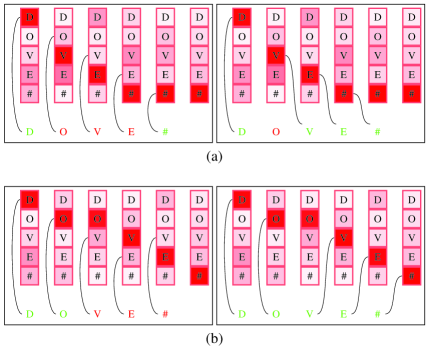
We consider the scene text recognition problem under the attention-based encoder-decoder framework, which is the state of the art. The existing methods usually employ a frame-wise maximal likelihood loss to optimize the models. When we train the model, the misalignment between the ground truth strings and the attention's output sequences of probability distribution, which is caused by missing or superfluous characters, will confuse and mislead the training process, and consequently make the training costly and degrade the recognition accuracy. To handle this problem, we propose a novel method called edit probability (EP) for scene text recognition. EP tries to effectively estimate the probability of generating a string from the output sequence of probability distribution conditioned on the input image, while considering the possible occurrences of missing/superfluous characters. The advantage lies in that the training process can focus on the missing, superfluous and unrecognized characters, and thus the impact of the misalignment problem can be alleviated or even overcome. We conduct extensive experiments on standard benchmarks, including the IIIT-5K, Street View Text and ICDAR datasets. Experimental results show that the EP can substantially boost scene text recognition performance.
Motivation & Objective
- To address the misalignment problem in attention-based scene text recognition caused by missing or superfluous characters during training.
- To reduce training confusion and cost by shifting gradient back-propagation focus from misaligned characters to the actual source of error—missing or superfluous characters.
- To develop a training objective that estimates the probability of generating the ground-truth string while considering possible insertions and deletions in the attention output sequence.
- To improve recognition accuracy without requiring expensive pixel-wise supervision or increasing inference time significantly.
Proposed method
- EP models the probability of generating the ground-truth string by considering all possible edit operations (insertions, deletions, substitutions) between the attention output sequence and the ground-truth string.
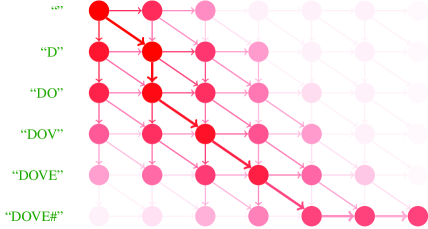
- It uses dynamic programming to compute the edit probability matrix, where each entry (i,j) represents the probability of aligning the first i characters of the ground-truth with the first j probability distributions from the attention output.
- The method computes the most probable edit path through the matrix, which guides back-propagation to focus on the location of missing or superfluous characters rather than misaligned ones.
- EP is integrated into the training process as a new loss objective, replacing standard frame-wise maximum likelihood loss, and is compatible with both standard and attention-based models.
- A lexicon-free prediction strategy is introduced using a tunable hyperparameter λ, and an efficient EP-Trie-based inference method is proposed to accelerate decoding with large lexicons.
- The approach is evaluated using standard benchmarks including IIIT-5K, SVT, and ICDAR, with ablation studies on training cost and inference speed.
Experimental results
Research questions
- RQ1How does modeling edit operations between the attention output and ground-truth string affect training stability and recognition accuracy in scene text recognition?
- RQ2Can a differentiable edit probability objective reduce the impact of misalignment caused by missing or superfluous characters during back-propagation?
- RQ3To what extent does EP improve performance compared to standard frame-wise maximum likelihood training, especially in the presence of attention drift?
- RQ4How efficient is EP-based training and inference compared to baseline methods, particularly when using large lexicons?
Key findings
- EP significantly improves recognition accuracy on standard benchmarks, achieving state-of-the-art results on IIIT-5K, SVT, and ICDAR datasets.
- The training time cost of EP-based methods increases by only 6.8ms and 7.0ms per iteration compared to Shi’s and Cheng’s baselines, respectively, with batch size 75.
- When using the Hunspell 50k lexicon, performance peaks at λ = 0.98, with accuracy decreasing sharply when λ approaches 1 due to over-correction.
- The EP-Trie-based inference method achieves the same accuracy as the enumeration-based method but reduces inference time from 2.566s to 0.11s per image.
- Lexicon-free prediction with λ = 0.5 yields identical accuracy to lexicon-free baselines, validating the effectiveness of the proposed method without ground-truth-related lexicons.
- In cases of misalignment, EP assigns higher probability to correct alignments by accounting for insertions/deletions, reducing error back-propagation to correctly recognized characters.
Read this paper
Open the full text in the Nubint reader and ask about any passage as you read.
Read this paper on NubintThis review was generated by AI from the original paper. Please check the paper before citing it.