
[Paper Review] EEG-GPT: Exploring Capabilities of Large Language Models for EEG Classification and Interpretation
EEG-GPT uses a large language model fine-tuned on verbally described EEG features to classify normal vs abnormal EEG with few-shot learning, and demonstrates step-wise reasoning with EEG tools for transparency.
In conventional machine learning (ML) approaches applied to electroencephalography (EEG), this is often a limited focus, isolating specific brain activities occurring across disparate temporal scales (from transient spikes in milliseconds to seizures lasting minutes) and spatial scales (from localized high-frequency oscillations to global sleep activity). This siloed approach limits the development EEG ML models that exhibit multi-scale electrophysiological understanding and classification capabilities. Moreover, typical ML EEG approaches utilize black-box approaches, limiting their interpretability and trustworthiness in clinical contexts. Thus, we propose EEG-GPT, a unifying approach to EEG classification that leverages advances in large language models (LLM). EEG-GPT achieves excellent performance comparable to current state-of-the-art deep learning methods in classifying normal from abnormal EEG in a few-shot learning paradigm utilizing only 2% of training data. Furthermore, it offers the distinct advantages of providing intermediate reasoning steps and coordinating specialist EEG tools across multiple scales in its operation, offering transparent and interpretable step-by-step verification, thereby promoting trustworthiness in clinical contexts.
Motivation & Objective
- Motivate a unifying EEG classification framework that leverages large language models to address multi-scale EEG phenomena.
- Evaluate whether an LLM can perform normal/abnormal EEG classification with few-shot and zero-shot learning.
- Demonstrate the potential of tree-of-thought and tool integration to provide transparent, step-by-step EEG interpretation.
Proposed method
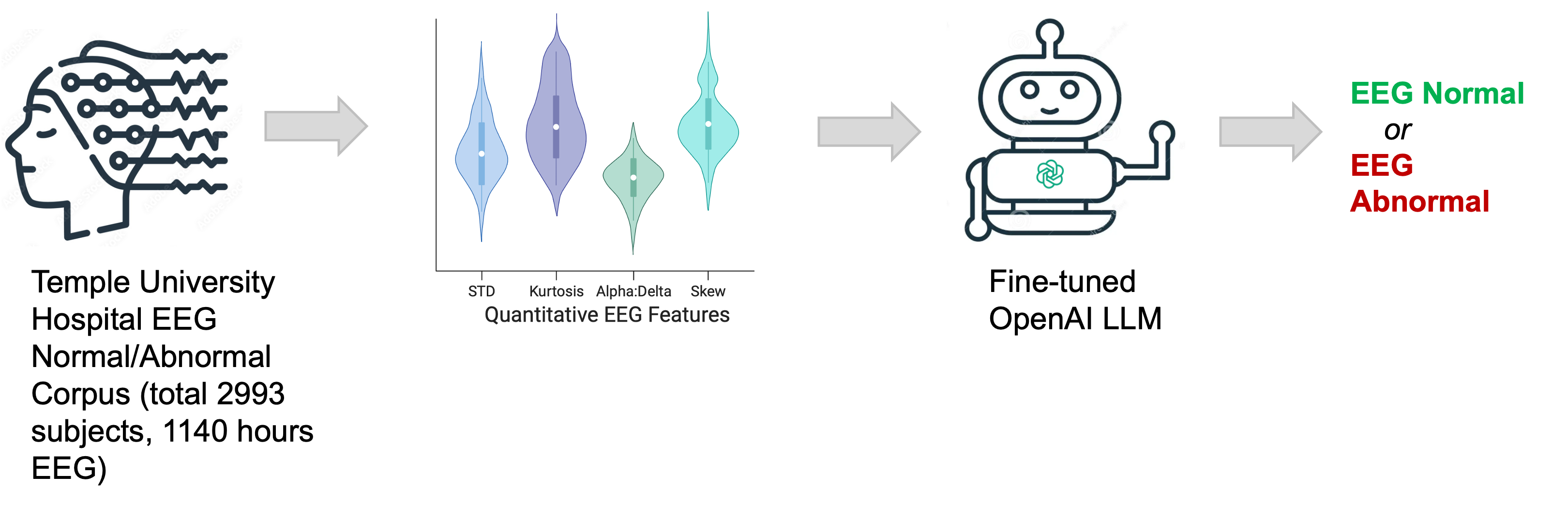
- Split EEG recordings into 20-second epochs and compute per-channel features (90th percentile of voltage amplitudes, standard deviation, kurtosis, alpha:delta, theta:alpha, delta:theta power ratios) for channels Cz, T5, T6, O1, O2.
- Convert feature summaries into verbal prompts and fine-tune the da Vinci GPT-3 base LLM using prompt-completion pairs to predict normal vs abnormal labels.
- Evaluate EEG-GPT in few-shot learning against traditional ML and deep-learning baselines using 2% of training data.
- Assess zero-shot performance with and without in-context learning.
- Explore reasoning capabilities by enabling the LLM to use specialized tools (seizure detector, spike detector, qEEG feature comparison) in a Tree of Thoughts framework.
- Demonstrate examples where the framework uses tools to reach a final classification.
![Figure 1: Diagram depicting the process of fine-tuning large language models [ 9 ]](https://ar5iv.labs.arxiv.org/html/2401.18006/assets/images/intro_finetuning.png)
Experimental results
Research questions
- RQ1Can an LLM, when fine-tuned on verbalized EEG features, match traditional ML methods in normal/abnormal EEG classification with limited training data?
- RQ2Does EEG-GPT retain strong performance in zero-shot and few-shot settings compared to deep learning models trained on raw EEG data?
- RQ3Can an LLM coordinate multiple EEG analysis tools in a transparent, step-by-step decision process to classify EEGs?
- RQ4What are the potential failure modes (e.g., hallucinations) of LLM-driven EEG interpretation, and how can human oversight mitigate them?
Key findings
- EEG-GPT achieves AUROC of 0.86 with 2% of training data, outperforming traditional ML methods under similar data constraints.
- In zero-shot mode, EEG-GPT performs better than chance and reaches AUROC 0.63 with in-context learning.
- With 2% data, EEG-GPT matches a deep-learning method trained on all available data, though some SOTA deep models still outperform it when fully trained.
- The Tree of Thoughts framework enables the LLM to use automated seizure detection, spike detection, and qEEG feature comparison tools to reach a final decision.
- Demonstrations illustrate the framework stopping early when evidence is sufficient (seizure example) or integrating multiple tools to reach a classification (non-seizure abnormal example).
- Compared to DL approaches that use raw EEG, EEG-GPT uses a limited feature set yet shows competitive performance in few-shot settings.
Better researchstarts right now
From reading papers to final review, dramatically reduce your research time.
No credit card · Free plan available
This review was created by AI and reviewed by human editors.