
[Paper Review] Effective Low-Cost Time-Domain Audio Separation Using Globally Attentive Locally Recurrent Networks
This paper proposes the Globally Attentive Locally Recurrent (GALR) network, a low-cost, efficient architecture for time-domain speech separation that combines locally recurrent processing with global self-attention to model long-range dependencies. GALR achieves state-of-the-art performance with 36.1% less runtime memory and 49.4% fewer FLOPs than DPRNN, while matching or exceeding its performance across three datasets, including a 2.4 dB SI-SNRi improvement on WSJ0-2mix.
Recent research on the time-domain audio separation networks (TasNets) has brought great success to speech separation. Nevertheless, conventional TasNets struggle to satisfy the memory and latency constraints in industrial applications. In this regard, we design a low-cost high-performance architecture, namely, globally attentive locally recurrent (GALR) network. Alike the dual-path RNN (DPRNN), we first split a feature sequence into 2D segments and then process the sequence along both the intra- and inter-segment dimensions. Our main innovation lies in that, on top of features recurrently processed along the inter-segment dimensions, GALR applies a self-attention mechanism to the sequence along the inter-segment dimension, which aggregates context-aware information and also enables parallelization. Our experiments suggest that GALR is a notably more effective network than the prior work. On one hand, with only 1.5M parameters, it has achieved comparable separation performance at a much lower cost with 36.1% less runtime memory and 49.4% fewer computational operations, relative to the DPRNN. On the other hand, in a comparable model size with DPRNN, GALR has consistently outperformed DPRNN in three datasets, in particular, with a substantial margin of 2.4dB absolute improvement of SI-SNRi in the benchmark WSJ0-2mix task.
Motivation & Objective
- To address the high memory and latency costs of existing time-domain speech separation models in industrial applications.
- To improve long-sequence modeling in TasNets by combining the strengths of RNNs and self-attention mechanisms.
- To design a compact, efficient architecture that maintains high separation performance with reduced computational and memory overhead.
- To validate the superiority of self-attention over RNNs for modeling global, long-range dependencies in audio sequences.
- To demonstrate consistent performance gains across diverse datasets, including speech-speech and speech-music separation tasks.
Proposed method
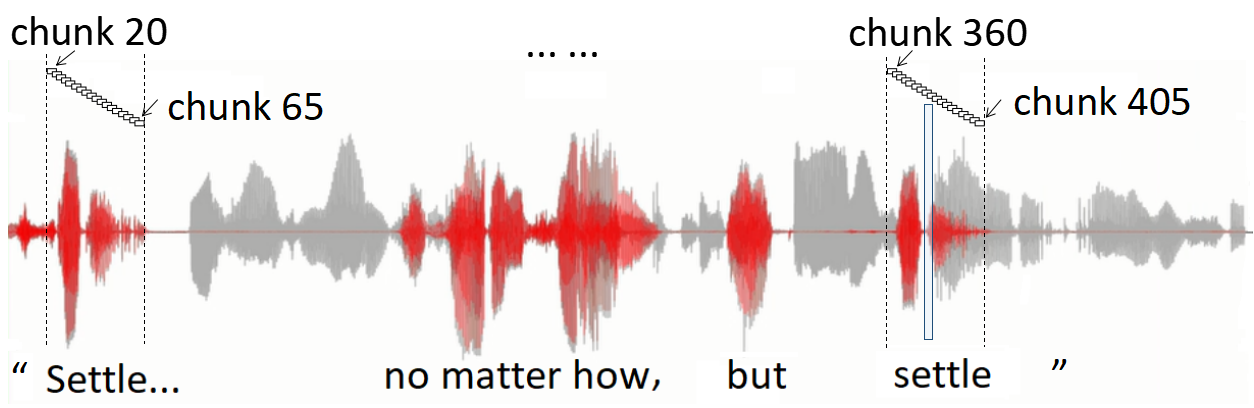
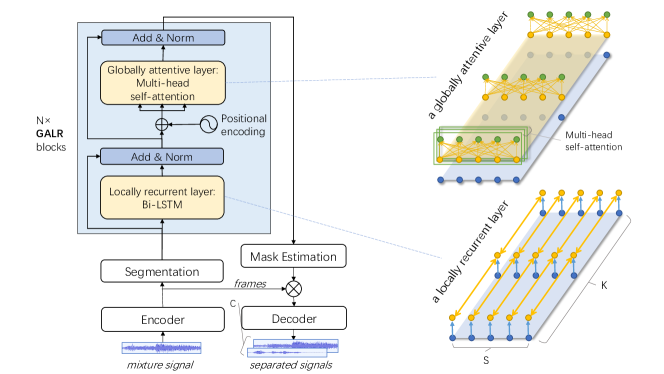
- The GALR architecture splits input waveforms into 2D segments, applying local recurrence along intra-segment dimensions to model short-term dependencies.
- It uses a recurrent network along inter-segment dimensions to capture sequential context across segments.
- A self-attention mechanism is applied on the inter-segment sequence to aggregate context-aware, long-range dependencies in parallel.
- The model leverages permutation invariant training (PIT) to optimize time-domain loss directly on raw waveforms.
- The architecture is designed to be parameter-efficient, with reduced FLOPs and memory usage compared to prior models like DPRNN.
- The method enables parallelization of global attention while preserving local recurrence, balancing modeling capacity and efficiency.
Experimental results
Research questions
- RQ1Can self-attention be effectively applied to long time-domain audio sequences in speech separation, overcoming the quadratic complexity of standard attention?
- RQ2Does combining local recurrence with global attention improve modeling of long-range dependencies compared to RNN-only approaches?
- RQ3Can a compact model achieve superior performance with significantly reduced FLOPs and memory usage compared to state-of-the-art baselines like DPRNN?
- RQ4How does the proposed architecture perform across diverse separation tasks, including speech-speech and speech-music mixtures?
- RQ5Is the attention mechanism more effective than RNNs for capturing distant contextual information in audio signals?
Key findings
- GALR achieved a 2.4 dB absolute improvement in SI-SNRi on the WSJ0-2mix dataset compared to DPRNN, despite having fewer parameters.
- With only 1.5M parameters, GALR reduced FLOPs by 49.4% and runtime memory by 36.1% compared to DPRNN, while maintaining comparable performance.
- On the larger Libri-2mix dataset, GALR achieved 0.2 dB higher SI-SNRi and SDRi than DPRNN with a smaller model size (2.3M vs. 2.6M parameters).
- In speech-music mixture separation, GALR outperformed DPRNN by 1.4 dB in SI-SNRi and 1.4 dB in SDRi, demonstrating superior robustness in challenging scenarios.
- The model consistently outperformed DPRNN across all three datasets, confirming the effectiveness of global attention for long-range sequence modeling.
- The results indicate that self-attention is better suited than RNNs for modeling global context in audio sequences, especially when distant dependencies are critical.
Read this paper
Open the full text in the Nubint reader and ask about any passage as you read.
Read this paper on NubintThis review was generated by AI from the original paper. Please check the paper before citing it.