
[論文レビュー] Effective quantum volume, fidelity and computational cost of noisy quantum processing experiments
本論文は、有効量子ボリューム、忠実度、テンソルネットワーク縮約コストを結びつけることで、ノイズのある量子実験の計算コストとノイズ耐性を統一的に定量化するフレームワークを導入する。信号対ノイズ比と古典的計算コストが有効回路ボリュームとともに指数的にトレードオフとなることが示され、最近の量子実験—ランダム回路サンプリング、量子スキャッタリング、Floquet回路—の高速かつ高精度なシミュレーションが、1データポイントあたり1つのGPUで可能になる。
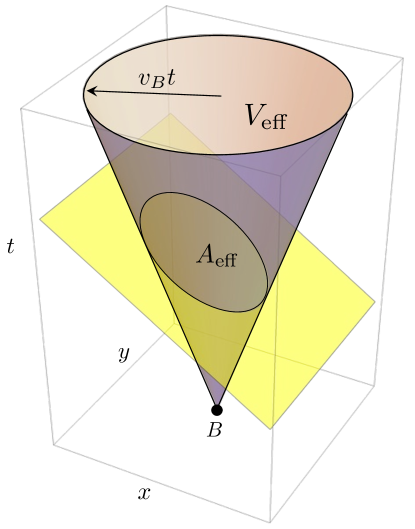
Today's experimental noisy quantum processors can compete with and surpass all known algorithms on state-of-the-art supercomputers for the computational benchmark task of Random Circuit Sampling [1-5]. Additionally, a circuit-based quantum simulation of quantum information scrambling [6], which measures a local observable, has already outperformed standard full wave function simulation algorithms, e.g., exact Schrodinger evolution and Matrix Product States (MPS). However, this experiment has not yet surpassed tensor network contraction for computing the value of the observable. Based on those studies, we provide a unified framework that utilizes the underlying effective circuit volume to explain the tradeoff between the experimentally achievable signal-to-noise ratio for a specific observable, and the corresponding computational cost. We apply this framework to recent quantum processor experiments of Random Circuit Sampling [5], quantum information scrambling [6], and a Floquet circuit unitary [7]. This allows us to reproduce the results of Ref. [7] in less than one second per data point using one GPU.
研究の動機と目的
- ノイズのある量子処理実験の古典的計算コストを体系的に評価する方法を確立すること。
- ノイズ下での量子実験における信号対ノイズ比と計算コストのトレードオフを明確にすること。
- 既存のランダム回路サンプリングフレームワークを、局所的観測量と非自明な回路構造へと拡張すること。
- 高忠実度のシミュレーションを通じて、最近の実験結果(Floquet回路や量子スキャッタリングを含む)に対するフレームワークの妥当性を検証すること。
- 有効ボリュームスケーリングを用いることで、一般の古典的アルゴリズムが最小限の計算コストで複雑な量子実験を再現可能であることを示すこと。
提案手法
- 有効忠実度 $ F_{\text{eff}} \sim e^{-\epsilon V_{\text{eff}}} $ を定義し、ここで $ \epsilon $ は2キュービットゲートあたりの誤差、$ V_{\text{eff}} $ は観測量に関連する有効回路ボリュームである。
- 古典的計算コストを推定するためにテンソルネットワーク縮約を用い、これは $ \propto 2^{\alpha A_{\text{eff}}} $ のスケーリングに従う。ここで $ A_{\text{eff}} $ はカットの有効面積を表す。
- 3つの実験的ケースにフレームワークを適用:ランダム回路サンプリング、量子情報スキャッタリング、Floquet回路ユニタリ。
- 有効ボリュームと光円錐截断を活用することで、1GPUあたり1データポイントあたり1秒未塔の高速なFloquet実験シミュレーションを実現。
- 複数の観測量とキュービット数において、数値的シミュレーションと実験データを比較し、誤差範囲内で一致を確認。
- 期待値の収束性とロバストネスを検証するため、オープン境界条件とクローズド境界条件をシミュレーションに適用。
実験結果
リサーチクエスチョン
- RQ1有効回路ボリューム $ V_{\text{eff}} $ がノイズのある量子実験における信号対ノイズ比と計算コストにどのように影響を与えるか?
- RQ2テンソルネットワーク縮約法は、局所的観測量を伴う量子実験の古典的コストをどの程度正確に推定できるか?
- RQ3有効忠実度フレームワークは、プリプレセントライゼッドFloquet系におけるスピン磁化の指数的減衰を説明できるか?
- RQ4境界条件の選択(オープン対クローズド)が、シミュレートされた期待値の収束性に与える影響はいかほどか?
- RQ5光円錐と相関長の観点から、与えられた量子実験を正確にシミュレートするために必要な最小系サイズはどの程度か?
主な発見
- 有効忠実度は、$ F_{\text{eff}} \sim e^{-\epsilon V_{\text{eff}}} $ のように有効回路ボリュームとともに指数的に減少し、ノイズと観測量の減衰の直接的な関係を提供する。
- Floquet回路実験の古典的計算コストは、効率的なテンソルネットワーク縮約のおかげで、1GPUあたり1データポイントあたり1秒未塔に抑えられる。
- 参考文献[7]の28キュービットFloquet回路の数値的シミュレーションは、複数の $ \theta_h $ 値において磁化と観測量期待値について実験データと一致する。
- $ \theta_h $ が小さい場合、長時間にわたる減衰を示すプリプレセントライゼーションを示し、ステップ数の指数的スケーリングと整合的である。
- qubit 62 の $ \langle Z \rangle $ の収束は、光円錐サイズよりも少ないキュービット数で達成され、特に $ \theta_h $ が小さい場合には相関長が短いためである。
- 23キュービットおよび31キュービットのシミュレーションでほぼ同一の結果が得られ、有効ボリューム截断が正確な推定に十分であることが示された。
![Figure 4: Numerical simulations for $\mathinner{\langle{Z}\rangle}$ of the qubit labelled 62 in Fig. 3 , with 20 steps of the Floquet circuit of Eq. ( 14 ). Figure also shows the experimental data reported in Fig. 4b of Ref. [ 7 ] . The difference between numerical simulations with 28 and 31 qubits](https://ar5iv.labs.arxiv.org/html/2306.15970/assets/x2.png)
より良い研究を、今すぐ始めましょう
論文の読解から最終レビューまで、研究時間を劇的に削減しましょう。
クレジットカード登録不要
このレビューはAIが作成し、人間の編集者が確認しました。