
[Paper Review] Efficient Adversarial Attacks on Online Multi-agent Reinforcement Learning
The paper analyzes adversarial poisoning attacks on online MARL, introducing mixed action and reward attacks that can efficiently steer agents to a target policy under white-box, gray-box, and black-box settings, with provable guarantees under certain conditions.
Due to the broad range of applications of multi-agent reinforcement learning (MARL), understanding the effects of adversarial attacks against MARL model is essential for the safe applications of this model. Motivated by this, we investigate the impact of adversarial attacks on MARL. In the considered setup, there is an exogenous attacker who is able to modify the rewards before the agents receive them or manipulate the actions before the environment receives them. The attacker aims to guide each agent into a target policy or maximize the cumulative rewards under some specific reward function chosen by the attacker, while minimizing the amount of manipulation on feedback and action. We first show the limitations of the action poisoning only attacks and the reward poisoning only attacks. We then introduce a mixed attack strategy with both the action poisoning and the reward poisoning. We show that the mixed attack strategy can efficiently attack MARL agents even if the attacker has no prior information about the underlying environment and the agents' algorithms.
Motivation & Objective
- Motivate the safety and trustworthiness concerns of MARL in safety-critical applications.
- Model an attacker who can manipulate rewards and/or actions to steer agents toward a target policy or higher attacker-defined rewards.
- Study attack effectiveness across white-box, gray-box, and black-box settings and identify limitations of single-modality attacks.
- Propose and analyze mixed attack strategies that achieve sub-linear attack cost and loss under various conditions.
Proposed method
- Formalize a poisoning attack framework where an attacker can override actions and/or rewards at each step.
- Define attack cost as the sum of action overrides and reward perturbations, and attack losses under two goals: (i) force a target policy, (ii) maximize attacker-defined rewards.
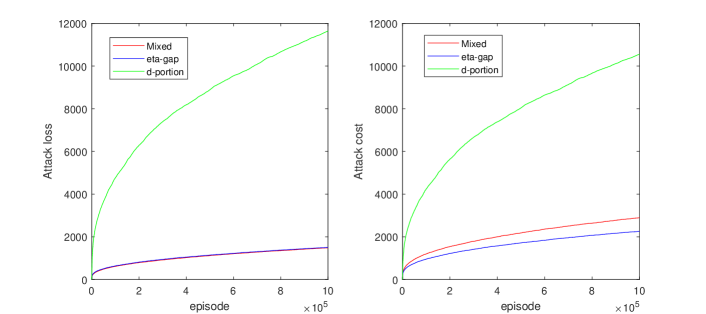
- Introduce and analyze white-box, gray-box, and black-box attack strategies, including d-portion action poisoning, eta-gap reward poisoning, and mixed strategies.
- Provide theoretical guarantees showing conditions under which the target policy becomes the unique NE/CE/CCE and bounds on attack cost and loss.
- Show that pure action-only or reward-only attacks have limitations, motivating mixed strategies that are efficient and effective.
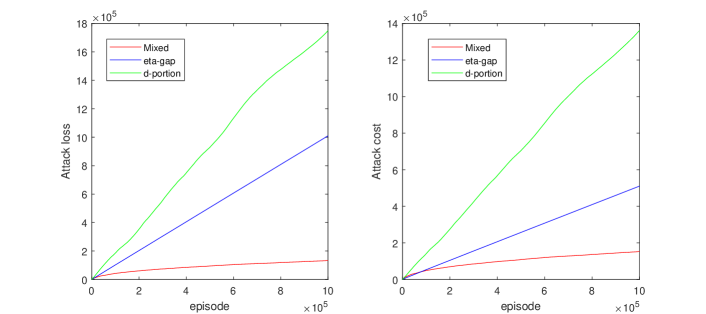
Experimental results
Research questions
- RQ1Can an attacker efficiently drive online MARL agents to a predefined target policy or attacker-specified reward objective across different information settings (white-box, gray-box, black-box)?
- RQ2Under what conditions do action-poisoning or reward-poisoning alone attacks fail, and how can mixed attacks overcome these limitations?
- RQ3What are the cost and loss trade-offs for different attack strategies in terms of sub-linear scaling with total interaction steps?
- RQ4How do mixed attacks perform across various MARL algorithms and environments regarding steering agents toward NE/CE/CCE?
- RQ5What theoretical guarantees can be established for attack effectiveness in terms of best-in-hindsight regret and policy uniqueness?
Key findings
- Pure action-poisoning or reward-poisoning alone attacks can be ineffective in some MGs and settings.
- A d-portion action poisoning attack can make the target policy the unique NE/CE/CCE under Condition 1.
- An eta-gap reward attack can enforce the target policy as the unique NE/CE/CCE under Condition 2.
- A gray-box mixed attack and a black-box approximate mixed attack can drive sub-linear loss and cost to force convergence to the target policy.
- Under sub-linear best-in-hindsight regret, attack losses and costs can be bounded by formulas involving R_min and the regret bound R(T).
- In gray-box settings, a mixed attack can succeed without full environment knowledge; in black-box settings, an exploration phase enables an approximate mixed attack.
Read this paper
Open the full text in the Nubint reader and ask about any passage as you read.
Read this paper on NubintThis review was generated by AI from the original paper. Please check the paper before citing it.