
[Paper Review] Efficient and Effective Vocabulary Expansion Towards Multilingual Large Language Models
This paper proposes EEVE, an efficient and effective vocabulary expansion method that enhances multilingual large language models by freezing parameters and initializing subword embeddings, enabling strong Korean language performance with only 2 billion fine-tuning tokens. The EEVE-Korean-10.8B-v1.0 model achieves state-of-the-art results on the Open Ko-LLM Leaderboard while preserving the English capabilities of its base model, SOLAR-10.7B.
This report introduces exttt{EEVE-Korean-v1.0}, a Korean adaptation of large language models that exhibit remarkable capabilities across English and Korean text understanding. Building on recent highly capable but English-centric LLMs, such as SOLAR-10.7B and Phi-2, where non-English texts are inefficiently processed with English-centric tokenizers, we present an efficient and effective vocabulary expansion (EEVE) method, which encompasses parameter freezing and subword initialization. In contrast to previous efforts that believe new embeddings require trillions of training tokens, we show that our method can significantly boost non-English proficiency within just 2 billion tokens. Surpassing most instruction-tuned LLMs on the Open Ko-LLM Leaderboard, as of January 2024, our model exttt{EEVE-Korean-10.8B-v1.0} ranks as the leading Korean pre-trained model in the open-source community, according to Hugging Face's leaderboard. We open-source our models on Huggingface to empower the open research community in various languages.
Motivation & Objective
- To address the performance gap in non-English languages like Korean, where English-centric tokenizers lead to inefficient processing and longer inference times.
- To enable effective adaptation of English-centric LLMs to Korean without requiring trillions of training tokens.
- To maintain strong English performance while significantly improving proficiency in Korean through targeted vocabulary expansion.
- To develop a training strategy that progressively fine-tunes model parameters to optimize efficiency and effectiveness.
- To release open-source, high-performing Korean LLMs to empower the research community.
Proposed method
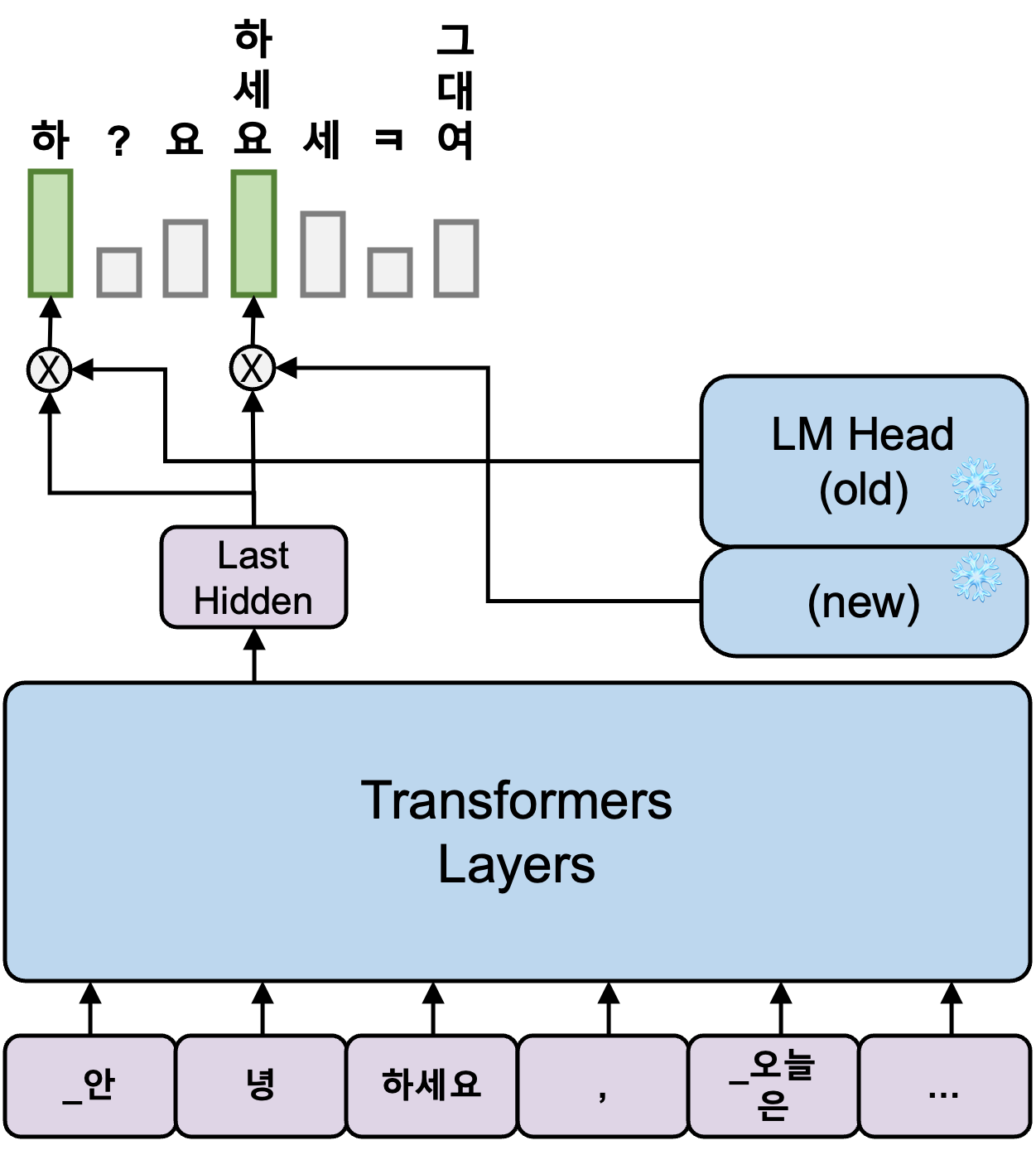
- The EEVE method employs parameter freezing across seven distinct training stages to gradually fine-tune model components, starting with input embeddings and progressing to full parameter updates.
- Subword-based embedding initialization is used to efficiently initialize new embeddings for frequently occurring Korean subwords and morphemes.
- A new tokenizer is trained on a Korean corpus, expanding the base vocabulary by adding 8,960 high-frequency tokens to reach a total of 40,960 tokens.
- The approach leverages the pre-trained reasoning and language understanding capabilities of base models like SOLAR-10.7B and Phi-2, transferring them to Korean with minimal retraining.
- The training pipeline is structured to prioritize input embedding updates first, minimizing parameter updates early on to avoid catastrophic forgetting.
- The method is applied to fine-tune two models: EEVE-Korean-10.8B-v1.0 and EEVE-Korean-2.8B-v1.0, both released on Hugging Face.
Experimental results
Research questions
- RQ1Can vocabulary expansion in multilingual LLMs be achieved efficiently with significantly fewer than trillions of tokens?
- RQ2Does parameter freezing and staged fine-tuning preserve English performance while boosting non-English capabilities?
- RQ3Can subword initialization effectively support new language tokens without extensive retraining?
- RQ4How does the EEVE method compare to instruction-tuned or end-to-end fine-tuned models in multilingual performance?
- RQ5Can preference tuning on Korean data improve performance without degrading English capabilities?
Key findings
- EEVE-Korean-10.8B-v1.0 outperforms all other open-source Korean pre-trained models on the Open Ko-LLM Leaderboard as of January 2024.
- The model achieves state-of-the-art performance in Korean tasks such as BoolQ, COPA, WiC, HellaSwag, and SentiNeg, while maintaining strong English performance.
- Despite using only 2 billion fine-tuning tokens, EEVE-Korean-10.8B-v1.0 surpasses models like OPEN-SOLAR-KO-10.7B, which use similar base models but do not preserve English capabilities.
- Preference tuning on Korean instruction data improved English performance, indicating that the embedding spaces of Korean and English tokens are well-aligned.
- The method successfully maintains English performance while enhancing Korean proficiency, unlike models such as LLaMA-2-chat, which degrade in Korean tasks after English preference tuning.
- The EEVE-Korean-2.8B-v1.0 model also outperforms phi-2-ko-v0.1, demonstrating the method’s effectiveness even at smaller scale.
Read this paper
Open the full text in the Nubint reader and ask about any passage as you read.
Read this paper on NubintThis review was generated by AI from the original paper. Please check the paper before citing it.