
[Paper Review] Efficient Decision-based Black-box Adversarial Attacks on Face Recognition
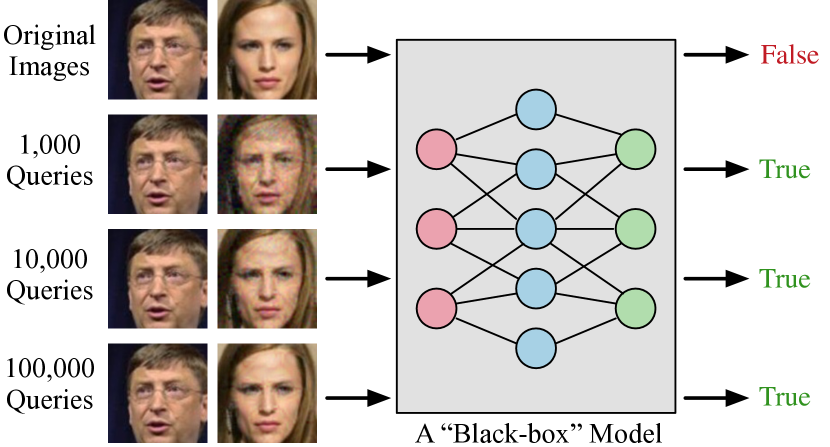
This paper proposes an efficient evolutionary attack method for decision-based black-box adversarial attacks on face recognition systems, leveraging local geometry modeling and dimensionality reduction to minimize perturbations with fewer queries. It achieves state-of-the-art query efficiency and smaller adversarial distortions, successfully attacking a real-world face verification API with lower MSE (2.54e-3) than baseline methods.
Face recognition has obtained remarkable progress in recent years due to the great improvement of deep convolutional neural networks (CNNs). However, deep CNNs are vulnerable to adversarial examples, which can cause fateful consequences in real-world face recognition applications with security-sensitive purposes. Adversarial attacks are widely studied as they can identify the vulnerability of the models before they are deployed. In this paper, we evaluate the robustness of state-of-the-art face recognition models in the decision-based black-box attack setting, where the attackers have no access to the model parameters and gradients, but can only acquire hard-label predictions by sending queries to the target model. This attack setting is more practical in real-world face recognition systems. To improve the efficiency of previous methods, we propose an evolutionary attack algorithm, which can model the local geometries of the search directions and reduce the dimension of the search space. Extensive experiments demonstrate the effectiveness of the proposed method that induces a minimum perturbation to an input face image with fewer queries. We also apply the proposed method to attack a real-world face recognition system successfully.
Motivation & Objective
- To evaluate the robustness of state-of-the-art face recognition models under realistic decision-based black-box attack settings where only hard-label queries are available.
- To address the inefficiency of existing black-box attacks that require excessive queries or produce large perturbations.
- To develop a query-efficient adversarial attack method that improves search direction optimization and reduces the effective search space dimension.
- To demonstrate practical applicability by successfully attacking a real-world face verification API from Tencent AI Platform.
Proposed method
- The method employs an evolutionary attack framework that models local geometries of search directions using a covariance matrix to guide query-efficient exploration.
- It performs coordinate selection with probabilities proportional to diagonal elements of the covariance matrix, enhancing convergence by focusing on more informative directions.
- Dimensionality reduction is applied by restricting the search space to a lower-dimensional subspace (e.g., 45×45×3), balancing efficiency and perturbation quality.
- The attack operates solely via hard-label queries—no gradients or model parameters are required—making it suitable for real-world black-box systems.
- The algorithm iteratively refines perturbations by querying the target model and updating the search distribution based on query outcomes.
- It combines dodging and impersonation attack strategies to evaluate robustness across different threat models.
Experimental results
Research questions
- RQ1Can an evolutionary attack method achieve higher query efficiency in decision-based black-box face recognition attacks compared to existing methods?
- RQ2How does modeling local geometries of search directions improve adversarial attack performance under query constraints?
- RQ3What is the optimal dimensionality of the search space for balancing attack success rate and perturbation magnitude?
- RQ4Can the proposed method successfully generate adversarial examples that evade real-world face recognition APIs with minimal visual distortion?
Key findings
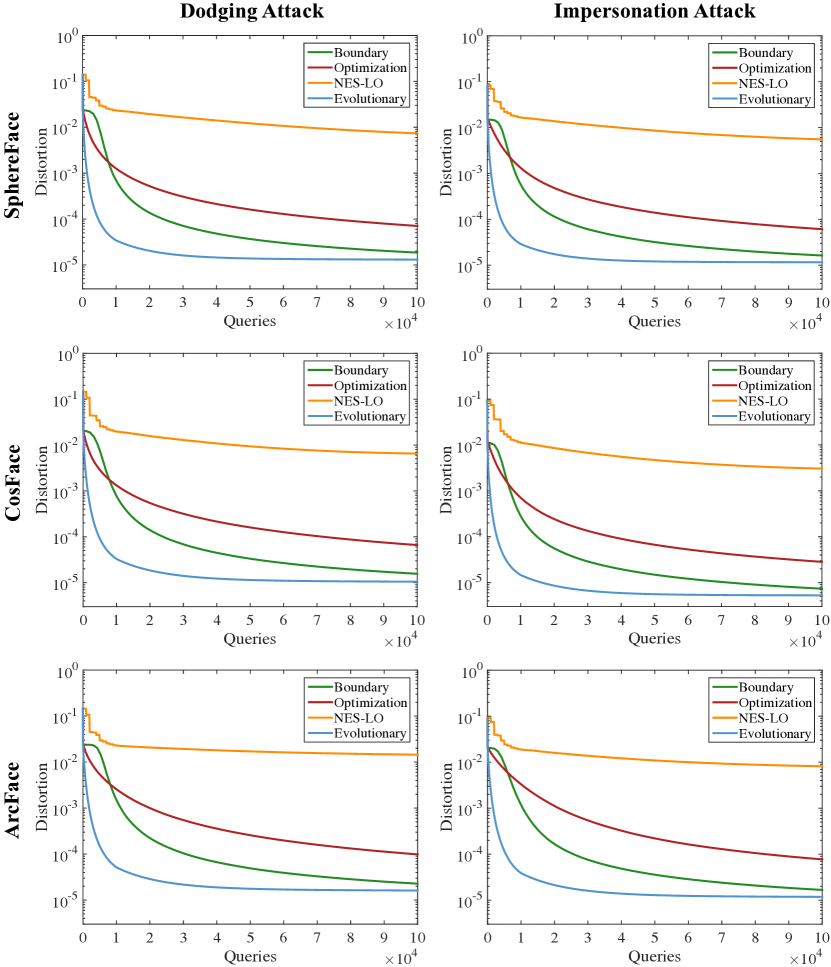
- The proposed evolutionary attack achieved the lowest average distortion (MSE = 2.54e-3) on the Tencent AI face verification API, outperforming Boundary (1.63e-2) and Optimization (1.71e-2) methods.
- The method converged faster and induced smaller perturbations in lower-dimensional search spaces, with 45×45×3 identified as the optimal dimension for balancing efficiency and quality.
- Coordinate selection based on covariance diagonal elements (cii) significantly improved attack performance compared to uniform sampling, demonstrating the benefit of adaptive sampling.
- The method successfully generated adversarial examples that evaded real-world face recognition systems, confirming its practical applicability.
- Extensive experiments on LFW and MegaFace datasets confirmed the robustness of state-of-the-art face recognition models to black-box attacks, highlighting security vulnerabilities.
Read this paper
Open the full text in the Nubint reader and ask about any passage as you read.
Read this paper on NubintThis review was generated by AI from the original paper. Please check the paper before citing it.