
[Paper Review] Efficient Episodic Memory Utilization of Cooperative Multi-Agent Reinforcement Learning
This paper proposes Efficient Episodic Memory Utilization (EMU) for cooperative multi-agent reinforcement learning, introducing a trainable encoder/decoder for semantically coherent memory embeddings and an episodic incentive mechanism to guide exploration toward high-return trajectories. EMU accelerates learning and avoids local optima, outperforming state-of-the-art methods on StarCraft II and Google Research Football benchmarks.
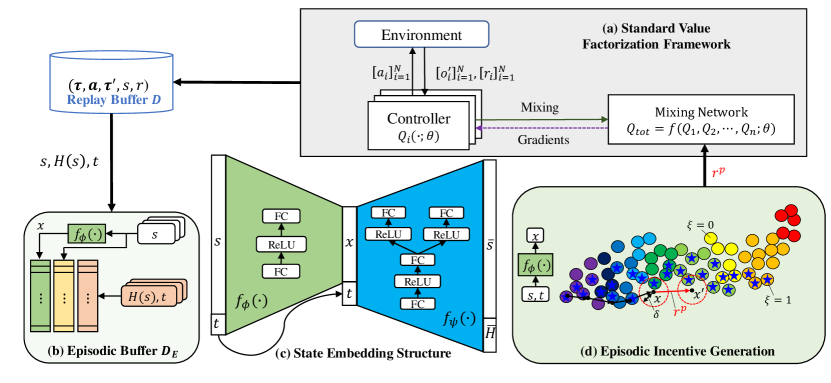
In cooperative multi-agent reinforcement learning (MARL), agents aim to achieve a common goal, such as defeating enemies or scoring a goal. Existing MARL algorithms are effective but still require significant learning time and often get trapped in local optima by complex tasks, subsequently failing to discover a goal-reaching policy. To address this, we introduce Efficient episodic Memory Utilization (EMU) for MARL, with two primary objectives: (a) accelerating reinforcement learning by leveraging semantically coherent memory from an episodic buffer and (b) selectively promoting desirable transitions to prevent local convergence. To achieve (a), EMU incorporates a trainable encoder/decoder structure alongside MARL, creating coherent memory embeddings that facilitate exploratory memory recall. To achieve (b), EMU introduces a novel reward structure called episodic incentive based on the desirability of states. This reward improves the TD target in Q-learning and acts as an additional incentive for desirable transitions. We provide theoretical support for the proposed incentive and demonstrate the effectiveness of EMU compared to conventional episodic control. The proposed method is evaluated in StarCraft II and Google Research Football, and empirical results indicate further performance improvement over state-of-the-art methods.
Motivation & Objective
- To address long training times and local optima in cooperative multi-agent reinforcement learning (MARL) under centralized training and decentralized execution (CTDE).
- To improve episodic memory utilization by replacing random projections with learnable, semantically meaningful embeddings that preserve state similarity for better exploration.
- To guide agents toward high-return trajectories by introducing an episodic incentive based on state desirability, reducing convergence to suboptimal policies.
- To ensure efficient memory recall and update by normalizing embeddings and using a data-driven threshold selection for similarity matching.
Proposed method
- Introduces a deterministic Conditional Autoencoder (dCAE) with a trainable encoder to embed global states into a low-dimensional, semantically coherent space, conditioned on timestep.
- Employs a decoder that reconstructs the global state and predicts return, with joint training to preserve key features for return estimation.
- Uses reconstruction loss and return prediction loss to train the dCAE, ensuring the embedding space captures features relevant to long-term return.
- Defines an episodic incentive reward based on the desirability of states—e.g., scoring in football or defeating enemies in StarCraft—used to improve Q-learning TD targets.
- Applies a normalized embedding space (z = (x − μ)/σ) to ensure equal weighting across dimensions and enable consistent similarity comparisons.
- Uses a data-driven threshold δ ≤ (6σ_y)^dim(y) / M to determine memory recall proximity, improving memory efficiency and coverage.
Experimental results
Research questions
- RQ1Can learnable, semantically coherent memory embeddings improve exploration efficiency in cooperative MARL compared to random projections?
- RQ2Does an episodic incentive based on state desirability lead to better policy learning and faster convergence than standard episodic control?
- RQ3How does EMU perform in comparison to state-of-the-art MARL methods on complex, partially observable environments like StarCraft II and Google Research Football?
- RQ4What is the computational overhead of maintaining a trainable episodic memory system in large-scale MARL?
- RQ5Can normalized embeddings and adaptive thresholding improve memory recall accuracy and reduce redundancy in episodic memory retrieval?
Key findings
- EMU significantly accelerates learning convergence in cooperative MARL by enabling more effective and targeted exploration through semantic memory embeddings.
- The episodic incentive mechanism improves the gradient signal in Q-learning, leading to faster policy improvement and reduced risk of local optima.
- Empirical results on StarCraft II Multi-Agent Challenge (SMAC) and Google Research Football (GRF) show EMU outperforms existing state-of-the-art MARL methods.
- The memory update and embedding computation overhead is negligible, taking less than two seconds per update even on high-dimensional state spaces.
- The normalized embedding space with adaptive thresholding ensures consistent and efficient memory recall, covering approximately 99.7% of the distribution with δ = 0.0013 under typical settings.
Read this paper
Open the full text in the Nubint reader and ask about any passage as you read.
Read this paper on NubintThis review was generated by AI from the original paper. Please check the paper before citing it.