
[Paper Review] Efficient Intrusion Detection: Combining $χ^2$ Feature Selection with CNN-BiLSTM on the UNSW-NB15 Dataset
This paper proposes a lightweight CNN-BiLSTM hybrid model combined with χ² feature selection for efficient intrusion detection on resource-constrained IoT devices using the UNSW-NB15 dataset. By reducing input features and optimizing model architecture, the approach achieves 97.90% accuracy in binary classification and 97.09% in multiclassification with inference times of 1.1 and 2.10 seconds, respectively, significantly improving efficiency over prior methods.
Intrusion Detection Systems (IDSs) have played a significant role in the detection and prevention of cyber-attacks in traditional computing systems. It is not surprising that this technology is now being applied to secure Internet of Things (IoT) networks against cyber threats. However, the limited computational resources available on IoT devices pose a challenge for deploying conventional computing-based IDSs. IDSs designed for IoT environments must demonstrate high classification performance, and utilize low-complexity models. Developing intrusion detection models in the field of IoT has seen significant advancements. However, achieving a balance between high classification performance and reduced complexity remains a challenging endeavor. In this research, we present an effective IDS model that addresses this issue by combining a lightweight Convolutional Neural Network (CNN) with bidirectional Long Short-Term Memory (BiLSTM). Additionally, we employ feature selection techniques to minimize the number of features inputted into the model, thereby reducing its complexity. This approach renders the proposed model highly suitable for resource-constrained IoT devices, ensuring it meets their computation capability requirements. Creating a model that meets the demands of IoT devices and attains enhanced precision is a challenging task. However, our suggested model outperforms previous works in the literature by attaining a remarkable accuracy rate of 97.90% within a prediction time of 1.1 seconds for binary classification. Furthermore, it achieves an accuracy rate of 97.09% within a prediction time of 2.10 seconds for multiclassification.
Motivation & Objective
- To address the challenge of deploying high-performance intrusion detection systems (IDS) on resource-constrained IoT devices with limited processing power, memory, and energy.
- To reduce model complexity and inference time while maintaining high classification accuracy through feature selection and architectural optimization.
- To improve multiclassification performance on imbalanced datasets like UNSW-NB15 by employing a weighted loss function to prioritize minority attack classes.
- To demonstrate that combining χ² feature selection with a lightweight CNN-BiLSTM architecture enables efficient, accurate, and deployable IDS for real-world IoT environments.
Proposed method
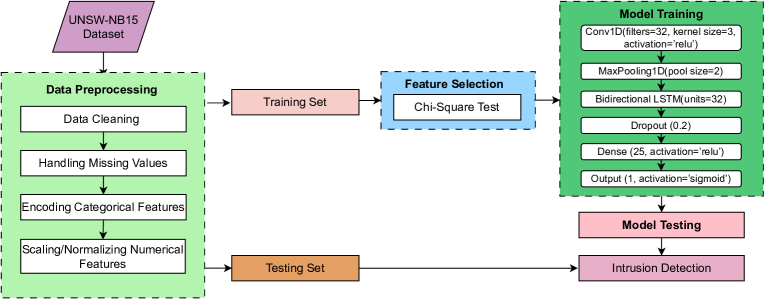
- A lightweight CNN-BiLSTM hybrid architecture is designed with reduced layers and parameters to minimize computational overhead for IoT deployment.
- χ² feature selection is applied to reduce the number of input features, decreasing model complexity and inference time.
- A weighted loss function is used during training to address class imbalance in the UNSW-NB15 dataset, improving detection of rare attack types such as 'Analysis' and 'Shellcode'.
- The model is trained and evaluated on the UNSW-NB15 dataset for both binary and multiclass classification tasks using standard metrics including accuracy, precision, recall, and F1-score.
- Inference time is measured to assess real-time applicability, with comparisons made to prior work using the full feature set.
Experimental results
Research questions
- RQ1Can a lightweight CNN-BiLSTM architecture combined with χ² feature selection achieve high intrusion detection accuracy while remaining suitable for deployment on resource-constrained IoT devices?
- RQ2How does feature selection impact the inference time and overall efficiency of a deep learning-based IDS on the UNSW-NB15 dataset?
- RQ3To what extent does a weighted loss function improve the detection performance of minority attack classes in the multiclassification setting?
- RQ4How does the proposed model compare in accuracy and inference speed to existing CNN-BiLSTM approaches that use the full feature set?
Key findings
- The proposed model achieves 97.90% accuracy in binary classification with a prediction time of 1.1 seconds, demonstrating high efficiency and performance.
- For multiclassification, the model attains 97.09% accuracy, 97.09% precision, 97.62% recall, and 97.27% F1-score, outperforming existing models on the UNSW-NB15 dataset.
- The use of χ² feature selection reduced inference time from 3.20 seconds (baseline) to 2.10 seconds, significantly enhancing real-time applicability.
- The model successfully identifies 8 out of 9 worms and 75 out of 76 shellcode attacks, with only one false negative, highlighting strong performance on minority classes due to the weighted loss function.
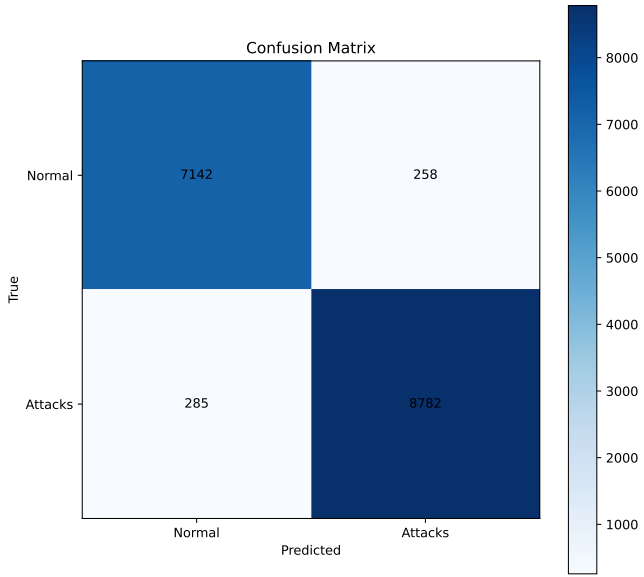
- The confusion matrix confirms high diagonal intensity, especially for the 'Normal' class, indicating strong overall classification reliability and model robustness.
Read this paper
Open the full text in the Nubint reader and ask about any passage as you read.
Read this paper on NubintThis review was generated by AI from the original paper. Please check the paper before citing it.