
[Paper Review] Efficient Language Model Training through Cross-Lingual and Progressive Transfer Learning
CLP-Transfer initializes a large target-language model from a source-language large model and a smaller target-language model, reusing weights and aligning embeddings to achieve substantial training savings while retaining or improving performance.
Most Transformer language models are primarily pretrained on English text, limiting their use for other languages. As the model sizes grow, the performance gap between English and other languages with fewer compute and data resources increases even further. Consequently, more resource-efficient training methods are needed to bridge the gap for languages with fewer resources available. To address this problem, we introduce a cross-lingual and progressive transfer learning approach, called CLP-Transfer, that transfers models from a source language, for which pretrained models are publicly available, like English, to a new target language. As opposed to prior work, which focused on the cross-lingual transfer between two languages, we extend the transfer to the model size. Given a pretrained model in a source language, we aim for a same-sized model in a target language. Instead of training a model from scratch, we exploit a smaller model that is in the target language but requires much fewer resources. Both small and source models are then used to initialize the token embeddings of the larger model based on the overlapping vocabulary of the source and target language. All remaining weights are reused from the model in the source language. This approach outperforms the sole cross-lingual transfer and can save up to 80% of the training steps compared to the random initialization.
Motivation & Objective
- Bridge the performance gap for non-English languages by enabling resource-efficient training of large language models.
- Extend cross-lingual transfer to model size, enabling same-sized target-language models to be trained efficiently.
- Leverage a small target-language model to assist initialization of embeddings for the large target-language model while reusing source-language Transformer weights.
Proposed method
- Initialize large target-model weights W_t^{(large)} from the source large model W_s^{(large)}.
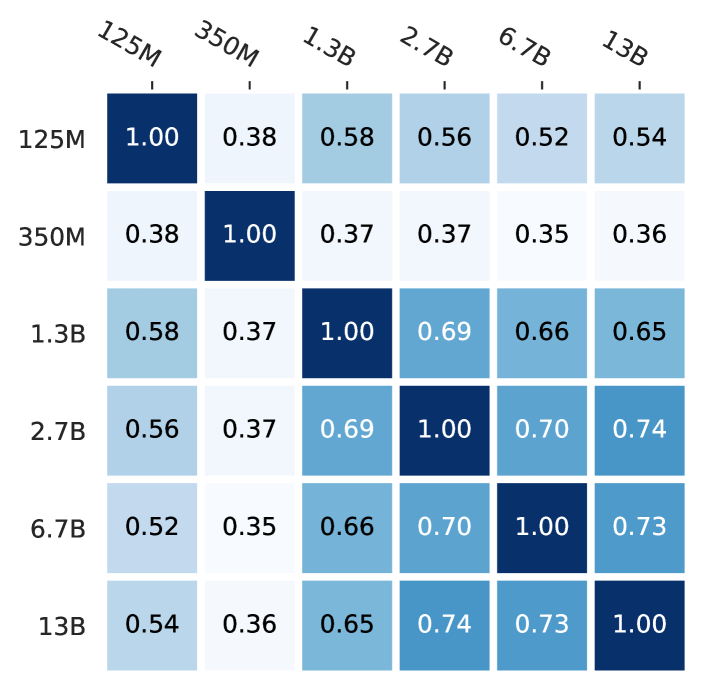
- Initialize overlapping token embeddings V_t^{(large)} from V_s^{(large)} for tokens in V_s ∩ V_t.
- For non-overlapping tokens, initialize embeddings as a weighted average of overlapping embeddings using a similarity-based weight function δ(v, v̂).
- Assume substantial vocabulary overlap and similar embedding spaces across model sizes to enable embedding transfer across languages and sizes.
- Evaluate on decoder-only GPT-2 and BLOOM architectures for German as target language, comparing against from-scratch and WECHSEL baselines.
Experimental results
Research questions
- RQ1Can cross-lingual transfer be effectively extended to match the model size in the target language (not just across languages)?
- RQ2Does using a small target-language model in conjunction with a source large model improve training efficiency and final performance compared to traditional cross-lingual transfer?
- RQ3What are the practical benefits in terms of training token savings and perplexity when applying CLP-Transfer to German GPT-2 and BLOOM models?
Key findings
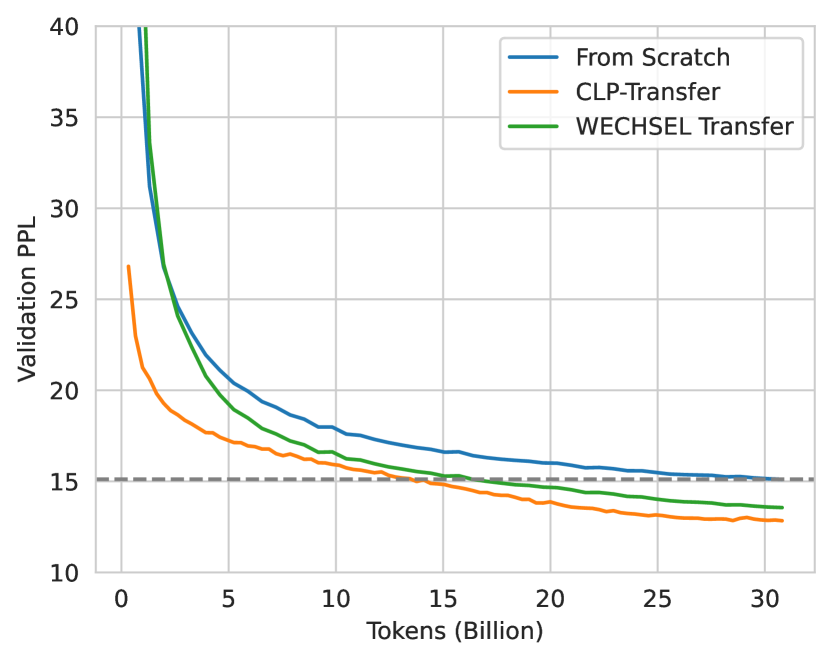
- CLP-Transfer matches or surpasses from-scratch training performance with only half the training tokens for GPT-2-XL German (1.5B) and 20% for BLOOM-CLP German (6.4B).
- For GPT-2, CLP-Transfer reaches the same perplexity as from-scratch training after about 50% of tokens; WECHSEL lags behind.
- For BLOOM, CLP-Transfer reaches equivalent perplexity after about 20% of tokens, indicating up to ~80% training savings.
- In zero-shot downstream tasks, BLOOM-CLP 6.4B achieves the best average among monolingual German models (0.43) and outperforms several baselines.
- Overall, CLP-Transfer demonstrates improved efficiency and competitive or superior downstream performance relative to baselines across multiple architectures and scales.
Read this paper
Open the full text in the Nubint reader and ask about any passage as you read.
Read this paper on NubintThis review was generated by AI from the original paper. Please check the paper before citing it.