
[Paper Review] Efficient Multimodal Learning from Data-centric Perspective
Bunny shows that a small multimodal model with carefully condensed training data can outperform larger MLLMs, achieving state-of-the-art results at 3B parameters.
Multimodal Large Language Models (MLLMs) have demonstrated notable capabilities in general visual understanding and reasoning tasks. However, their deployment is hindered by substantial computational costs in both training and inference, limiting accessibility to the broader research and user communities. A straightforward solution is to leverage smaller pre-trained vision and language models, which inevitably cause significant performance drops. In this paper, we demonstrate the possibility of training a smaller but better MLLM with high-quality training data. Specifically, we introduce Bunny, a family of lightweight MLLMs with flexible vision and language backbones for efficient multimodal learning from selected training data. Experiments show that our Bunny-4B/8B outperforms the state-of-the-art large MLLMs on multiple benchmarks. We expect that this work can provide the community with a clean and flexible open-source tool for further research and development. The code, models, and data can be found in https://github.com/BAAI-DCAI/Bunny.
Motivation & Objective
- Motivate the need for affordable, high-performing multimodal models due to high training/inference costs of MLLMs.
- Propose Bunny, a family of lightweight MLLMs with flexible backbones and a data-centric training strategy.
- Demonstrate that dataset condensation and careful fine-tuning can close or surpass the gap with larger models.
Proposed method
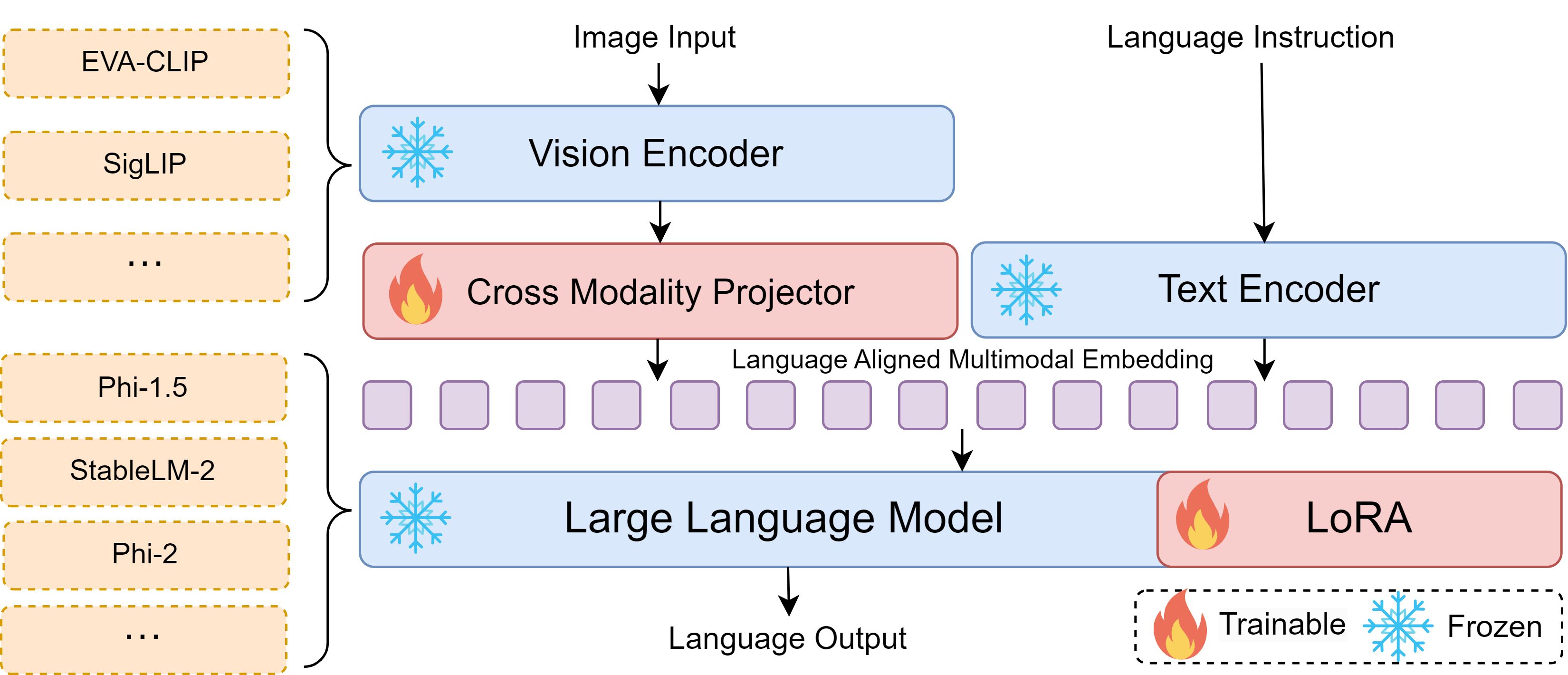
- Introduce Bunny with plug-and-play vision encoders and LLM backbones (SigLIP-SO, EVA-CLIP, Phi-2, etc.).
- Construct high-quality pre-training data by condensing LAION-2B into a 2M coreset using CLIP embeddings and clustering-based selection.
- Create fine-tuning data Bunny-695K combining multimodal datasets and high-quality pure text data to preserve cognition.
- Use a two-stage training: (1) align vision and text embeddings via the cross-modality projector; (2) visual instruction tuning with LoRA on the LLM and projector.
- Train with a cross-entropy loss for next-token prediction in both stages; LoRA preferred over full fine-tuning.
- Evaluate on 11 benchmarks including MME perception/cognition, MMBench, SEED-Bench, MMMU, VQA-v2, GQA, ScienceQA-IMG, and POPE.
Experimental results
Research questions
- RQ1Can a small, data-optimized multimodal model surpass larger MLLMs on standard benchmarks?
- RQ2How does data condensation and high-quality fine-tuning data influence performance relative to model size?
- RQ3What backbone combinations (vision encoder + LLM) yield the best trade-offs for Bunny?
Key findings
- Bunny-3B with SigLIP-SO and Phi-2 outperforms many lightweight MLLMs of similar size and even some larger models on multiple benchmarks.
- Bunny-3B achieves competitive or superior results compared to LLaVA-v1.5-13B on several tasks despite having about a quarter of the parameters.
- Among backbones, SigLIP-SO + Phi-2 gives the best overall performance across benchmarks.
- Data condensation and maintaining high-quality pure-text data in fine-tuning improve cognition and multimodal capabilities.
Read this paper
Open the full text in the Nubint reader and ask about any passage as you read.
Read this paper on NubintThis review was generated by AI from the original paper. Please check the paper before citing it.