
[Paper Review] Efficient Neural Network Approaches for Conditional Optimal Transport with Applications in Bayesian Inference
This paper proposes two deep learning-based methods—PCP-Map and COT-Flow—for efficient conditional optimal transport (COT) in Bayesian inference. By parameterizing monotone transport maps via neural networks (a partially convex network and a regularized normalizing flow), the approaches enable fast sampling and density estimation from complex conditional posteriors, outperforming state-of-the-art methods in convergence speed and numerical accuracy on high-dimensional inverse problems.
We present two neural network approaches that approximate the solutions of static and dynamic $\unicode{x1D450}\unicode{x1D45C}\unicode{x1D45B}\unicode{x1D451}\unicode{x1D456}\unicode{x1D461}\unicode{x1D456}\unicode{x1D45C}\unicode{x1D45B}\unicode{x1D44E}\unicode{x1D459}\unicode{x0020}\unicode{x1D45C}\unicode{x1D45D}\unicode{x1D461}\unicode{x1D456}\unicode{x1D45A}\unicode{x1D44E}\unicode{x1D459}\unicode{x0020}\unicode{x1D461}\unicode{x1D45F}\unicode{x1D44E}\unicode{x1D45B}\unicode{x1D460}\unicode{x1D45D}\unicode{x1D45C}\unicode{x1D45F}\unicode{x1D461}$ (COT) problems. Both approaches enable conditional sampling and conditional density estimation, which are core tasks in Bayesian inference$\unicode{x2013}$particularly in the simulation-based ($\unicode{x201C}$likelihood-free$\unicode{x201D}$) setting. Our methods represent the target conditional distribution as a transformation of a tractable reference distribution. Obtaining such a transformation, chosen here to be an approximation of the COT map, is computationally challenging even in moderate dimensions. To improve scalability, our numerical algorithms use neural networks to parameterize candidate maps and further exploit the structure of the COT problem. Our static approach approximates the map as the gradient of a partially input-convex neural network. It uses a novel numerical implementation to increase computational efficiency compared to state-of-the-art alternatives. Our dynamic approach approximates the conditional optimal transport via the flow map of a regularized neural ODE; compared to the static approach, it is slower to train but offers more modeling choices and can lead to faster sampling. We demonstrate both algorithms numerically, comparing them with competing state-of-the-art approaches, using benchmark datasets and simulation-based Bayesian inverse problems.
Motivation & Objective
- Address the computational intractability of solving conditional optimal transport (COT) problems in high-dimensional Bayesian inference.
- Develop scalable, differentiable neural network parameterizations of COT maps that enable fast sampling and density estimation.
- Overcome limitations of adversarial training in measure transport by using likelihood-maximization for training.
- Enable amortized conditional sampling across multiple conditioning variables, reducing per-inference cost.
- Provide a practical, reproducible framework for conditional posterior approximation when likelihoods or priors are intractable.
Proposed method
- PCP-Map parameterizes the conditional transport map as the gradient of a partially input-convex neural network (PICNN), ensuring monotonicity and uniqueness via convex potential.
- COT-Flow models conditional transport via the flow of a regularized neural ODE, enforcing conservative dynamics through a velocity field parameterized by a neural network.
- Both methods train via maximum likelihood of observed target samples, avoiding adversarial optimization and enabling end-to-end backpropagation.
- The PCP-Map approach uses convex optimization for sampling, while COT-Flow uses ODE integration, offering faster sampling once trained.
- A two-step hyperparameter search heuristic is employed to identify robust configurations across diverse datasets and problem settings.
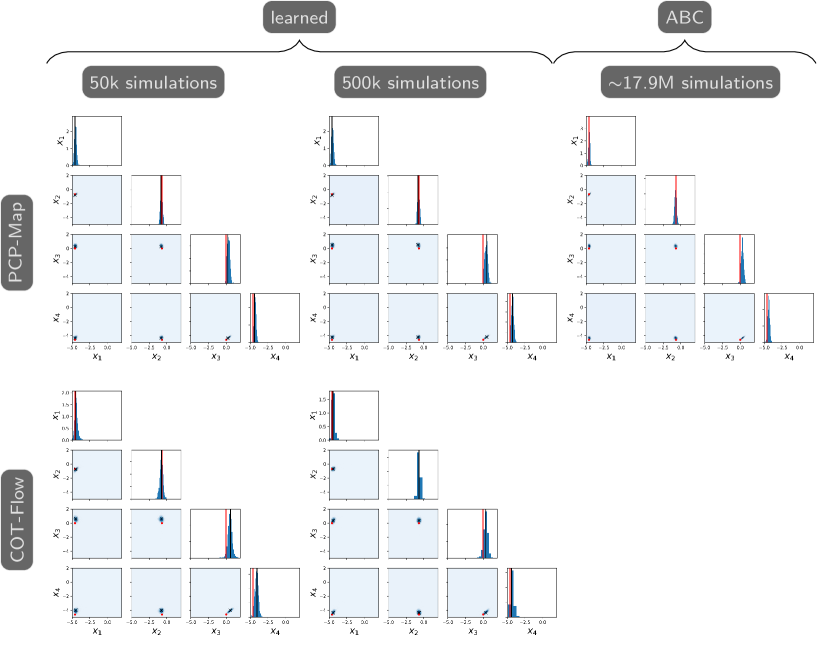
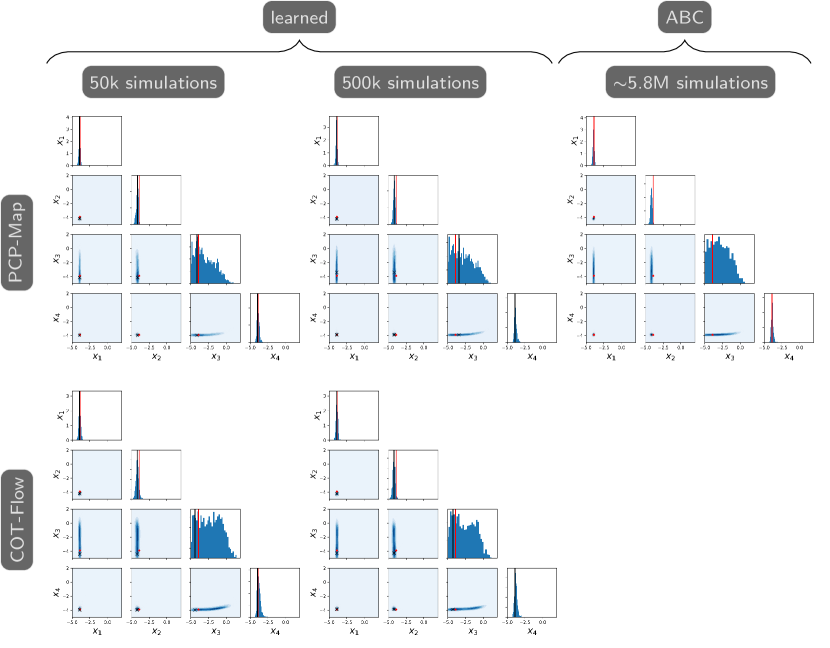
- The methods are applied to benchmark inverse problems, including stochastic Lotka-Volterra and 1D shallow water equations, with high-dimensional conditioning.
Experimental results
Research questions
- RQ1Can neural networks efficiently parameterize conditional optimal transport maps while preserving desirable theoretical properties like monotonicity and uniqueness?
- RQ2How do likelihood-based training of transport maps compare to adversarial training in terms of convergence speed and sample quality in Bayesian inference?
- RQ3What is the trade-off between training time and sampling speed in different COT formulations, particularly between static (PCP-Map) and dynamic (COT-Flow) approaches?
- RQ4To what extent can these methods scale to high-dimensional problems where traditional grid-based or polynomial approximations fail?
- RQ5How robust are the methods to hyperparameter choices, and can a simple heuristic improve configuration selection across diverse applications?
Key findings
- PCP-Map achieved convergence in approximately 715 seconds on a high-dimensional inverse problem with 14 effective parameters and 3,500 measurements.
- PCP-Map demonstrated faster convergence than the amortized CP-Flow method, despite being a static formulation.
- COT-Flow enabled faster sampling than PCP-Map due to ODE integration, especially after well-trained velocity fields were learned.
- Both methods outperformed SMC-ABC in numerical accuracy for the 1D shallow water equations problem, despite ABC’s strong theoretical guarantees.
- PCP-Map showed consistent performance across a wide range of hyperparameters (feature width, context width, depth), requiring only three key hyperparameters.
- The methods were effective in likelihood-free settings where prior or likelihood evaluations were intractable, demonstrating utility in real-world inverse problems involving SDEs or legacy code.
Read this paper
Open the full text in the Nubint reader and ask about any passage as you read.
Read this paper on NubintThis review was generated by AI from the original paper. Please check the paper before citing it.