
[Paper Review] EGNet:Edge Guidance Network for Salient Object Detection
EGNet models complementary salient edge information and salient object information within a single network, using a non-local edge features extractor and a one-to-one guidance fusion to improve boundary preservation and localization in salient object detection.
Fully convolutional neural networks (FCNs) have shown their advantages in the salient object detection task. However, most existing FCNs-based methods still suffer from coarse object boundaries. In this paper, to solve this problem, we focus on the complementarity between salient edge information and salient object information. Accordingly, we present an edge guidance network (EGNet) for salient object detection with three steps to simultaneously model these two kinds of complementary information in a single network. In the first step, we extract the salient object features by a progressive fusion way. In the second step, we integrate the local edge information and global location information to obtain the salient edge features. Finally, to sufficiently leverage these complementary features, we couple the same salient edge features with salient object features at various resolutions. Benefiting from the rich edge information and location information in salient edge features, the fused features can help locate salient objects, especially their boundaries more accurately. Experimental results demonstrate that the proposed method performs favorably against the state-of-the-art methods on six widely used datasets without any pre-processing and post-processing. The source code is available at http: //mmcheng.net/egnet/.
Motivation & Objective
- Motivate preserving salient object boundaries by leveraging edge cues and location information.
- Model two complementary information streams: salient object features and salient edge features.
- Develop a single network that fuses edge and object information via a one-to-one guidance mechanism.
Proposed method
- Extract multi-resolution salient object features using a U-Net-like progressive fusion with side paths and deep supervision.
- Introduce a non-local salient edge features module that fuses local edge cues with global location information through a top-down propagation scheme.
- Compute edge supervision with a dedicated cross-entropy loss for edge maps.
- Propose a one-to-one guidance module that fuses edge features with multi-resolution object features to produce refined saliency predictions.
- Train with joint losses from edge and object pathways, including deep supervision and a fused final map.
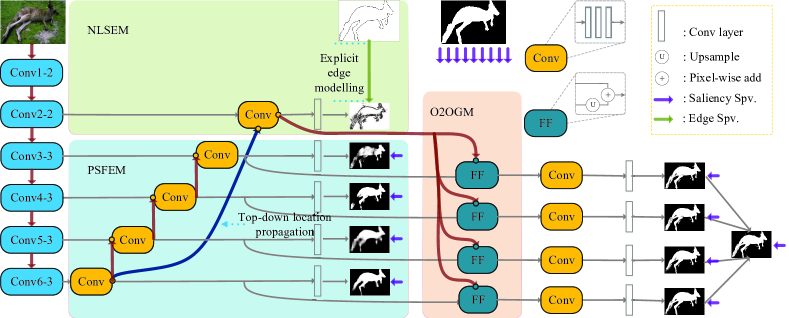
Experimental results
Research questions
- RQ1Can salient edge information and location information be effectively modeled and fused with salient object features in a single network?
- RQ2Does a one-to-one guidance fusion improve boundary accuracy and localization compared to baseline multi-scale fusion?
- RQ3How do edge cues influence saliency boundary sharpness and overall detection performance across standard benchmarks?
Key findings
- EGNet achieves state-of-the-art performance on six datasets across multiple metrics without pre- or post-processing.
- Explicit modeling and mutual guidance between edge and object features improves boundary quality and localization.
- Top-down location propagation and one-to-one guidance yield significant gains over edge-only or simple fusion strategies.
- Edge-guided features produce sharper object boundaries and better saliency maps compared to NLDF-style edge penalties.
- Ablation studies show the proposed components (edge propagation, one-to-one fusion) contribute substantial improvements over baselines.
Read this paper
Open the full text in the Nubint reader and ask about any passage as you read.
Read this paper on NubintThis review was generated by AI from the original paper. Please check the paper before citing it.