
[Paper Review] EgoDistill: Egocentric Head Motion Distillation for Efficient Video Understanding
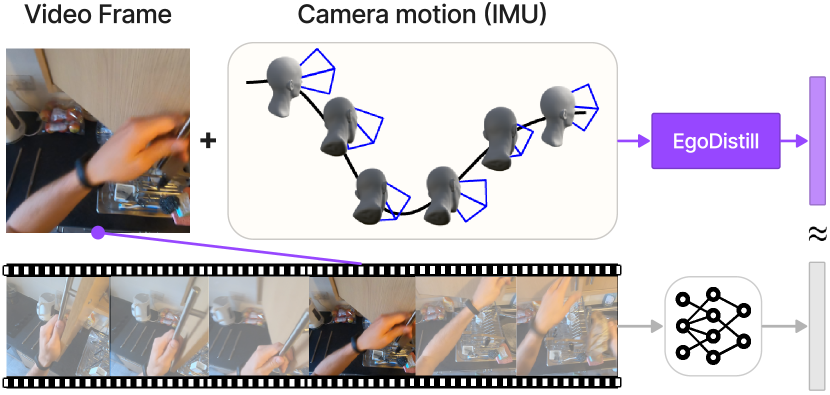
EgoDistill proposes a knowledge distillation framework that reconstructs expensive egocentric video clip features using only a single RGB frame and lightweight IMU head motion data, achieving 200× fewer GFLOPs than baseline models while outperforming state-of-the-art efficient video understanding methods on Ego4D and EPIC-Kitchens.
Recent advances in egocentric video understanding models are promising, but their heavy computational expense is a barrier for many real-world applications. To address this challenge, we propose EgoDistill, a distillation-based approach that learns to reconstruct heavy egocentric video clip features by combining the semantics from a sparse set of video frames with the head motion from lightweight IMU readings. We further devise a novel self-supervised training strategy for IMU feature learning. Our method leads to significant improvements in efficiency, requiring 200x fewer GFLOPs than equivalent video models. We demonstrate its effectiveness on the Ego4D and EPICKitchens datasets, where our method outperforms state-of-the-art efficient video understanding methods.
Motivation & Objective
- Address the high computational cost of state-of-the-art egocentric video understanding models, which limits deployment on resource-constrained AR/VR devices.
- Explore whether head motion signals from IMUs can serve as a proxy for dense video frame dynamics to reduce model inference cost.
- Develop a distillation-based method that leverages IMU and sparse visual frames to reconstruct full video clip features from heavy video models.
- Improve IMU feature learning through a novel self-supervised pre-training strategy to enhance downstream video understanding performance.
- Achieve a better accuracy-efficiency trade-off than existing methods that adaptively sample video frames.
Proposed method
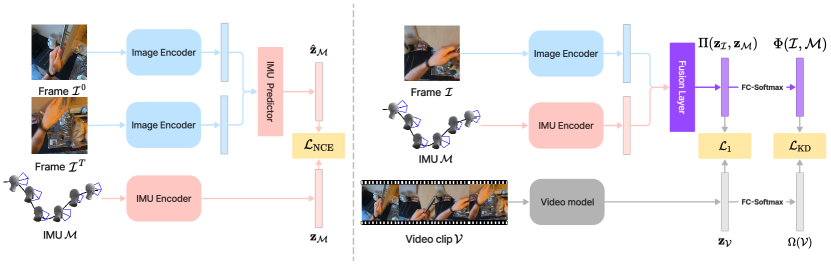
- Train a lightweight student model to reconstruct dense video clip features from a single RGB frame and temporally sparse IMU readings, using knowledge distillation from a powerful teacher video model.
- Use a novel self-supervised pre-training stage for IMU features to improve their representational quality before distillation.
- Condition the distillation process on both visual semantics from sparse frames and motion dynamics from IMU to preserve both appearance and motion information.
- Apply knowledge distillation with a contrastive loss to align the student’s output features with the teacher’s dense clip-level representations.
- Design the student model to be end-to-end trainable and efficient, enabling real-time inference on low-resource devices.
- Utilize IMU data not as a modality for fusion, but as a dynamic signal that enables reconstruction of motion-aware video features from minimal visual input.
Experimental results
Research questions
- RQ1Can IMU data effectively substitute for dense video frames in reconstructing complex egocentric video features?
- RQ2Does combining sparse visual frames with IMU signals lead to better video feature reconstruction than using visual frames alone?
- RQ3Can a self-supervised pre-training strategy for IMU improve the performance of distillation-based video understanding models?
- RQ4To what extent does EgoDistill reduce computational cost while maintaining or improving accuracy compared to state-of-the-art efficient video models?
- RQ5In which types of egocentric actions does IMU-based distillation provide the greatest performance gain?
Key findings
- EgoDistill reduces inference GFLOPs by 200× compared to the original MotionFormer model, achieving 200× higher efficiency.
- For a 50-minute egocentric video, EgoDistill reduces inference time from 25 minutes to 36 seconds, demonstrating real-time feasibility.
- On EPIC-Kitchens, EgoDistill achieves 4.4% higher accuracy than STTS while running 6.5× faster, outperforming state-of-the-art adaptive sampling methods.
- EgoDistill improves action recognition accuracy by 20.3% on ambiguous actions like 'close' and 10.4% on 'put' by leveraging IMU to disambiguate scene motion.
- The model performs best on actions with predictable head motion (e.g., 'cut', 'close') and worse on actions with minimal or uncorrelated head motion (e.g., 'press', 'fill').
- Qualitative results show that EgoDistill generates distinct, motion-aware features conditioned on IMU, enabling retrieval of clips with consistent camera motion, unlike models using only visual frames.
Read this paper
Open the full text in the Nubint reader and ask about any passage as you read.
Read this paper on NubintThis review was generated by AI from the original paper. Please check the paper before citing it.