
[Paper Review] Elastic Decision Transformer
Elastic Decision Transformer (EDT) enhances Decision Transformers by dynamically adjusting the history length during inference to enable trajectory stitching—selecting shorter histories for sub-optimal paths and longer ones for optimal paths. This approach improves sequence generation and outperforms both DT and Q-learning-based methods on D4RL and Atari benchmarks by learning better policies from sub-optimal demonstrations.
This paper introduces Elastic Decision Transformer (EDT), a significant advancement over the existing Decision Transformer (DT) and its variants. Although DT purports to generate an optimal trajectory, empirical evidence suggests it struggles with trajectory stitching, a process involving the generation of an optimal or near-optimal trajectory from the best parts of a set of sub-optimal trajectories. The proposed EDT differentiates itself by facilitating trajectory stitching during action inference at test time, achieved by adjusting the history length maintained in DT. Further, the EDT optimizes the trajectory by retaining a longer history when the previous trajectory is optimal and a shorter one when it is sub-optimal, enabling it to "stitch" with a more optimal trajectory. Extensive experimentation demonstrates EDT's ability to bridge the performance gap between DT-based and Q Learning-based approaches. In particular, the EDT outperforms Q Learning-based methods in a multi-task regime on the D4RL locomotion benchmark and Atari games. Videos are available at: https://kristery.github.io/edt/
Motivation & Objective
- To address the limitation of Decision Transformers in trajectory stitching, where optimal trajectories cannot be formed from sub-optimal demonstrations.
- To enable better decision-making in offline reinforcement learning by adapting the history length based on trajectory quality.
- To improve performance in multi-task offline RL settings by leveraging variable-length history inputs.
- To develop a computationally efficient method that enhances Decision Transformers without requiring major architectural changes.
Proposed method
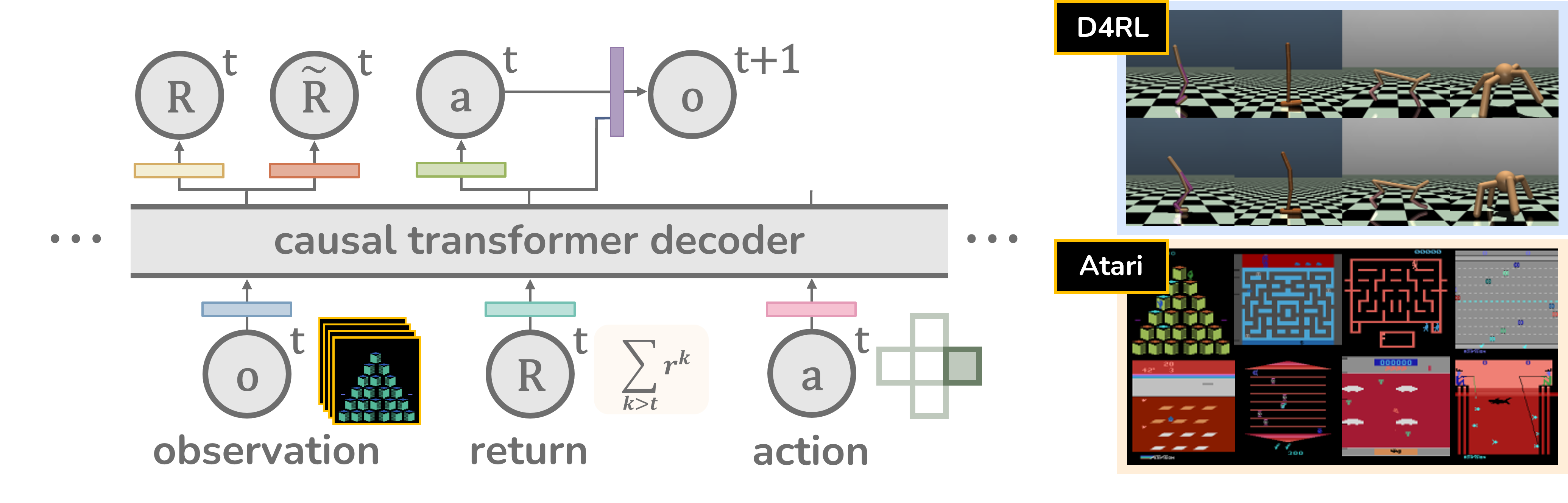
- EDT uses expectile regression to estimate the maximum achievable return for different history lengths, identifying the optimal history length at inference time.
- The model selects the history length that maximizes the estimated return, allowing it to 'refresh' its context when encountering sub-optimal trajectories.
- For sub-optimal paths, a shorter history is used to reduce influence from poor past actions, increasing exploration potential.
- For optimal paths, a longer history is retained to maintain stability and consistency in action prediction.
- The method integrates seamlessly with existing Decision Transformer frameworks, adding minimal computational overhead.
- The approach enables trajectory stitching by allowing the model to switch to more favorable future trajectories when the current path is sub-optimal.
Experimental results
Research questions
- RQ1Can a dynamic history length in Decision Transformers enable effective trajectory stitching from sub-optimal demonstrations?
- RQ2How does varying the history length based on trajectory quality affect policy performance in offline reinforcement learning?
- RQ3Can a learnable history length mechanism outperform fixed-length history approaches in multi-task offline RL?
- RQ4Does the proposed method improve performance on standard benchmarks like D4RL and Atari compared to Q-learning-based and standard DT approaches?
Key findings
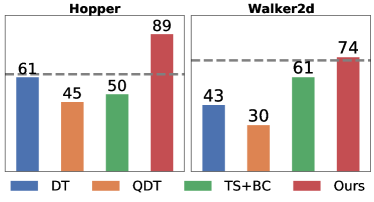
- EDT outperforms Q-learning-based methods on the D4RL locomotion benchmark in multi-task settings, demonstrating superior sample efficiency and policy quality.
- On Atari games, EDT achieves state-of-the-art performance among offline RL methods, surpassing both DT and Q-learning baselines.
- The method successfully enables trajectory stitching, allowing the agent to combine better segments from sub-optimal trajectories to form superior overall trajectories.
- EDT improves performance across diverse environments by dynamically selecting the optimal history length based on value function estimates.
- The computational overhead introduced by EDT is minimal, making it practical for integration with existing DT variants.
- Empirical results show that EDT significantly enhances the performance of standard Decision Transformers, especially in complex, multi-task offline RL regimes.
Read this paper
Open the full text in the Nubint reader and ask about any passage as you read.
Read this paper on NubintThis review was generated by AI from the original paper. Please check the paper before citing it.