
[Paper Review] Electric Vehicle E-hailing Fleet Dispatching and Charge Scheduling
The paper proposes a probabilistic matching framework for central dispatch of a fully electrified e-hailing fleet, incorporating charge scheduling and driver compliance incentives to maximize expected profits.
With recent developments in vehicle and battery technologies, electric vehicles (EVs) are rapidly getting established as a sustainable alternative to traditional fossil-fuel vehicles. This has made the large-scale electrification of ride-sourcing operations a practical viability, providing an opportunity for a leap toward urban sustainability goals. Despite having a similar driving range to fossil-fuel vehicles, EVs are disadvantaged by their long charging times which compromises the total fleet service time. To efficiently manage an EV fleet, the operator needs to address the charge scheduling problem as part of the dispatch strategy. This paper introduces a probabilistic matching method which evaluates the optimal trip and charging decisions for a fully electrified e-hailing fleet, with the goal of maximising the operator's expected market profit. In the midst of the technological transition towards autonomous vehicles, it is also critical to include stochastic driver behaviours in transport models as presented in this paper. Since drivers may either comply with trip dispatching or choose to reject a charging trip order considering the additional fees, contrary to the commonly assumed fleet autonomy, the proposed method designs an incentivisation scheme (charging discounts) to encourage driver compliance so that the planned charging trips and the associated profit can be realised.
Motivation & Objective
- Motivate and address large-scale EV adoption in ride-sourcing by integrating dispatch and charge scheduling.
- Develop a centralized probabilistic matching method that accounts for dynamic demand, charging times, and driver behaviour.
- Design an incentivisation policy (charging discounts) to improve driver compliance with charging trips.
- Incorporate stochastic driver behaviour and passenger cancellations into the fleet management model.
Proposed method
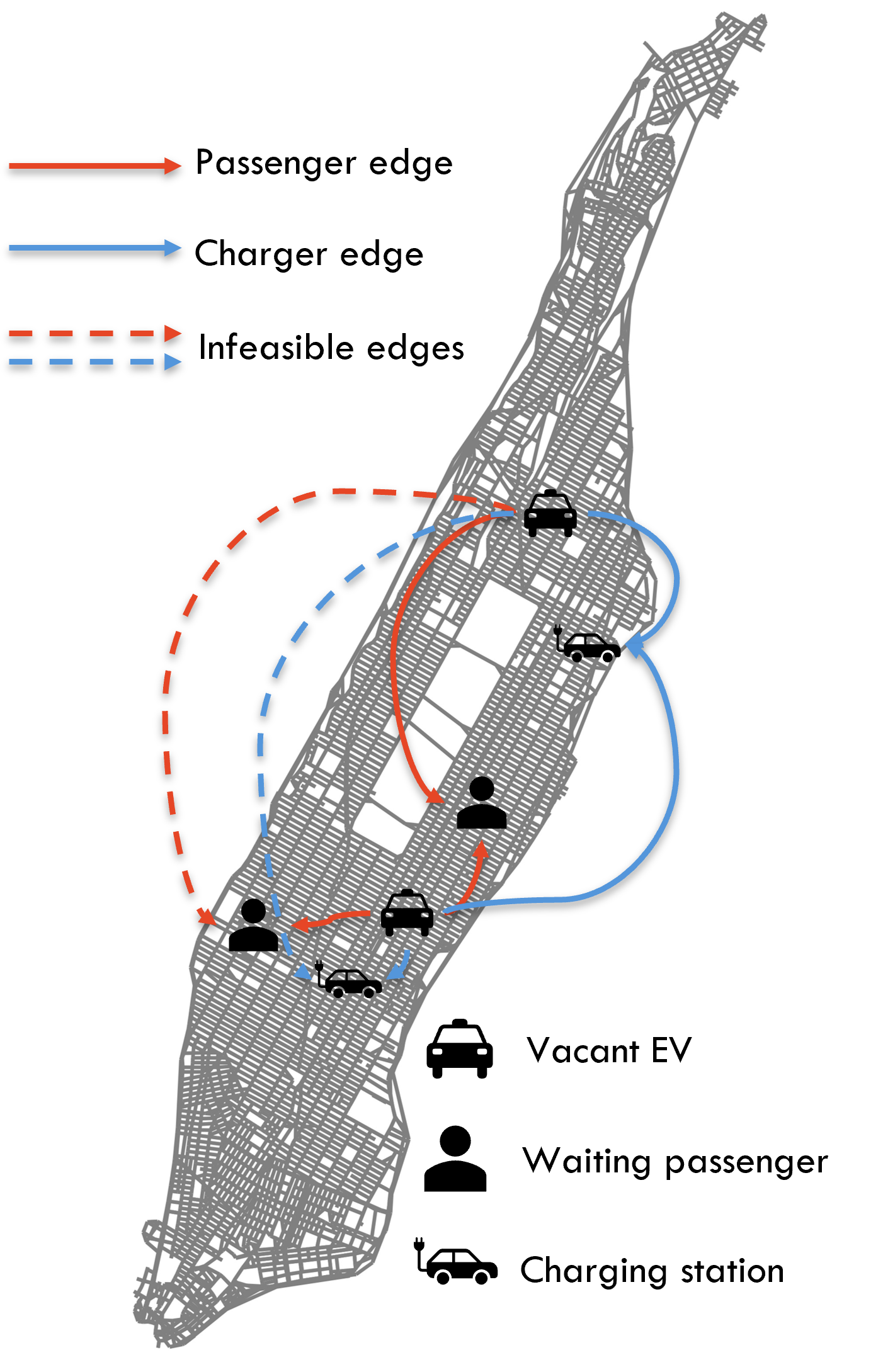
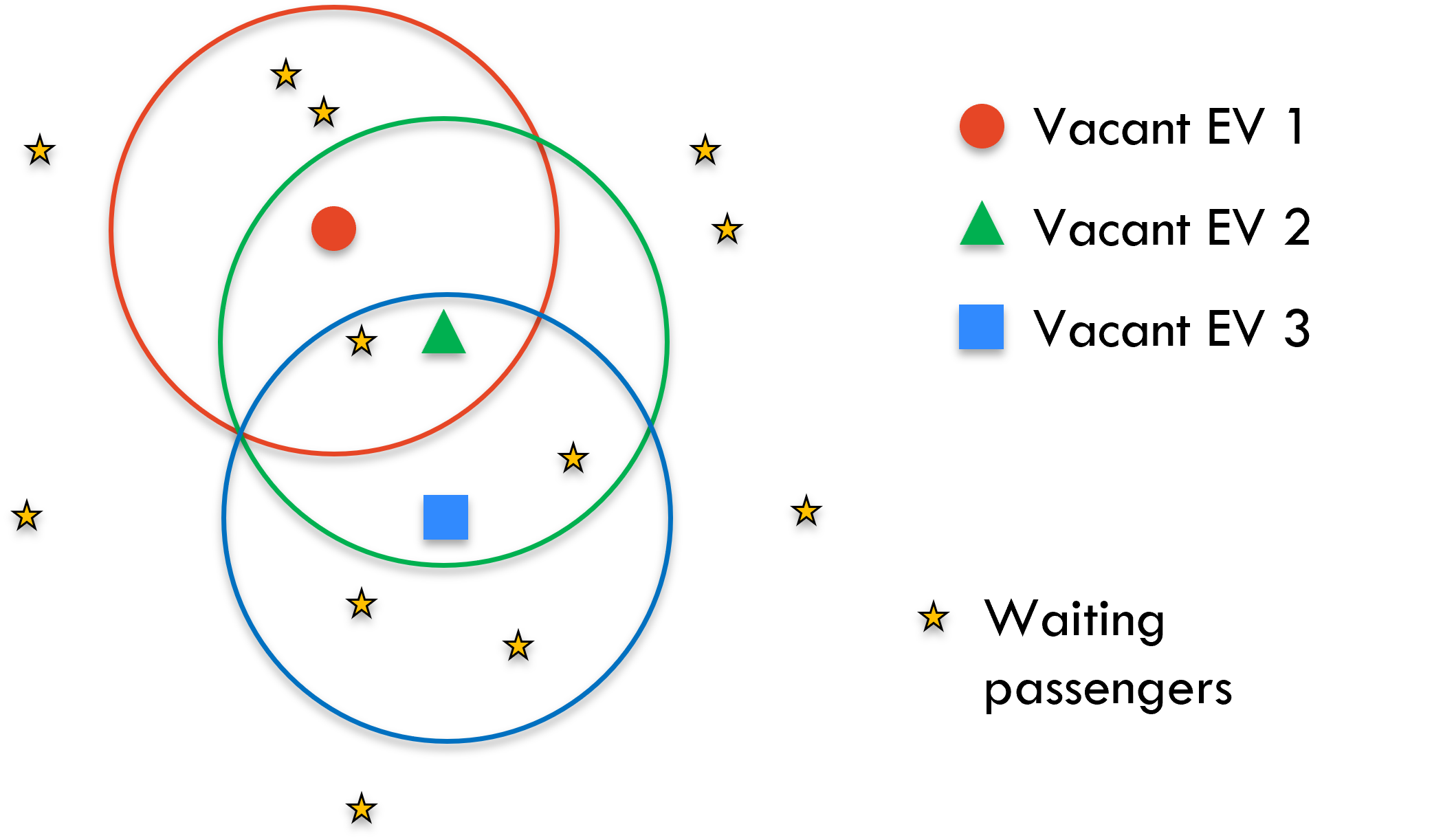
- Define a batch matching framework at discrete intervals to pair vacant EVs with waiting passengers or chargers within SoC limits.
- Quantify expected benefits from dispatch options considering monetary profit, service quality, and marginal value of charge (rho_e).
- Model dynamic charging prices and discounts to compute driver compliance for charging trips; use a two-step optimization (incentive design then bipartite matching).
- Compute marginal value of charge rho_e via local zone-based profit baselines and future demand/supply predictions.
- Incorporate passenger cancellation and driver shift/exit behaviours to reflect realistic market dynamics.
Experimental results
Research questions
- RQ1How can a centralized probabilistic matching framework maximize the e-hailing TNC's expected profits under EV charge scheduling constraints?
- RQ2How should charging incentives be designed to maximize driver compliance and overall dispatch profitability under stochastic driver and passenger behaviours?
- RQ3What is the impact of SoC dynamics and charging times on optimal dispatch decisions and service quality?
- RQ4How can marginal value of charge in local zones be estimated and used to inform matching decisions?
- RQ5What behavioural models (passenger cancellations, driver compliance, shifts) influence the performance of the proposed method?
Key findings
- A probabilistic matching approach can incorporate charging decisions and driver compliance to improve expected profits.
- Charging incentives (discounts) influence driver compliance and can be optimized in a two-step process to support the matching solution.
- The model accounts for passenger waiting and pickup times, and the marginal value of fleet SoC to capture future profitability.
- A local marginal value of charge rho_e is computed per vehicle-zone to guide dispatching and charging decisions.
- Simulation setup uses Manhattan network with EVs, charging stations, and realistic passenger patience to validate the method.
Read this paper
Open the full text in the Nubint reader and ask about any passage as you read.
Read this paper on NubintThis review was generated by AI from the original paper. Please check the paper before citing it.