
[Paper Review] Electromagnetic Information Theory: Fundamentals, Modeling, Applications, and Open Problems
This paper introduces Electromagnetic Information Theory (EIT) to unify electromagnetic field physics with information theory, enabling accurate modeling of spatially continuous, correlated, and non-monochromatic wireless channels. By leveraging random fields, degrees of freedom, and mutual information analysis in continuous EM fields, EIT reveals that massive MIMO systems overestimate capacity due to non-physical assumptions, and proposes new architectures like CAP-MIMO and LDMA to achieve higher spectral efficiency.
Traditional massive multiple-input multiple-output (MIMO) information theory adopt non-physically consistent assumptions, including white-noised, scalar-quantity, far-field, discretized, and monochromatic EM fields, which mismatch the nature of the underlying electromagnetic (EM) fields supporting the physical layer of wireless communication systems. To incorporate EM laws into designing procedures of the physical layer, we first propose the novel concept of EM physical layer, whose backbone theory is called EM information theory (EIT). In this article, we systematically investigate the basic ideas and main results of EIT. First, we review the fundamental analytical tools of classical information theory and EM theory. Then, we introduce the modeling and analysis methodologies of EIT, including continuous field modeling, degrees of freedom, and mutual information analyses. Several EIT-inspired applications are discussed to illustrate how EIT guides the design of practical wireless systems. Finally, we point out the open problems of EIT, where further research efforts are required for EIT to construct a unified interdisciplinary theory.
Motivation & Objective
- To address the fundamental mismatch in traditional massive MIMO theory, which relies on non-physically consistent assumptions such as white, uncorrelated, far-field, and monochromatic EM fields.
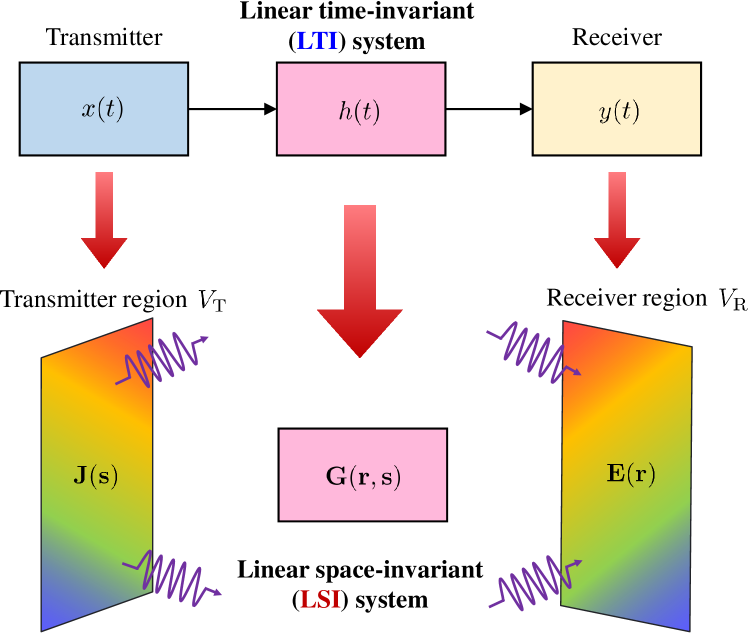
- To develop a unified theoretical framework—Electromagnetic Information Theory (EIT)—that integrates Maxwell’s equations with information-theoretic principles for physically consistent wireless system design.
- To model electromagnetic channels and noise using continuous random fields, enabling accurate degrees of freedom and mutual information analysis in spatially continuous systems.
- To propose new physical-layer architectures such as continuous-aperture MIMO (CAP-MIMO) and location division multiple access (LDMA) that exploit EIT-predicted spatial degrees of freedom.
- To identify and clarify open problems in EIT, including analog/digital signal processing challenges, compatible noise modeling, and the operational definition of EM capacity.
Proposed method
- Introduces random fields as the foundational mathematical tool to unify probabilistic information theory with deterministic electromagnetic field theory.
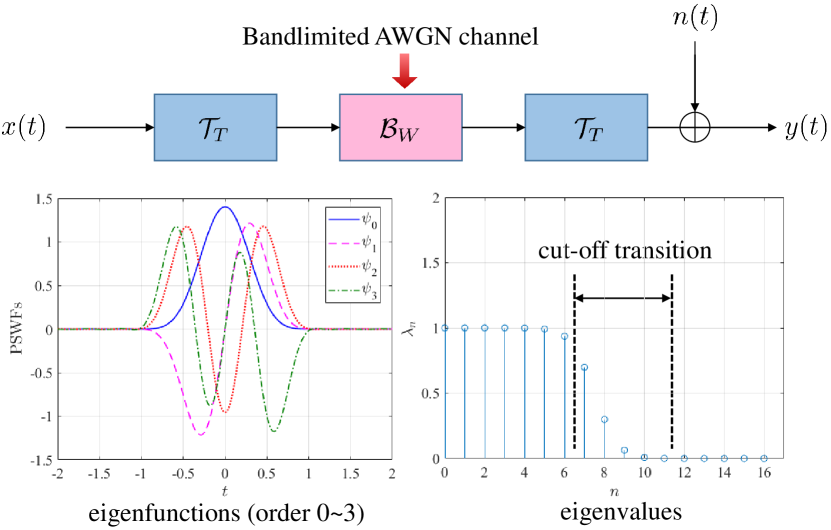
- Applies prolate spheroidal wave functions (PSWFs) and Karhunen-Loève expansion to model and decompose continuous EM fields and their degrees of freedom.
- Derives degrees of freedom (DoF) and mutual information for continuous EM channels using solutions to Maxwell’s equations under bounded aperture constraints.
- Models EM noise based on physical origins (e.g., thermal, shot, quantum) and analyzes their spatial correlation to prevent capacity divergence in dense systems.
- Proposes CAP-MIMO as a transceiver architecture with fully continuous aperture to harvest all spatial DoF predicted by EIT.
- Introduces LDMA as a new multiple access scheme that exploits spatial location as a multiple access dimension, enabled by EIT’s prediction of extra DoF.
Experimental results
Research questions
- RQ1How can electromagnetic field laws be consistently integrated into information-theoretic capacity analysis to replace non-physical assumptions in massive MIMO?
- RQ2What is the correct model for electromagnetic noise in dense, continuous-aperture systems that prevents unbounded capacity growth?
- RQ3How do degrees of freedom in continuous EM fields differ from those in discrete MIMO, and what is their impact on system capacity?
- RQ4Can new physical-layer architectures like CAP-MIMO and LDMA be designed based on EIT to achieve higher spectral efficiency than conventional MIMO?
- RQ5What are the fundamental open problems in defining and evaluating the true electromagnetic capacity in continuous waveform channels?
Key findings
- Traditional massive MIMO theory overestimates capacity because it assumes uncorrelated, white, and far-field noise, which breaks down in ultradense systems due to EM mutual coupling and thermal fluctuation.
- The assumption of i.i.d. thermal noise leads to a mathematical divergence of end-to-end capacity in dense MIMO as the number of antennas increases, violating energy conservation.
- A correlated noise model with a small spatial coherence length is required to ensure finite EIT capacity, bridging macro-scale and micro-scale noise physics.
- EIT predicts extra spatial degrees of freedom in continuous-aperture systems, enabling new architectures like CAP-MIMO that fully exploit these DoF for higher capacity.
- The proposed LDMA scheme uses spatial location as a multiple access dimension, offering a new way to enhance multi-user capacity beyond conventional multiple access schemes.
- The operational EM capacity remains an open problem, as current EIT mutual information values are upper bounds and not yet operationally achievable under general conditions.
Read this paper
Open the full text in the Nubint reader and ask about any passage as you read.
Read this paper on NubintThis review was generated by AI from the original paper. Please check the paper before citing it.