
[Paper Review] Electromagnetic Scattering at an Arbitrarily Accelerated Interface
This paper presents a general analytical solution for electromagnetic scattering at a one-dimensional, arbitrarily accelerated interface in the subluminal regime, leveraging relativistic spacetime formalism to derive scattering coefficients that inherently produce controllable chirping. The key contribution is a synthesis method to design the interface trajectory for arbitrary chirp profiles, enabling tailored wavefront modulation in microwave and optical devices using space-time engineered metamaterials without moving parts.
We present a general analytical solution to the problem of electromagnetic scattering at a one-dimensional arbitrarily accelerated space-time engineered-modulation (ASTEM) interface in the subluminal regime. We show that such an interface fundamentally produces chirping, whose profile can be designed according to specifications. This work represents an important step in the development of ASTEM crystals and holds significant potential for applications in microwave and optical devices reliant on chirp-based functionalities.
Motivation & Objective
- To develop a general analytical framework for electromagnetic scattering at a one-dimensional, arbitrarily accelerated interface in the subluminal regime.
- To extend prior work on uniformly accelerated or uniformly modulated space-time engineered metamaterials (STEMs) to non-uniform acceleration.
- To enable the design of interface trajectories that produce specific, arbitrary chirp profiles in scattered electromagnetic waves.
- To provide a synthesis method linking desired chirp specifications to the required velocity and trajectory of the interface.
- To demonstrate the feasibility of creating complex wavefront shaping in dynamic, non-moving metamaterials using relativistic electrodynamics.
Proposed method
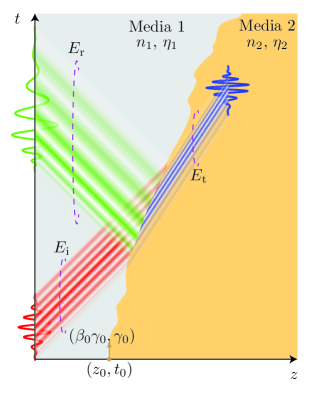
- The problem is analyzed using a frame-hopping strategy, transforming fields to the comoving frame of the interface, applying stationary boundary conditions, and transforming back to the lab frame.
- The scattering coefficients are derived in terms of the interface's velocity β(t), which is determined by the proper acceleration a(τ) and initial conditions (z₀, t₀, β₀, γ₀).
- The solution expresses the reflected and transmitted waves as nonlinearly modulated functions of time, with phase arguments depending on the relativistic Doppler shift and impedance mismatch.
- The key equation (2c) computes β(t) as a function of time, integrating the proper acceleration over time and accounting for relativistic velocity addition.
- For synthesis, the inverse problem is solved by equating the phase evolution of the transmitted wave to a desired chirp profile, leading to Eq. (4) for β(t).
- The interface trajectory z(t) is then obtained by integrating β(t), as shown in Eq. (6) for a linear chirp case.
Experimental results
Research questions
- RQ1Can a general analytical solution be derived for electromagnetic scattering at an arbitrarily accelerated interface in the subluminal regime?
- RQ2How does non-uniform acceleration affect the chirping of scattered electromagnetic waves?
- RQ3What is the inverse relationship between a desired chirp profile and the required interface trajectory?
- RQ4Can the interface motion be designed to produce arbitrary, user-specified chirp waveforms in the transmitted or reflected waves?
- RQ5To what extent can relativistic electrodynamics be used to model and synthesize dynamic, non-moving electromagnetic interfaces with tailored wavefront responses?
Key findings
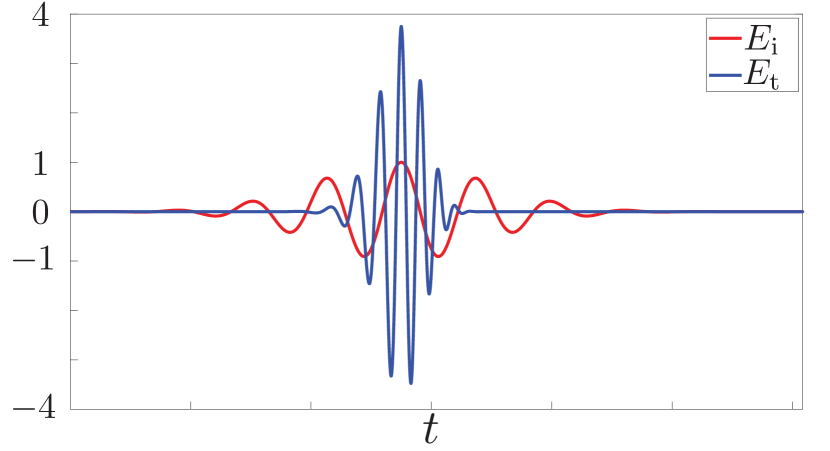
- The scattered waves exhibit intrinsic chirping due to the nonlinear time dependence of the phase arguments in the reflected and transmitted wave expressions.
- The scattering coefficients depend on the interface's instantaneous velocity β(t), which is derived from the proper acceleration and initial conditions via relativistic velocity addition.
- A synthesis method is established that allows the design of the interface trajectory to produce any specified chirp profile, such as a linear upward chirp with parameter a=5.
- For a linear chirp φ(t) = a t² / α², the resulting interface trajectory is given by Eq. (6), which features a logarithmic dependence on time and is physically realizable.
- The method is general and applicable to chirp profiles of arbitrary complexity, not limited to linear chirps.
- The solution does not require explicit coordinate transformations, as the scattering coefficients depend only on ratios of partial derivatives of the transformation, simplifying the derivation.
Read this paper
Open the full text in the Nubint reader and ask about any passage as you read.
Read this paper on NubintThis review was generated by AI from the original paper. Please check the paper before citing it.