
[Paper Review] Elucidating STEM Concepts through Generative AI: A Multi-modal Exploration of Analogical Reasoning
The paper proposes an AI-driven multimodal system that generates analogies and visual storyboards from STEM concepts using GPT-4, producing animated videos to enhance understanding and engagement, with preliminary, non-empirical testing.
This study explores the integration of generative artificial intelligence (AI), specifically large language models, with multi-modal analogical reasoning as an innovative approach to enhance science, technology, engineering, and mathematics (STEM) education. We have developed a novel system that utilizes the capacities of generative AI to transform intricate principles in mathematics, physics, and programming into comprehensible metaphors. To further augment the educational experience, these metaphors are subsequently converted into visual form. Our study aims to enhance the learners' understanding of STEM concepts and their learning engagement by using the visual metaphors. We examine the efficacy of our system via a randomized A/B/C test, assessing learning gains and motivation shifts among the learners. Our study demonstrates the potential of applying large language models to educational practice on STEM subjects. The results will shed light on the design of educational system in terms of harnessing AI's potential to empower educational stakeholders.
Motivation & Objective
- Motivate and address challenges in teaching abstract STEM concepts through analogies and visuals.
- Develop a system that automatically generates intuitive analogies from STEM concepts.
- Transform selected analogies into visual storyboards and animated videos to support learning.
- Ground the approach in multimedia learning theories to enhance comprehension and engagement.
Proposed method
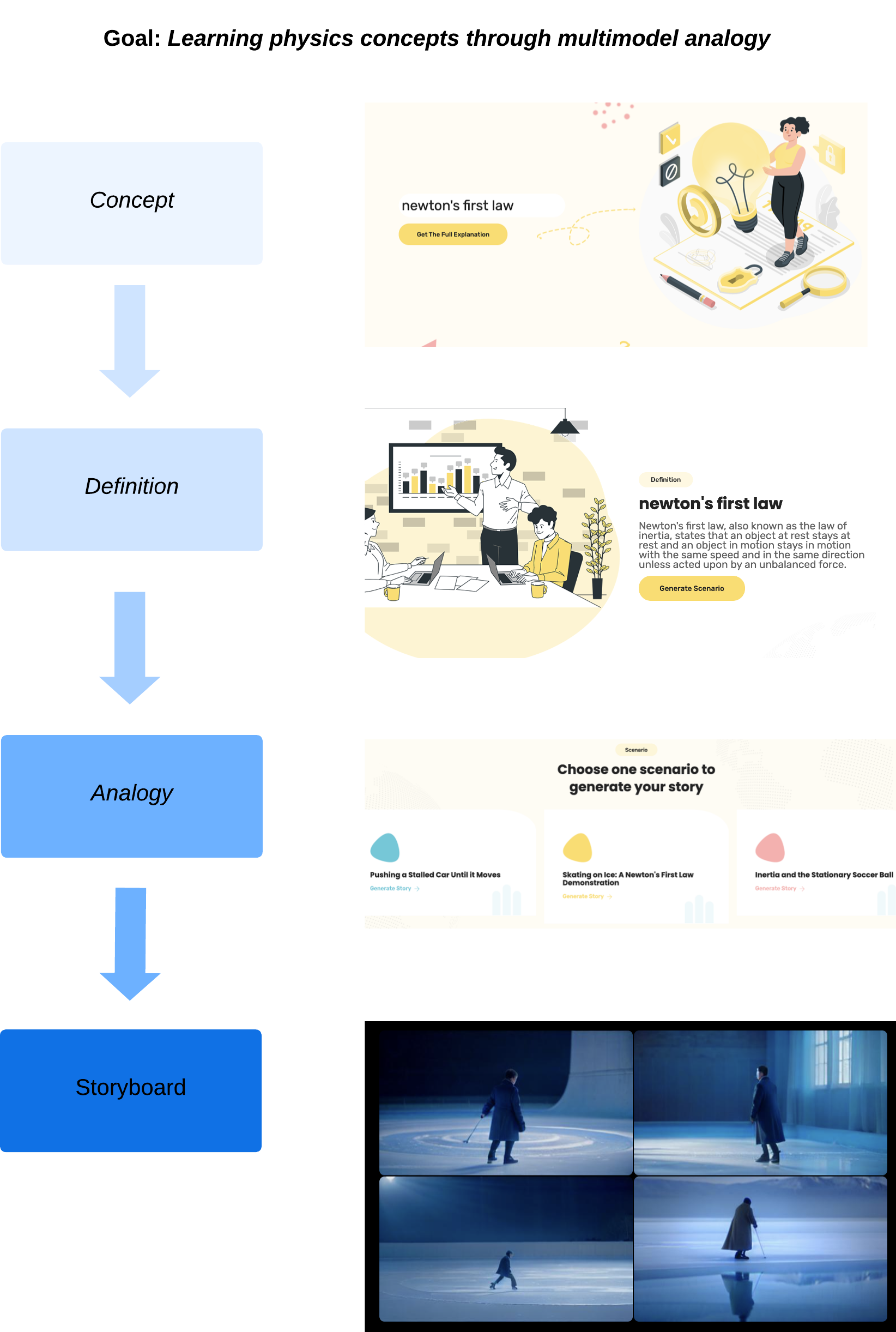
- Use GPT-4 to generate three analogies for a given STEM concept.
- Create a narrative from the chosen analogy to form a storyboard of four images with descriptions.
- Convert storyboard visuals into an animated instructional video.
- Anchor the design in Mayer’s multimedia learning theory, Paivio’s dual coding theory, and Piagetian constructivism.
Experimental results
Research questions
- RQ1How effectively can AI-generated analogies help learners understand complex STEM concepts?
- RQ2Can a multimodal pipeline (text analogies → visual storyboard → animation) improve comprehension and engagement?
- RQ3What are the practical challenges in generating accurate and comprehensive visual representations of analogies?
- RQ4Does the approach align with established multimedia learning and cognitive theories in practice?
Key findings
- Preliminary content generation shows GPT-4 can produce informative text analogies for STEM topics.
- Visual analogue generation faces challenges in depicting all components of multi-part concepts.
- Dynamic visual analogies are feasible but pose difficulty in designing meaningful transitions.
- The authors identify the need for learner-based empirical studies to assess learning outcomes and engagement.
- The prototype demonstrates potential for expanding multimodal AI-assisted pedagogy beyond computer science.
Read this paper
Open the full text in the Nubint reader and ask about any passage as you read.
Read this paper on NubintThis review was generated by AI from the original paper. Please check the paper before citing it.