
[Paper Review] Embedding Transfer with Label Relaxation for Improved Metric Learning
This paper proposes a novel embedding transfer method that leverages pairwise similarities from a source embedding space as relaxed labels to train target models via a relaxed contrastive loss. By incorporating detailed inter-sample relations and emphasizing important pairs, the method significantly improves metric learning performance, reduces model size and dimensionality, and enhances self-supervised and classification models beyond existing techniques.
This paper presents a novel method for embedding transfer, a task of transferring knowledge of a learned embedding model to another. Our method exploits pairwise similarities between samples in the source embedding space as the knowledge, and transfers them through a loss used for learning target embedding models. To this end, we design a new loss called relaxed contrastive loss, which employs the pairwise similarities as relaxed labels for inter-sample relations. Our loss provides a rich supervisory signal beyond class equivalence, enables more important pairs to contribute more to training, and imposes no restriction on manifolds of target embedding spaces. Experiments on metric learning benchmarks demonstrate that our method largely improves performance, or reduces sizes and output dimensions of target models effectively. We further show that it can be also used to enhance quality of self-supervised representation and performance of classification models. In all the experiments, our method clearly outperforms existing embedding transfer techniques.
Motivation & Objective
- To improve metric learning performance by transferring knowledge from a pre-trained source embedding model to a target model.
- To overcome limitations of existing embedding transfer methods that treat all samples equally or use only binary class labels.
- To enable effective knowledge distillation in metric learning by utilizing rich, continuous pairwise similarities as supervisory signals.
- To reduce target model size and embedding dimension without significant performance loss.
- To demonstrate universality by enhancing self-supervised representations and classification models.
Proposed method
- The method transfers knowledge from a source embedding model by extracting pairwise similarities between samples in the source space.
- It introduces a relaxed contrastive loss that uses these pairwise similarities as 'relaxed labels' to guide training of the target model.
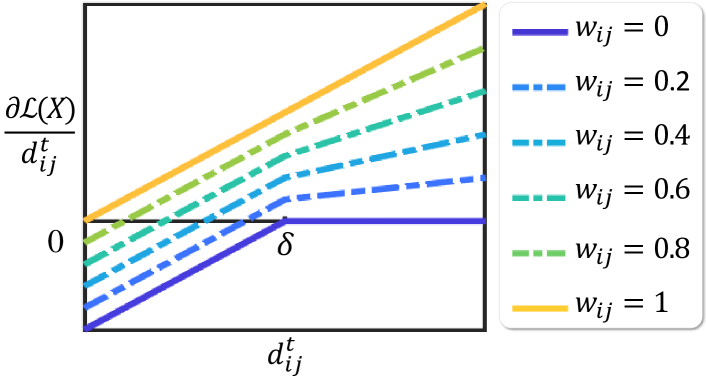
- The loss dynamically adjusts the strength of positive and negative pair optimization based on the similarity values, allowing more important pairs to contribute more.
- Unlike standard contrastive loss, it does not require $\ell_2$ normalization of the target embedding space, enabling more flexible and efficient use of embedding dimensions.
- The loss is designed to be compatible with standard training protocols, using the same optimizer and learning rate schedule as the source model.
- The method is applied in three settings: metric learning, self-supervised representation learning, and knowledge distillation for classification.
Experimental results
Research questions
- RQ1Can pairwise similarities in a source embedding space serve as a richer supervisory signal than binary class labels for embedding transfer?
- RQ2Does emphasizing more semantically meaningful sample pairs improve target model performance in metric learning?
- RQ3Can the relaxed contrastive loss effectively transfer knowledge without constraining the target embedding space manifold?
- RQ4To what extent can this method compress embedding models while preserving or improving performance?
- RQ5Can the method enhance self-supervised and classification models beyond metric learning tasks?
Key findings
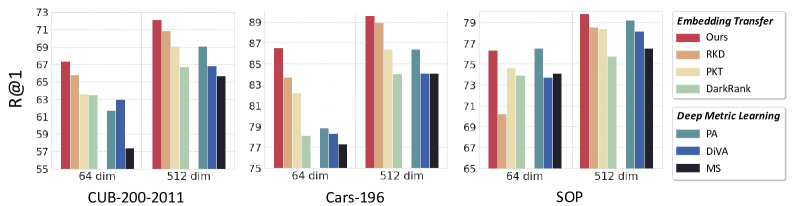
- On standard metric learning benchmarks, the proposed method achieves state-of-the-art performance with 512-dimensional embeddings, outperforming existing transfer techniques.
- When compressing models (e.g., ResNet56 to ResNet20), the method reduces model size and embedding dimension with only a negligible drop in performance.
- In self-supervised learning, the method improves linear evaluation accuracy to 93.9 on CIFAR-10 and 89.6 on STL-10, surpassing PKT and RKD.
- In classification model distillation on CIFAR-100, the method achieves 71.95% accuracy with ResNet20, outperforming CRD and HKD.
- The method consistently outperforms existing embedding transfer techniques across all evaluated settings, including metric learning, self-supervised learning, and classification.
- The relaxed contrastive loss enables effective knowledge transfer without requiring $\ell_2$ normalization, leading to better utilization of embedding dimensions.
Read this paper
Open the full text in the Nubint reader and ask about any passage as you read.
Read this paper on NubintThis review was generated by AI from the original paper. Please check the paper before citing it.