
[Paper Review] EmbodiedGPT: Vision-Language Pre-Training via Embodied Chain of Thought
EmbodiedGPT is an end-to-end 10B-parameter multi-modal foundation model for embodied AI that uses EgoCOT to train chain-of-thought planning and closes the loop from high-level planning to low-level control, achieving state-of-the-art or comparable results on embodied tasks.
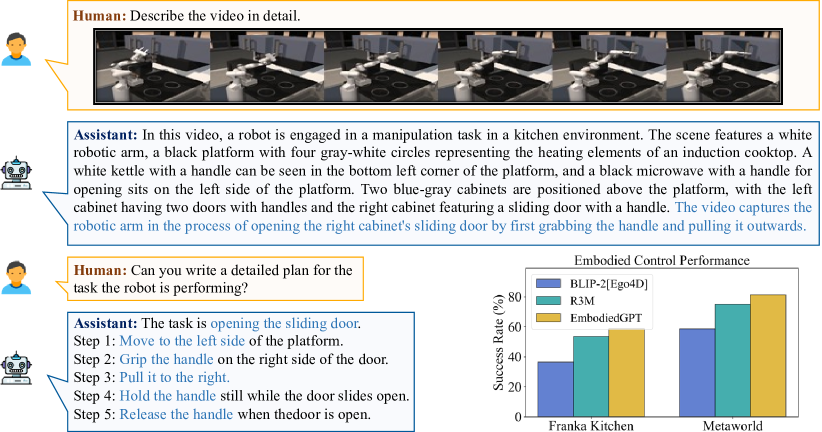
Embodied AI is a crucial frontier in robotics, capable of planning and executing action sequences for robots to accomplish long-horizon tasks in physical environments. In this work, we introduce EmbodiedGPT, an end-to-end multi-modal foundation model for embodied AI, empowering embodied agents with multi-modal understanding and execution capabilities. To achieve this, we have made the following efforts: (i) We craft a large-scale embodied planning dataset, termed EgoCOT. The dataset consists of carefully selected videos from the Ego4D dataset, along with corresponding high-quality language instructions. Specifically, we generate a sequence of sub-goals with the "Chain of Thoughts" mode for effective embodied planning. (ii) We introduce an efficient training approach to EmbodiedGPT for high-quality plan generation, by adapting a 7B large language model (LLM) to the EgoCOT dataset via prefix tuning. (iii) We introduce a paradigm for extracting task-related features from LLM-generated planning queries to form a closed loop between high-level planning and low-level control. Extensive experiments show the effectiveness of EmbodiedGPT on embodied tasks, including embodied planning, embodied control, visual captioning, and visual question answering. Notably, EmbodiedGPT significantly enhances the success rate of the embodied control task by extracting more effective features. It has achieved a remarkable 1.6 times increase in success rate on the Franka Kitchen benchmark and a 1.3 times increase on the Meta-World benchmark, compared to the BLIP-2 baseline fine-tuned with the Ego4D dataset.
Motivation & Objective
- Motivate and enable embodied AI agents to plan step-by-step using multi-modal inputs.
- Create high-quality, executable planning data (EgoCOT) aligned with egocentric video and language.
- Develop an efficient training approach to adapt a base LLM for embodied planning via prefix tuning.
- Build a closed-loop architecture linking high-level planning to low-level control for improved task execution.
Proposed method
- Construct EgoCOT by sourcing Ego4D videos, generating chain-of-thought plans with sub-goals, and filtering via semantics and human verification.
- Adopt prefix tuning to adapt a frozen LLaMA-7B model for executable planning from EgoCOT prompts.
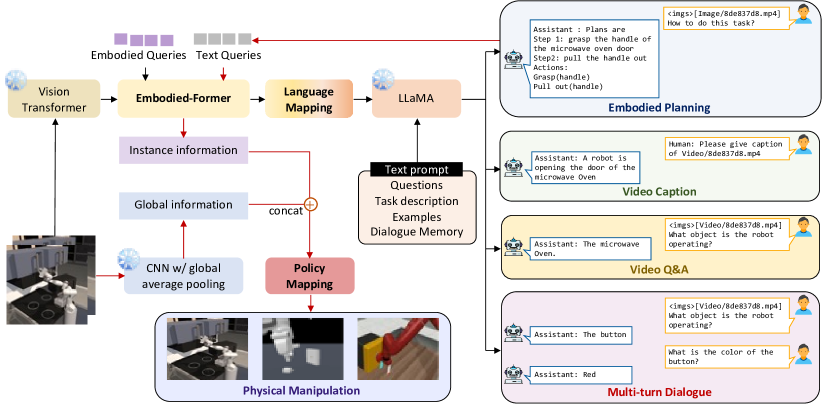
- Design Embodied-former to map visual and planning queries to language model inputs and to extract task-relevant features for control.
- Enable a policy network to generate low-level actions from instance-level features and global context.
- Pre-train vision and language components with image-text data before engaging in EgoCOT-based video-grounded training.
- Create EgoVQA by extending Ego4D with egocentric VQA data to enrich multi-modal training.
Experimental results
Research questions
- RQ1How can chain-of-thought planning be effectively generated and leveraged for embodied tasks?
- RQ2Can a unified vision-language model with a closed loop from planning to control improve embodied planning and manipulation performance?
- RQ3What impact does EgoCOT-based training have on low-level control success rates in benchmark tasks?
- RQ4How does EmbodiedGPT compare to existing baselines in embodied captioning, VQA, planning, and control?
Key findings
- EmbodiedGPT achieves superior or comparable visual captioning and VQA quality to larger or baseline models in embodied settings.
- The EgoCOT-based training and the closed-loop design significantly improve embodied control success rates on Franka Kitchen and Meta-World benchmarks.
- EmbodiedGPT outperforms BLIP-2 fine-tuned on Ego4D and R3M on Franka Kitchen (differences of 22.1% and 5.5%) and Meta-World (differences of 22.5% and 4.2%).
- Ablation shows that chain-of-thought training and closed-loop planning-to-control contribute substantially to performance gains.
Read this paper
Open the full text in the Nubint reader and ask about any passage as you read.
Read this paper on NubintThis review was generated by AI from the original paper. Please check the paper before citing it.