
[Paper Review] Embracing assay heterogeneity with neural processes for markedly improved bioactivity predictions
This paper proposes MetaBind, a meta-learning framework using neural processes to model assay heterogeneity in bioactivity data, enabling highly accurate and adaptable affinity predictions across diverse protein targets and assay types. By learning from sparse, heterogeneous data and leveraging task-specific support sets, MetaBind achieves state-of-the-art performance with significantly lower error rates than conventional models.
Predicting the bioactivity of a ligand is one of the hardest and most important challenges in computer-aided drug discovery. Despite years of data collection and curation efforts by research organizations worldwide, bioactivity data remains sparse and heterogeneous, thus hampering efforts to build predictive models that are accurate, transferable and robust. The intrinsic variability of the experimental data is further compounded by data aggregation practices that neglect heterogeneity to overcome sparsity. Here we discuss the limitations of these practices and present a hierarchical meta-learning framework that exploits the information synergy across disparate assays by successfully accounting for assay heterogeneity. We show that the model achieves a drastic improvement in affinity prediction across diverse protein targets and assay types compared to conventional baselines. It can quickly adapt to new target contexts using very few observations, thus enabling large-scale virtual screening in early-phase drug discovery.
Motivation & Objective
- To address the challenge of sparse and heterogeneous bioactivity data in drug discovery, which limits the performance and transferability of existing predictive models.
- To develop a model that can effectively exploit information synergy across disparate assays despite differences in experimental conditions and assay types.
- To enable rapid adaptation to new targets and assays using only a few observed activity measurements, supporting large-scale virtual screening.
- To improve the accuracy and robustness of ligand affinity prediction by explicitly modeling assay-level variability rather than treating it as noise.
Proposed method
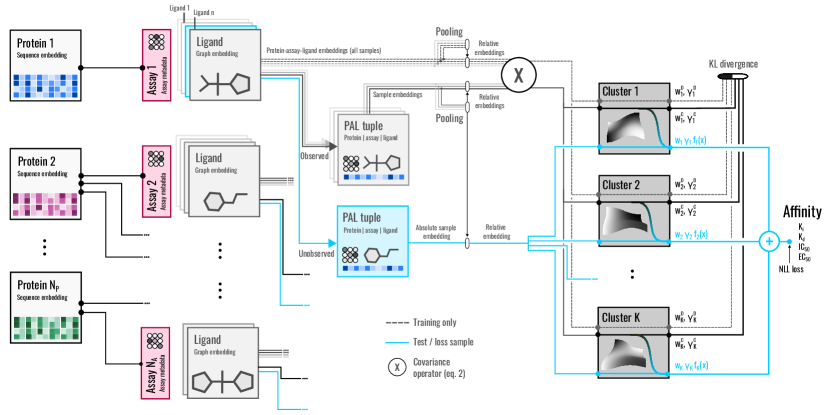
- The model employs a hierarchical meta-learning framework where each assay is treated as a distinct learning task, and assays are grouped into K covariance clusters to model shared structural patterns.
- A neural process architecture is used to learn a distribution over functions for each assay, conditioned on a small support set of observed ligand-protein pairs and their measured bioactivities.
- The model uses graph-convolutional networks for ligand representations and convolutional networks for protein embeddings, with a cross-covariance operator to aggregate information across tasks.
- A Kullback-Leibler divergence loss is applied during training to encourage the model to reconstruct the full covariance structure of each assay from a random subset of its observations.
- The framework is trained end-to-end on ChEMBL 30 data, filtering for high-confidence, human-targeted binding assays with Ki, Kd, IC50, and EC50 endpoints.
- The model is evaluated using task-level metrics (T-RMSE, T-MAE) and a paired-assay split to assess its ability to distinguish between heterogeneous assays with the same target.
Experimental results
Research questions
- RQ1Can a meta-learning model effectively capture and utilize assay heterogeneity to improve bioactivity prediction across diverse protein targets?
- RQ2How well does the model generalize to new, unseen targets and assays with minimal labeled data?
- RQ3To what extent can the model distinguish between biologically similar but experimentally heterogeneous assays?
- RQ4Does accounting for assay-level variability lead to a significant improvement in prediction accuracy compared to conventional models?
Key findings
- MetaBind achieves a task-level root-mean-square error (T-RMSE) of 0.48 pK units on the test set, representing a drastic improvement over conventional baselines.
- The model demonstrates strong zero-shot generalization, achieving a T-MAE of 0.36 pK units on 178 unseen target proteins with median ligand similarity of 0.32 between training and test sets.
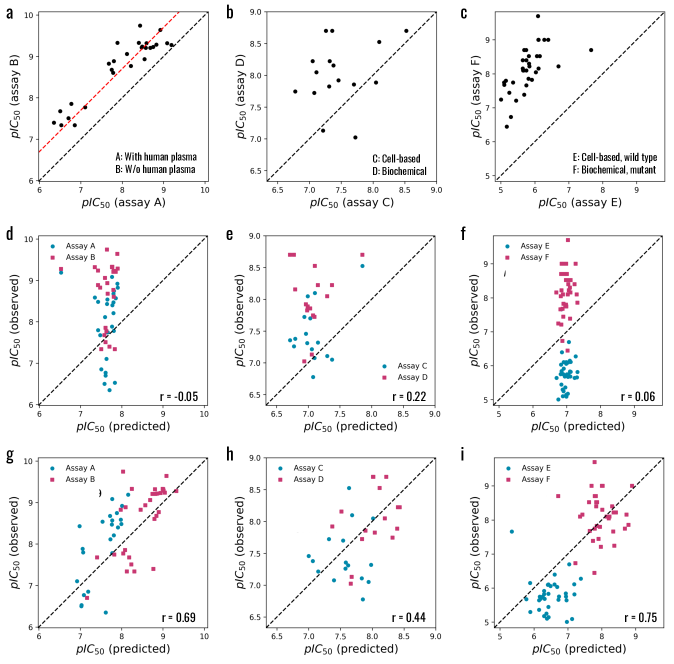
- In the paired-assay split, MetaBind successfully identifies and models differences between assays targeting the same protein but exhibiting distinct structure-activity relationships, indicating robust heterogeneity handling.
- The model outperforms standard deep learning and Gaussian process baselines across diverse assay types, including biochemical and cell-based assays.
- The use of a Kullback-Leibler loss term enables effective covariance structure reconstruction from partial observation sets, enhancing generalization and uncertainty calibration.
Read this paper
Open the full text in the Nubint reader and ask about any passage as you read.
Read this paper on NubintThis review was generated by AI from the original paper. Please check the paper before citing it.