
[Paper Review] Emergent Analogical Reasoning in Large Language Models
GPT-3 demonstrates strong zero-shot analogical reasoning across multiple domains, matching or exceeding human performance in most tasks; preliminary GPT-4 may improve further.
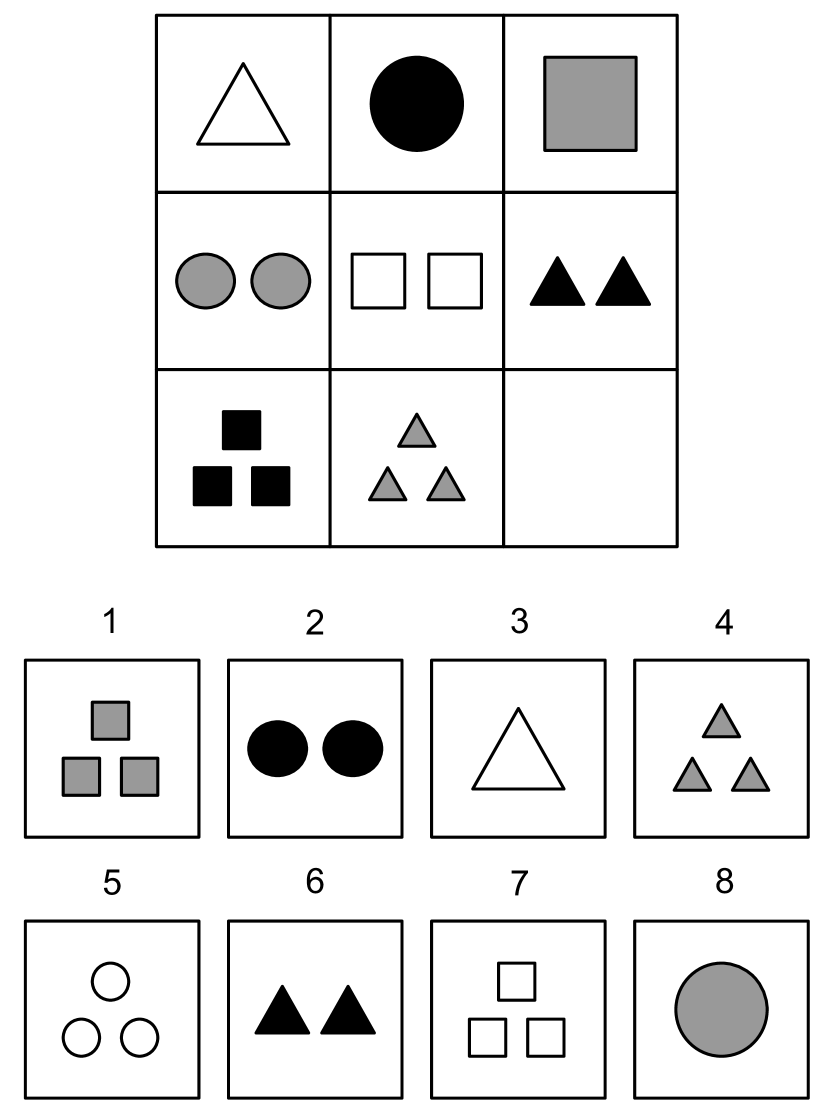
The recent advent of large language models has reinvigorated debate over whether human cognitive capacities might emerge in such generic models given sufficient training data. Of particular interest is the ability of these models to reason about novel problems zero-shot, without any direct training. In human cognition, this capacity is closely tied to an ability to reason by analogy. Here, we performed a direct comparison between human reasoners and a large language model (the text-davinci-003 variant of GPT-3) on a range of analogical tasks, including a non-visual matrix reasoning task based on the rule structure of Raven's Standard Progressive Matrices. We found that GPT-3 displayed a surprisingly strong capacity for abstract pattern induction, matching or even surpassing human capabilities in most settings; preliminary tests of GPT-4 indicated even better performance. Our results indicate that large language models such as GPT-3 have acquired an emergent ability to find zero-shot solutions to a broad range of analogy problems.
Motivation & Objective
- Assess whether a large language model (GPT-3) can solve novel analogy problems without explicit training.
- Directly compare GPT-3 performance to human participants across multiple analogical domains.
- Characterize patterns of analogical reasoning and error profiles in GPT-3 relative to humans.
- Explore whether emergent analogy abilities extend to more meaningful real-world relations through verbal and story analogies.
Proposed method
- Evaluate text-davinci-003 (GPT-3) on four analogy task domains: text-based matrix reasoning (Digit Matrices), letter-string analogies, four-term verbal analogies, and story analogies.
- Compare zero-shot GPT-3 performance to UCLA undergraduates (humans) on each domain.
- Use both generative (producing answers) and multiple-choice formats to gauge performance.
- Analyze error patterns and influence of problem structure (e.g., number of rules, progression, spatial alignment).
- Examine qualitative aspects of analogy use for problem solving and cross-domain generalization.
Experimental results
Research questions
- RQ1Can GPT-3 solve zero-shot analogy problems across synthetic and real-world domains without task-specific training?
- RQ2How does GPT-3 performance compare to human participants on matrix, string, verbal, and story analogies?
- RQ3What are the similarity patterns in GPT-3 and human error across problem types and structures?
- RQ4Does GPT-3 show signs of abstract rule induction and analogical mapping akin to human reasoning?
- RQ5Are there domains where GPT-3 struggles or excels, and how does GPT-4 potentially improve these abilities?
Key findings
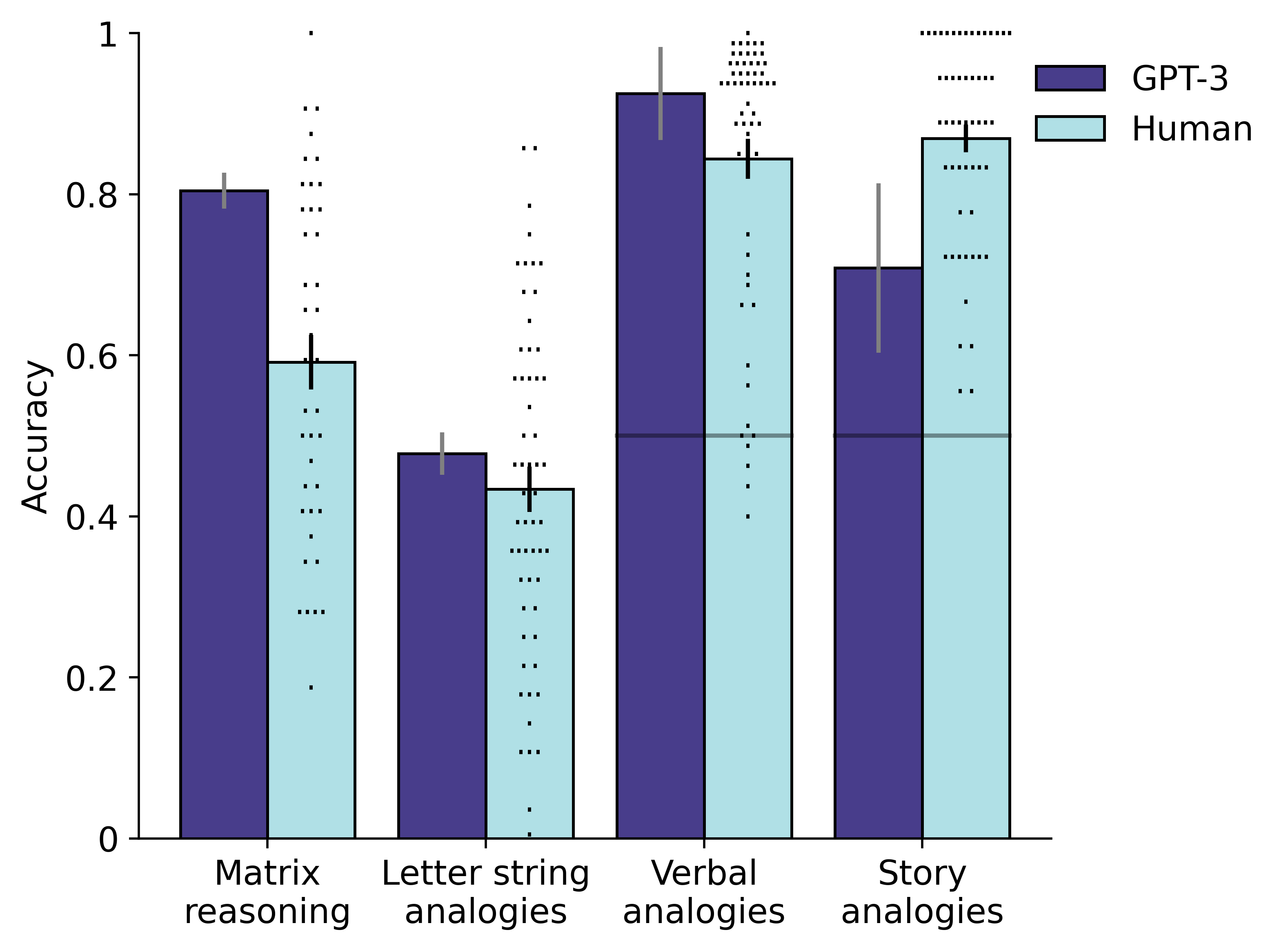
- GPT-3 matched or exceeded human performance on zero-shot Digit Matrices and letter-string analogies.
- GPT-3 showed strong zero-shot performance on four-term verbal analogies and story analogies, with human performance sometimes superior in story analogies (far analogy sensitivity noted).
- GPT-3’s error patterns correlated with relational complexity and problem structure similarly to humans (e.g., progression rules, number of unique rules, spatial alignment effects).
- GPT-3’s performance on letter strings and verbal analogies demonstrated generalization across domains, indicating abstract notions like successorship can transfer between alphabetic and real-world concepts.
- Preliminary GPT-4 results indicated even better performance in analogous tasks, suggesting emergent capabilities scale with model advancements.
Read this paper
Open the full text in the Nubint reader and ask about any passage as you read.
Read this paper on NubintThis review was generated by AI from the original paper. Please check the paper before citing it.