
[Paper Review] Emergent World Models and Latent Variable Estimation in Chess-Playing Language Models
This paper demonstrates that a language model trained solely on next-token prediction for chess game transcripts develops emergent world models, including internal representations of board state and latent player skill estimation. Using linear probes and activation interventions, the authors validate these representations by editing the model’s internal state and observing improved or degraded play, achieving up to a 2.6x win rate increase with skill vector intervention.
Language models have shown unprecedented capabilities, sparking debate over the source of their performance. Is it merely the outcome of learning syntactic patterns and surface level statistics, or do they extract semantics and a world model from the text? Prior work by Li et al. investigated this by training a GPT model on synthetic, randomly generated Othello games and found that the model learned an internal representation of the board state. We extend this work into the more complex domain of chess, training on real games and investigating our model's internal representations using linear probes and contrastive activations. The model is given no a priori knowledge of the game and is solely trained on next character prediction, yet we find evidence of internal representations of board state. We validate these internal representations by using them to make interventions on the model's activations and edit its internal board state. Unlike Li et al's prior synthetic dataset approach, our analysis finds that the model also learns to estimate latent variables like player skill to better predict the next character. We derive a player skill vector and add it to the model, improving the model's win rate by up to 2.6 times.
Motivation & Objective
- To investigate whether language models trained on real chess game transcripts develop internal world models without explicit game rules or supervision.
- To determine if such models can estimate latent variables like player skill to improve next-token prediction.
- To validate internal representations through causal interventions on model activations, such as modifying board state or skill level.
- To compare the effectiveness of probing and intervention techniques in a real-world, rule-based domain like chess.
Proposed method
- Train an 8-layer and 16-layer GPT model on 16 million real chess games from the Lichess database, using only next-token prediction.
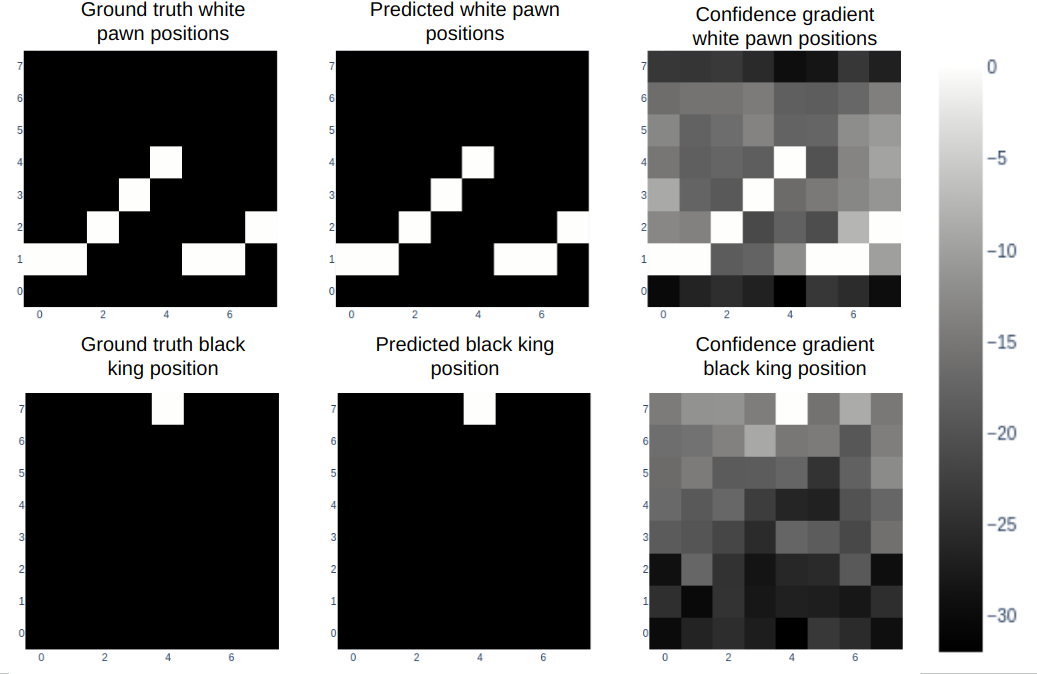
- Use linear probes to extract internal representations of board state and player skill from model activations.
- Perform causal interventions by modifying the model’s hidden states: injecting or subtracting skill vectors to alter performance.
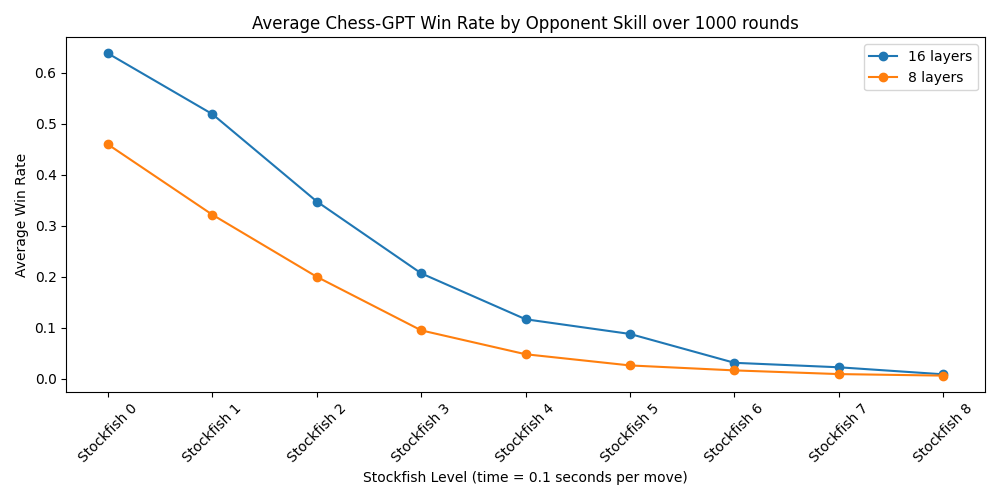
- Validate interventions by measuring win rates against Stockfish 16 in both standard and randomly initialized board settings.
- Use gradient-based probing to identify and manipulate latent variables such as Elo rating, enabling controlled changes in model behavior.
- Evaluate model performance using win rates and legality of moves (98%+ legal moves post-intervention).
Experimental results
Research questions
- RQ1Can a language model trained on real chess game transcripts develop an internal representation of the board state without prior knowledge of the game?
- RQ2Does the model learn to estimate latent variables such as player skill to improve next-token prediction?
- RQ3Can linear probes successfully recover and manipulate the model’s internal board state and skill representation?
- RQ4To what extent can causal interventions on model activations improve or degrade the model’s chess-playing performance?
- RQ5How does the model’s performance vary when initialized from a standard position versus a randomly moved position after skill vector intervention?
Key findings
- The model learns a robust internal representation of the chess board state, as validated by linear probes that reconstruct piece positions with high confidence.
- The model estimates player skill via a latent vector, which can be probed and manipulated to alter performance.
- Adding a positive skill vector increases the 16-layer model’s win rate by up to 2.6x against Stockfish 16 in randomly initialized games.
- The 8-layer model’s win rate improves by 2x under the same conditions, indicating scalable impact of skill vector intervention.
- Interventions preserve legality, with over 98% of moves remaining legal after manipulation, confirming controlled behavior.
- The model classifies 99.4% of randomly initialized games as low-skill, supporting the hypothesis that it learns to infer player strength from context.
Read this paper
Open the full text in the Nubint reader and ask about any passage as you read.
Read this paper on NubintThis review was generated by AI from the original paper. Please check the paper before citing it.