
[Paper Review] EMG-Based Hand Gesture Recognition through Diverse Domain Feature Enhancement and Machine Learning-Based Approach
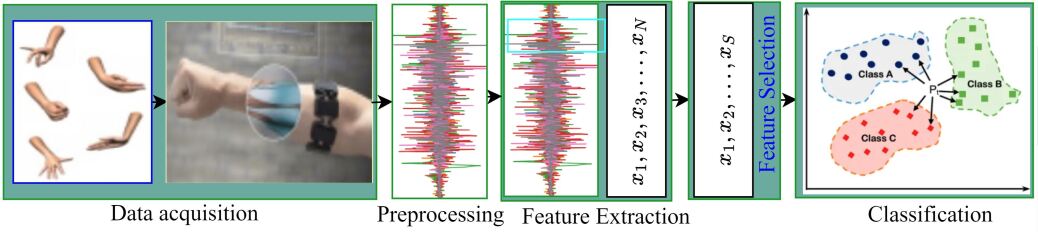
This paper proposes an EMG-based hand gesture recognition system using comprehensive morphological, time-domain, and frequency-domain feature extraction, followed by Extra Tree Classifier-based feature selection and KNN classification. The approach achieves 97.43% accuracy, outperforming prior methods by leveraging rich, relevant features while reducing computational load.
Surface electromyography (EMG) serves as a pivotal tool in hand gesture recognition and human-computer interaction, offering a non-invasive means of signal acquisition. This study presents a novel methodology for classifying hand gestures using EMG signals. To address the challenges associated with feature extraction where, we explored 23 distinct morphological, time domain and frequency domain feature extraction techniques. However, the substantial size of the features may increase the computational complexity issues that can hinder machine learning algorithm performance. We employ an efficient feature selection approach, specifically an extra tree classifier, to mitigate this. The selected potential feature fed into the various machine learning-based classification algorithms where our model achieved 97.43\% accuracy with the KNN algorithm and selected feature. By leveraging a comprehensive feature extraction and selection strategy, our methodology enhances the accuracy and usability of EMG-based hand gesture recognition systems. The higher performance accuracy proves the effectiveness of the proposed model over the existing system. \keywords{EMG signal, machine learning approach, hand gesture recognition.
Motivation & Objective
- To improve the accuracy and robustness of EMG-based hand gesture recognition by addressing feature effectiveness and computational complexity.
- To investigate the impact of diverse feature extraction techniques—morphological, time-domain, and frequency-domain—on classification performance.
- To reduce dimensionality and computational cost through an efficient feature selection method using the Extra Tree Classifier.
- To evaluate and compare multiple machine learning algorithms on both original and selected features for optimal classification performance.
- To develop a practical, high-accuracy system suitable for real-world applications such as prosthetics and human-computer interaction.
Proposed method
- Employed 23 distinct feature extraction techniques across three domains: morphological (e.g., peak-to-peak amplitude, waveform length), time-domain (e.g., mean absolute value, root mean square), and frequency-domain (e.g., spectral centroid, power spectral density).
- Applied the Extra Tree Classifier (ETC) for feature selection, ranking features based on their importance and reducing the feature set to 10 high-impact features.
- Used the selected 10 features as input to multiple machine learning classifiers, including KNN, SVM, Random Forest, and Gaussian Naïve Bayes.
- Evaluated model performance using standard metrics: accuracy, precision, recall, F1-score, sensitivity, and specificity.
- Compared the proposed method with state-of-the-art models, particularly focusing on feature engineering and model architecture trade-offs.
- Selected KNN as the optimal classifier due to its high accuracy (97.43%), sensitivity (99.88%), and specificity (99.86%) with the selected feature set.
Experimental results
Research questions
- RQ1How do morphological, time-domain, and frequency-domain features collectively improve EMG-based hand gesture recognition accuracy?
- RQ2What is the impact of feature selection using the Extra Tree Classifier on reducing computational complexity while maintaining classification performance?
- RQ3Which machine learning algorithm achieves the highest accuracy when trained on both original and selected EMG features?
- RQ4How does the proposed method compare to existing state-of-the-art approaches in terms of accuracy and efficiency?
- RQ5Can a simple yet effective model like KNN outperform complex models such as CNN in EMG-based gesture recognition with proper feature engineering?
Key findings
- The proposed method achieved 97.43% classification accuracy using KNN with 10 selected features, significantly outperforming prior state-of-the-art models.
- KNN achieved 99.88% sensitivity and 99.86% specificity, indicating strong performance across all gesture classes with minimal misclassification.
- The Extra Tree Classifier successfully reduced the feature set to 10 most relevant features, improving model efficiency without sacrificing accuracy.
- The KNN classifier outperformed more complex models like CNN and Random Forest, demonstrating that simpler models can be more effective with well-engineered features.
- All gesture classes achieved F1-scores of 97.00% or higher, indicating consistent and robust performance across all hand gestures.
- The model’s performance surpasses that of Rubio et al.’s CNN (94.70%) and Random Forest (95.39%) models, even without deep learning, due to superior feature engineering and selection.
Read this paper
Open the full text in the Nubint reader and ask about any passage as you read.
Read this paper on NubintThis review was generated by AI from the original paper. Please check the paper before citing it.