
[Paper Review] EMO: Emote Portrait Alive -- Generating Expressive Portrait Videos with Audio2Video Diffusion Model under Weak Conditions
EMO proposes a diffusion-based audio-to-video generation framework for expressive talking head videos that directly maps audio to facial motions without intermediate 3D models or landmarks. It achieves state-of-the-art performance in realism, identity preservation, and expressiveness—especially for singing and dynamic head movements—by integrating a speed controller, face region controller, and FrameEncoding for identity consistency, outperforming SOTA methods on FID, FVD, and E-FID metrics.
In this work, we tackle the challenge of enhancing the realism and expressiveness in talking head video generation by focusing on the dynamic and nuanced relationship between audio cues and facial movements. We identify the limitations of traditional techniques that often fail to capture the full spectrum of human expressions and the uniqueness of individual facial styles. To address these issues, we propose EMO, a novel framework that utilizes a direct audio-to-video synthesis approach, bypassing the need for intermediate 3D models or facial landmarks. Our method ensures seamless frame transitions and consistent identity preservation throughout the video, resulting in highly expressive and lifelike animations. Experimental results demonsrate that EMO is able to produce not only convincing speaking videos but also singing videos in various styles, significantly outperforming existing state-of-the-art methodologies in terms of expressiveness and realism.
Motivation & Objective
- To address the limitations of existing talking head models that rely on 3D models or facial landmarks, which restrict expressive diversity and natural motion.
- To enable high-fidelity, expressive video generation directly from audio and a single reference image, without intermediate representations.
- To improve video stability and reduce artifacts such as jittering or facial distortions during audio-driven generation.
- To preserve identity and style consistency across diverse portrait styles (realistic, anime, 3D) and long-duration audio inputs.
- To achieve superior performance in expressiveness, realism, and synchronization compared to state-of-the-art methods.
Proposed method
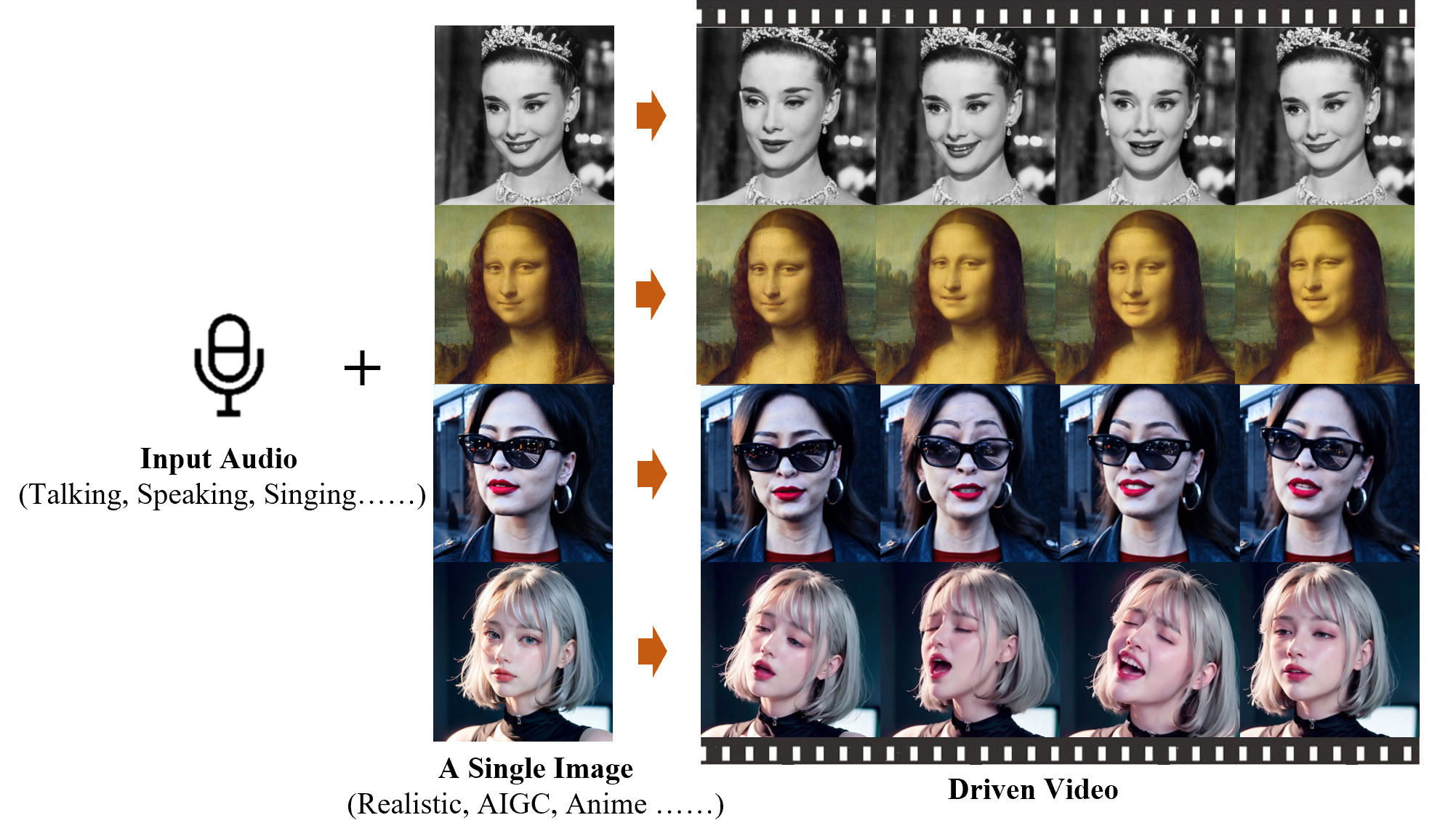
- A direct audio-to-video diffusion model is used to generate video frames from audio and a single reference image, bypassing 3D or landmark-based intermediate representations.
- A speed controller and face region controller are introduced as stable hyperparameters to suppress frame-level jittering and facial distortions during diffusion sampling.
- FrameEncoding, a reference-encoding module inspired by ReferenceNet, is designed to preserve identity and style consistency across the entire video sequence.
- The model is trained on a large-scale dataset of over 250 hours of diverse audio-video content, including speeches, films, and singing in multiple languages.
- Motion frames are used to extend video generation beyond the initial sequence, enabling long-duration outputs aligned with input audio length.
- The framework supports generation of both speaking and singing videos with rich facial expressions and varied head poses.
Experimental results
Research questions
- RQ1Can a diffusion-based audio-to-video model generate expressive, realistic talking head videos without relying on 3D models or facial keypoint supervision?
- RQ2How can audio-to-video generation be stabilized to prevent facial jittering and distortions during diffusion sampling?
- RQ3To what extent can identity and portrait style be preserved across diverse visual styles (e.g., realistic, anime, 3D) using a single reference image?
- RQ4Can the model generalize to long-duration audio, such as singing, while maintaining synchronization and expressive dynamics?
- RQ5How does the proposed method compare quantitatively and qualitatively to existing SOTA approaches in terms of realism, identity fidelity, and expressiveness?
Key findings
- EMO achieves a new state-of-the-art FID score of 8.76, significantly outperforming Wav2Lip (9.38), SadTalker (10.31), and DreamTalk (58.80).
- The model achieves the lowest FVD score of 67.66, indicating superior video quality and temporal coherence compared to baselines.
- EMO achieves the best E-FID score of 0.116, demonstrating superior expressiveness in facial movements, especially micro-expressions and dynamic changes.
- Qualitative results show that EMO generates more natural head movements and richer facial expressions than Wav2Lip, SadTalker, and DreamTalk, particularly in singing scenarios.
- The method successfully generates long-duration videos (up to 1 minute) with consistent identity and synchronized lip movements, even with tonal audio like singing.
- Despite not leading in SyncNet, EMO excels in expressiveness and realism, as confirmed by user studies and qualitative evaluations.

Read this paper
Open the full text in the Nubint reader and ask about any passage as you read.
Read this paper on NubintThis review was generated by AI from the original paper. Please check the paper before citing it.