
[Paper Review] Emoji-Powered Representation Learning for Cross-Lingual Sentiment Classification
This paper proposes ELSA, a novel emoji-powered representation learning framework that leverages emojis as both surrogate sentiment labels and a training signal to learn cross-lingual and language-specific sentiment representations. By jointly training on multilingual tweets with emoji prediction, ELSA improves cross-lingual sentiment classification performance, achieving state-of-the-art results even with limited labeled data, particularly outperforming translation-based baselines on French and German datasets.
Sentiment classification typically relies on a large amount of labeled data. In practice, the availability of labels is highly imbalanced among different languages, e.g., more English texts are labeled than texts in any other languages, which creates a considerable inequality in the quality of related information services received by users speaking different languages. To tackle this problem, cross-lingual sentiment classification approaches aim to transfer knowledge learned from one language that has abundant labeled examples (i.e., the source language, usually English) to another language with fewer labels (i.e., the target language). The source and the target languages are usually bridged through off-the-shelf machine translation tools. Through such a channel, cross-language sentiment patterns can be successfully learned from English and transferred into the target languages. This approach, however, often fails to capture sentiment knowledge specific to the target language, and thus compromises the accuracy of the downstream classification task. In this paper, we employ emojis, which are widely available in many languages, as a new channel to learn both the cross-language and the language-specific sentiment patterns. We propose a novel representation learning method that uses emoji prediction as an instrument to learn respective sentiment-aware representations for each language. The learned representations are then integrated to facilitate cross-lingual sentiment classification. The proposed method demonstrates state-of-the-art performance on benchmark datasets, which is sustained even when sentiment labels are scarce.
Motivation & Objective
- To address the imbalance in labeled sentiment data across languages, especially the scarcity of labeled examples in non-English languages.
- To overcome the limitations of machine translation-based cross-lingual sentiment classification, which often fails to preserve language-specific sentiment expressions.
- To leverage the cross-linguistic ubiquity of emojis as a shared emotional signal to learn both general and language-specific sentiment representations.
- To develop a self-supervised representation learning method that uses emoji prediction to improve cross-lingual sentiment classification without relying on large-scale parallel corpora.
- To demonstrate that emoji-based supervision can outperform traditional methods, especially when labeled data is scarce.
Proposed method
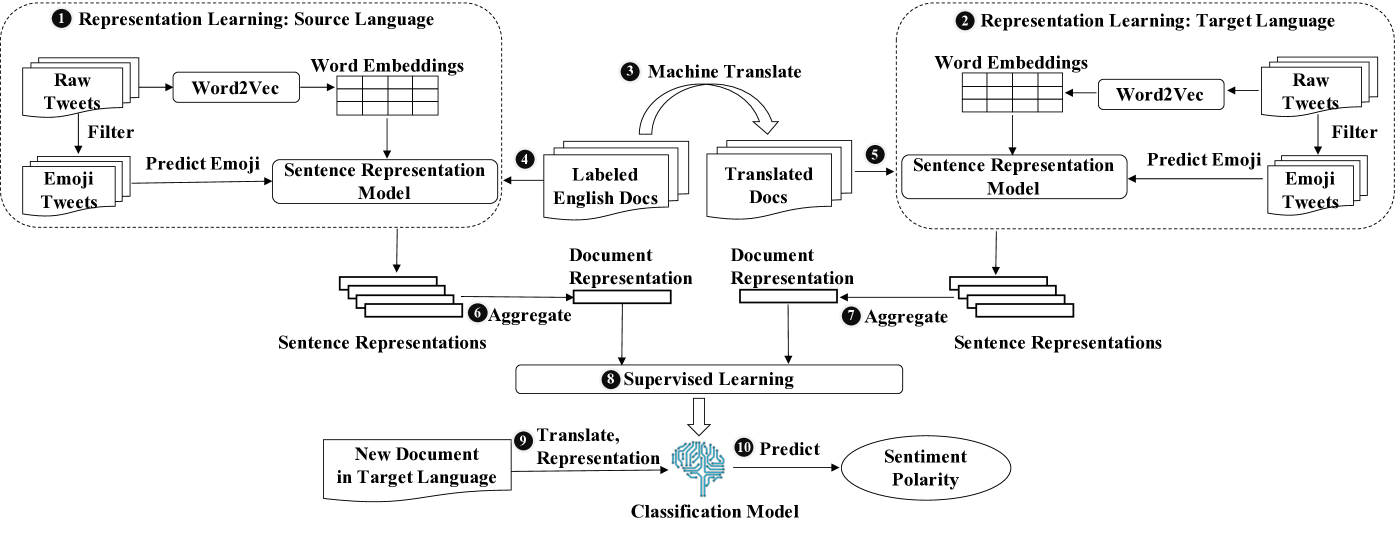
- The method introduces a multi-task learning framework where emoji prediction is used as a self-supervised signal to train shared and language-specific text encoders.
- It employs a Siamese-like architecture to jointly learn multilingual sentence representations, with separate encoders for source and target languages.
- The model is pre-trained on large-scale multilingual tweets using emoji prediction as a proxy for sentiment, enabling it to learn sentiment-aware representations without explicit sentiment labels.
- After pre-training, the model fine-tunes on a small amount of labeled data in the target language, leveraging the learned representations for downstream sentiment classification.
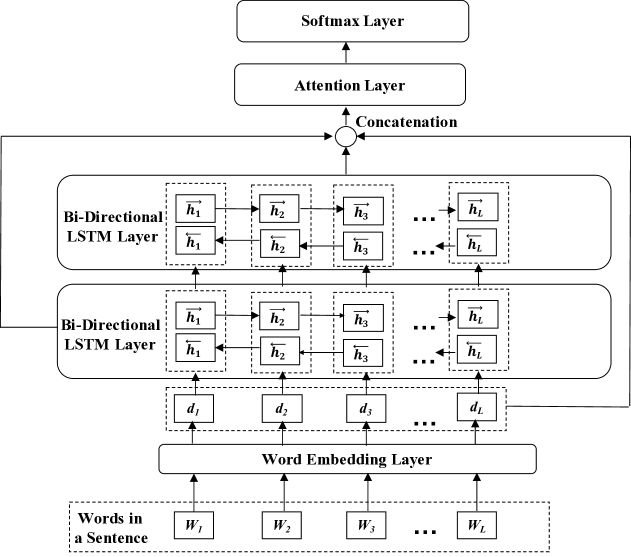
- The framework uses word embeddings and a CNN-based architecture to extract contextual features before emoji prediction and classification heads.
- The approach integrates both cross-lingual alignment and language-specific adaptation by jointly optimizing for emoji prediction and sentiment classification.
Experimental results
Research questions
- RQ1Can emojis serve as a reliable proxy for sentiment across multiple languages to improve cross-lingual representation learning?
- RQ2Does using emoji prediction as a self-supervised signal lead to better performance in low-resource sentiment classification compared to translation-based methods?
- RQ3To what extent can the model capture language-specific sentiment patterns while maintaining cross-lingual transferability?
- RQ4How does the performance of the emoji-powered method scale with decreasing amounts of labeled data?
- RQ5Can the model outperform existing state-of-the-art methods in cross-lingual sentiment classification under data-scarce conditions?
Key findings
- ELSA achieves a test accuracy of 0.696 on French tweets and 0.809 on German tweets, significantly outperforming the baseline MT-CNN model, which achieves 0.535 and 0.654, respectively.
- The improvement over the MT-CNN baseline is statistically significant (p < 0.05) for both French and German, as confirmed by McNemar’s test.
- ELSA maintains strong performance even with limited labeled data, demonstrating robustness in low-resource settings.
- The model outperforms the uniform guess baseline (0.451 for French, 0.628 for German), indicating meaningful learning beyond random chance.
- Despite using only 81M raw tweets and 13.7M emoji-laden tweets—less than the 300M raw tweets used by prior work—ELSA achieves superior results, suggesting higher data efficiency.
- The results indicate that emoji-based self-supervision captures both general and language-specific sentiment patterns more effectively than translation-based methods.
Read this paper
Open the full text in the Nubint reader and ask about any passage as you read.
Read this paper on NubintThis review was generated by AI from the original paper. Please check the paper before citing it.