
[Paper Review] Emotion Analysis in NLP: Trends, Gaps and Roadmap for Future Directions
A comprehensive review of 154 NLP papers (2014–2022) on emotion analysis (EA) in NLP, identifying definitions, frameworks, datasets, applications, gaps, and a roadmap for future work.
Emotions are a central aspect of communication. Consequently, emotion analysis (EA) is a rapidly growing field in natural language processing (NLP). However, there is no consensus on scope, direction, or methods. In this paper, we conduct a thorough review of 154 relevant NLP publications from the last decade. Based on this review, we address four different questions: (1) How are EA tasks defined in NLP? (2) What are the most prominent emotion frameworks and which emotions are modeled? (3) Is the subjectivity of emotions considered in terms of demographics and cultural factors? and (4) What are the primary NLP applications for EA? We take stock of trends in EA and tasks, emotion frameworks used, existing datasets, methods, and applications. We then discuss four lacunae: (1) the absence of demographic and cultural aspects does not account for the variation in how emotions are perceived, but instead assumes they are universally experienced in the same manner; (2) the poor fit of emotion categories from the two main emotion theories to the task; (3) the lack of standardized EA terminology hinders gap identification, comparison, and future goals; and (4) the absence of interdisciplinary research isolates EA from insights in other fields. Our work will enable more focused research into EA and a more holistic approach to modeling emotions in NLP.
Motivation & Objective
- Assess how EA tasks are defined and labeled in NLP.
- Identify dominant emotion frameworks and which emotions are modeled.
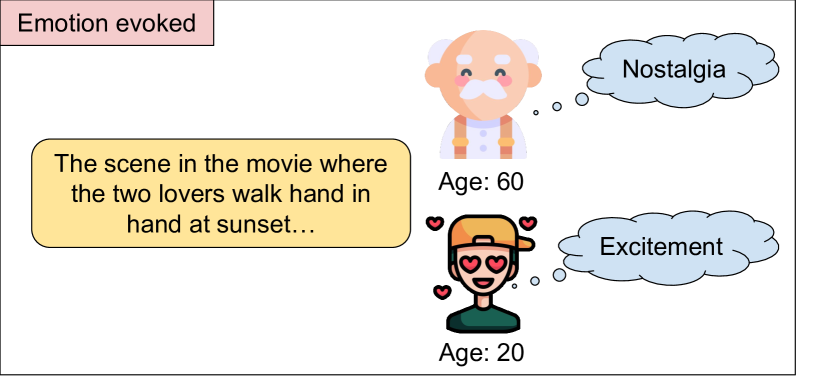
- Evaluate consideration of demographic and cultural subjectivity in EA.
- Catalog main NLP applications and datasets used in EA.
- Propose a roadmap to address gaps and improve EA modeling in NLP.
Proposed method
- Survey 154 NLP papers (2014–2022) from the ACL Anthology using keywords related to EA.
- Classify papers by emotions used, models, language, data sources, modality, nomenclature, and applications.
- Analyze dominance of Ekman and Plutchik models and prevalence of discrete emotion categories.
- Assess data diversity, annotation schemes, terminology consistency, and interdisciplinarity.
- Synthesize findings into a roadmap with concrete recommendations.
Experimental results
Research questions
- RQ1How are EA tasks defined in NLP and what terminology is used?
- RQ2What emotion frameworks dominate EA in NLP and which emotions are modeled?
- RQ3Do EA studies account for demographic or cultural subjectivity in data or labels?
- RQ4What are the primary NLP applications and datasets used for EA?
- RQ5What gaps exist and what directions are proposed for future EA research?
Key findings
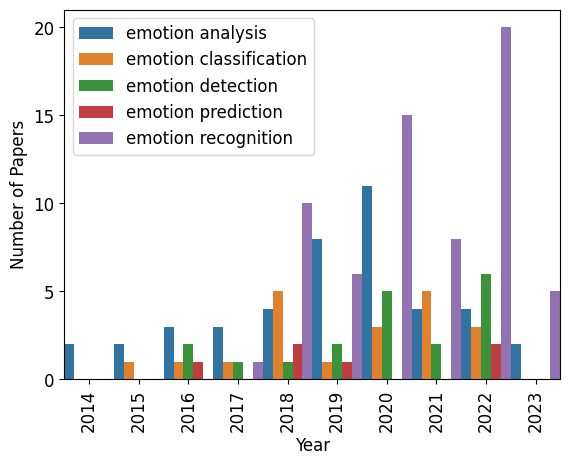
- EA task terminology is heterogeneous, with classification/recognition being most common and terms often used interchangeably.
- Ekman’s discrete emotions are the most used framework, with Plutchik’s model as the next most common; dimensional and componential models are less represented.
- Many studies do not incorporate demographic or cultural factors into data or modeling, highlighting a subjectivity gap.
- Emotion recognition in conversation is the most prominent EA application, followed by narrative text analysis and healthcare-related uses.
- Most datasets are English, sourced from movies/TV, and annotated with Ekman-type categories; multilingual and more nuanced datasets are emerging but still limited.
- A lack of standardized nomenclature, limited interdisciplinarity, and insufficient task alignment with real-world applications are identified as key shortcomings.
Read this paper
Open the full text in the Nubint reader and ask about any passage as you read.
Read this paper on NubintThis review was generated by AI from the original paper. Please check the paper before citing it.