
[Paper Review] Empowering Biomedical Discovery with AI Agents
This paper proposes AI agents as collaborative, skeptical systems that integrate large language models, machine learning tools, and experimental platforms to accelerate biomedical discovery. By enabling continual learning, hypothesis generation, and autonomous workflow execution, these agents can support novel scientific insights beyond data extrapolation, advancing toward autonomous biomedical research.
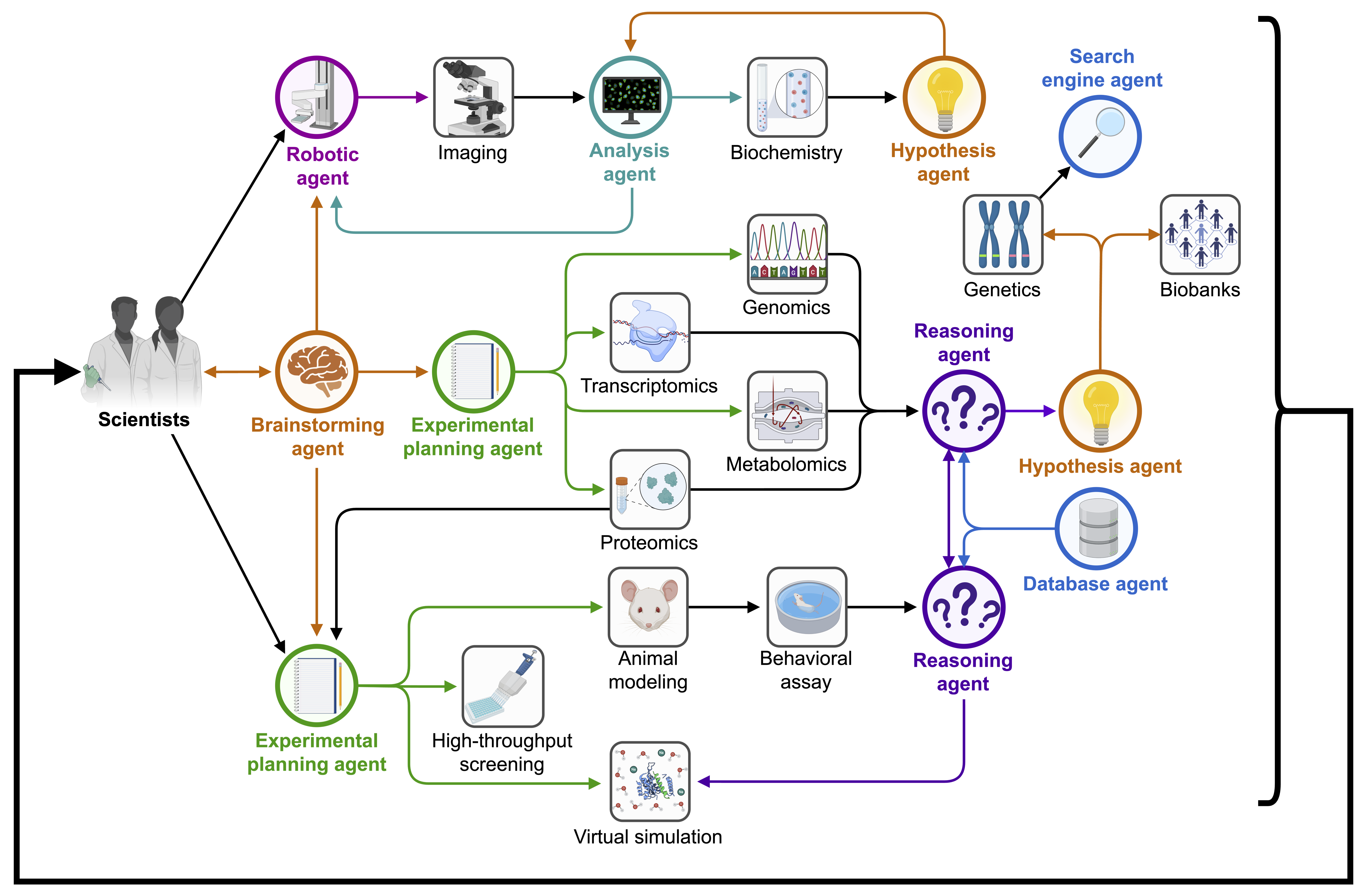
We envision "AI scientists" as systems capable of skeptical learning and reasoning that empower biomedical research through collaborative agents that integrate AI models and biomedical tools with experimental platforms. Rather than taking humans out of the discovery process, biomedical AI agents combine human creativity and expertise with AI's ability to analyze large datasets, navigate hypothesis spaces, and execute repetitive tasks. AI agents are poised to be proficient in various tasks, planning discovery workflows and performing self-assessment to identify and mitigate gaps in their knowledge. These agents use large language models and generative models to feature structured memory for continual learning and use machine learning tools to incorporate scientific knowledge, biological principles, and theories. AI agents can impact areas ranging from virtual cell simulation, programmable control of phenotypes, and the design of cellular circuits to developing new therapies.
Motivation & Objective
- To develop AI agents that act as collaborative partners in biomedical research, integrating human expertise with AI capabilities.
- To enable AI agents to generate novel, non-linear hypotheses grounded in scientific principles, moving beyond simple data extrapolation.
- To address the challenge of catastrophic forgetting in continual learning while maintaining trust through uncertainty-aware reasoning.
- To design AI agents capable of autonomous, closed-loop experimentation and hypothesis refinement using real-time feedback.
- To establish ethical and safety protocols for AI agents interacting with biological and experimental systems.
Proposed method
- Employing large language models (LLMs) and generative models to provide structured memory and reasoning for continual learning.
- Integrating multimodal foundation models to process diverse data types, including text, sequences, images, and high-dimensional omics data.
- Designing AI agents with perception, interaction, memory, and reasoning modules to function as autonomous problem solvers.
- Implementing reinforcement learning with human feedback (RLHF) and instruction tuning to align agent behavior with scientific reasoning and human preferences.
- Using in-context learning and few-shot prompting to enable zero-shot or few-shot adaptation to new biological tasks.
- Applying cross-modal alignment techniques to unify representations across text, molecular structures, and experimental readouts.
Experimental results
Research questions
- RQ1How can AI agents generate novel biological hypotheses that are not linear extrapolations of existing literature?
- RQ2What architectural and training components are required for AI agents to perform skeptical reasoning and manage uncertainty in scientific discovery?
- RQ3How can AI agents avoid catastrophic forgetting while continuously learning from new biological data and experimental outcomes?
- RQ4In what ways can AI agents collaborate with humans and other agents to accelerate complex biomedical workflows?
- RQ5What safeguards are necessary to ensure safe and ethical deployment of AI agents in experimental and in-vitro settings?
Key findings
- AI agents can autonomously decompose complex biomedical problems into manageable subtasks and coordinate specialized tools for targeted solutions.
- By combining LLMs with machine learning models and experimental platforms, AI agents achieve closed-loop learning and hypothesis refinement in simulated and real-world settings.
- The integration of structured memory and continual learning enables agents to retain and update scientific knowledge without catastrophic forgetting.
- AI agents demonstrate the ability to generate hypotheses that extend beyond existing literature, suggesting potential for pioneering discoveries.
- Through human-in-the-loop feedback and RLHF, agents improve alignment with scientific reasoning and increase trustworthiness in collaborative research.
- The framework supports diverse applications, including in-silico modeling, phenotypic control, and cellular circuit design, showcasing broad biomedical relevance.
Better researchstarts right now
From reading papers to final review, dramatically reduce your research time.
No credit card · Free plan available
This review was created by AI and reviewed by human editors.