
[Paper Review] Empowering Time Series Analysis with Large Language Models: A Survey
This survey systematically reviews the application of large language models (LLMs) to time series analysis, categorizing methods into five approaches: direct query, tokenization, prompt design, fine-tuning, and model integration. It highlights key challenges like concept drift and non-stationarity, and identifies future research directions including interpretability, multi-modality, domain generalization, and safety in mission-critical applications.
Recently, remarkable progress has been made over large language models (LLMs), demonstrating their unprecedented capability in varieties of natural language tasks. However, completely training a large general-purpose model from the scratch is challenging for time series analysis, due to the large volumes and varieties of time series data, as well as the non-stationarity that leads to concept drift impeding continuous model adaptation and re-training. Recent advances have shown that pre-trained LLMs can be exploited to capture complex dependencies in time series data and facilitate various applications. In this survey, we provide a systematic overview of existing methods that leverage LLMs for time series analysis. Specifically, we first state the challenges and motivations of applying language models in the context of time series as well as brief preliminaries of LLMs. Next, we summarize the general pipeline for LLM-based time series analysis, categorize existing methods into different groups (i.e., direct query, tokenization, prompt design, fine-tune, and model integration), and highlight the key ideas within each group. We also discuss the applications of LLMs for both general and spatial-temporal time series data, tailored to specific domains. Finally, we thoroughly discuss future research opportunities to empower time series analysis with LLMs.
Motivation & Objective
- To address the challenges of training general-purpose time series models from scratch due to data volume, diversity, and non-stationarity.
- To explore how pre-trained LLMs can be adapted for time series tasks despite concept drift and distribution shifts.
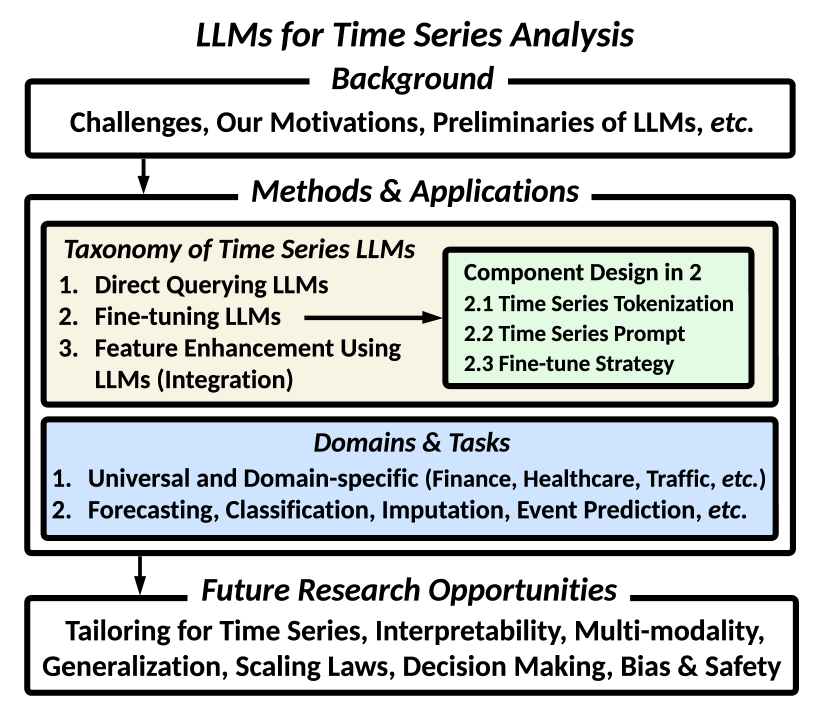
- To provide a systematic taxonomy of LLM-based time series analysis methods across five categories: direct query, tokenization, prompt design, fine-tuning, and model integration.
- To examine domain-specific applications of LLMs in healthcare, finance, traffic, and environmental sciences.
- To identify and discuss emerging research opportunities in interpretability, multi-modality, domain generalization, and safety for time series LLMs.
Proposed method
- Categorizes LLM-based time series methods into five distinct methodologies: direct query, tokenization, prompt design, fine-tuning, and model integration.
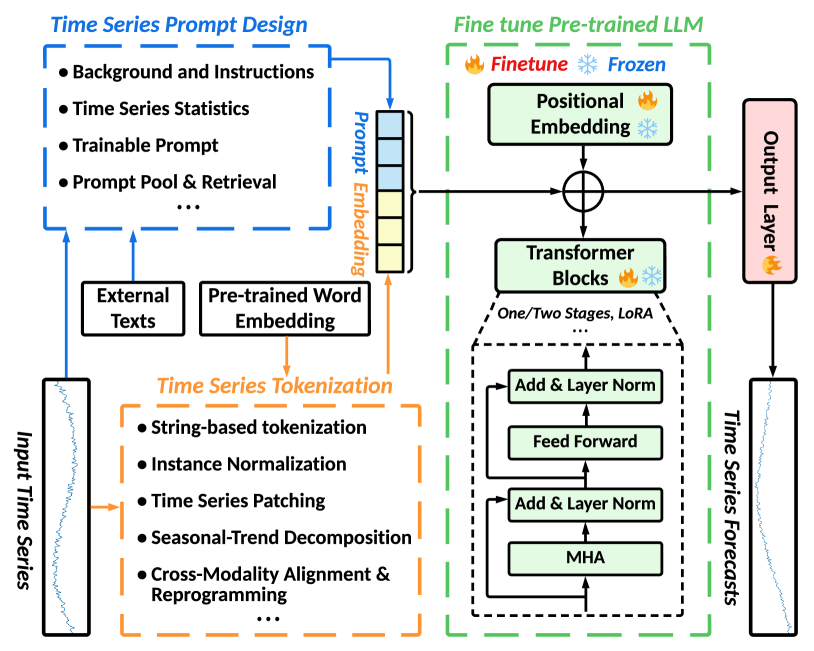
- Proposes a framework for adapting LLMs to time series by treating sequential data as tokenized sequences, enabling natural language processing techniques.
- Reviews prompt engineering strategies, including few-shot and zero-shot prompting, to guide LLMs for time series tasks without fine-tuning.
- Examines fine-tuning strategies to adapt LLMs to specific time series tasks such as forecasting, anomaly detection, and classification.
- Explores model integration techniques that combine LLMs with specialized time series models to enhance performance and robustness.
- Introduces a comprehensive table summarizing 21 representative methods, their modeling strategies, tasks, and application domains.
Experimental results
Research questions
- RQ1How can pre-trained LLMs be effectively leveraged for time series analysis despite the challenges of data non-stationarity and concept drift?
- RQ2What are the key methodological categories for applying LLMs to time series, and how do they differ in design and performance?
- RQ3How can LLMs be adapted to handle diverse time series data across domains such as finance, healthcare, and environmental monitoring?
- RQ4What are the critical open challenges in interpretability, multi-modality, and domain generalization for LLM-based time series models?
- RQ5How do scaling laws and agent-like behaviors emerge in LLMs when applied to time series data, and what implications do they have for future development?
Key findings
- LLMs can be effectively applied to time series tasks through methods like prompt design and fine-tuning, even without retraining from scratch.
- Tokenization strategies that encode temporal lags at multiple frequencies (e.g., daily, hourly, second-level) improve model understanding of time series structure.
- Prompt learning architectures, such as those based on Wang et al. (2022), can be used to automatically learn task-specific prompts for better performance.
- Interpretability remains a major challenge, but prototype-based and gradient-based methods, along with knowledge distillation, offer promising paths to explain LLM outputs.
- Multi-modal integration—combining time series with text, tabular, and image data—is a critical frontier, especially in domains like healthcare.
- Domain generalization and robustness to distribution shift are essential, with meta-learning and invariant representation learning emerging as key strategies.
Read this paper
Open the full text in the Nubint reader and ask about any passage as you read.
Read this paper on NubintThis review was generated by AI from the original paper. Please check the paper before citing it.