
[Paper Review] Emu: Generative Pretraining in Multimodality
Emu is a 14B Transformer-based multimodal foundation model pretrained with a unified autoregressive objective on interleaved multimodal data (text, images, video) to generate both text and images, achieving strong zero-shot and few-shot performance across vision-language tasks.
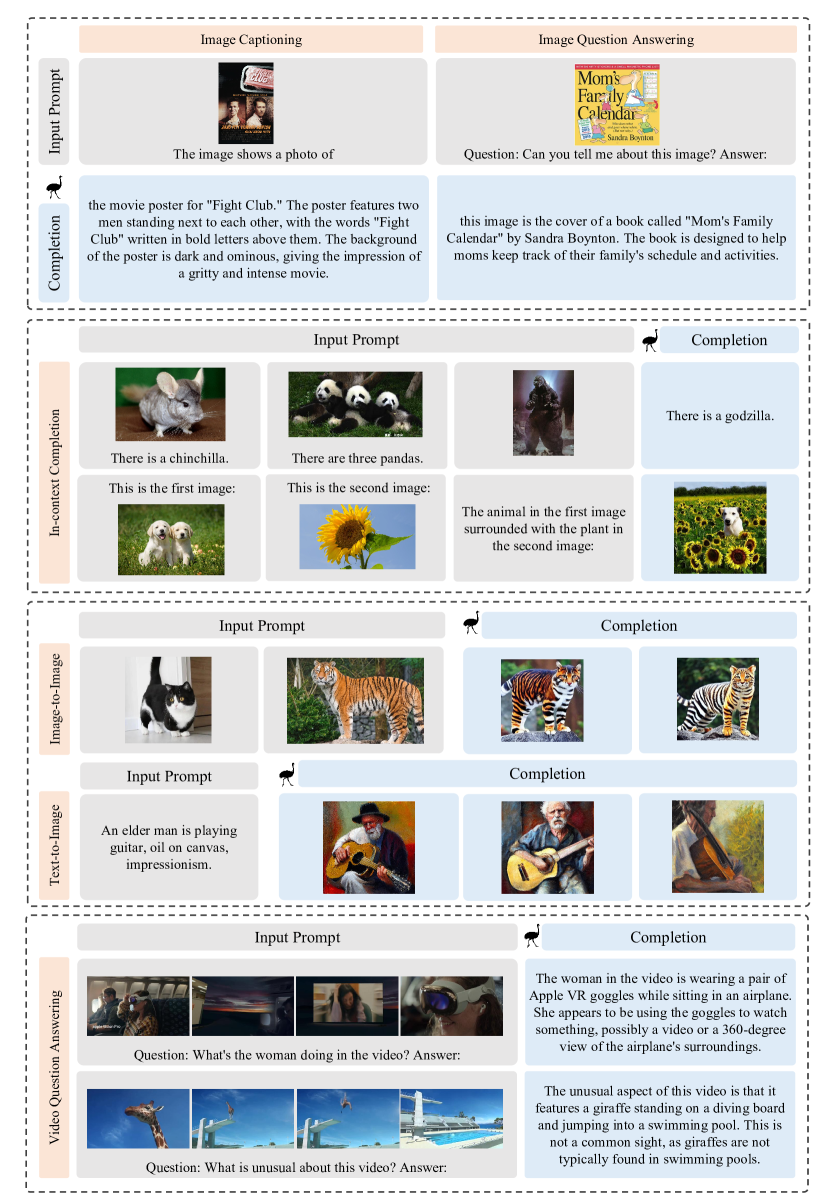
We present Emu, a Transformer-based multimodal foundation model, which can seamlessly generate images and texts in multimodal context. This omnivore model can take in any single-modality or multimodal data input indiscriminately (e.g., interleaved image, text and video) through a one-model-for-all autoregressive training process. First, visual signals are encoded into embeddings, and together with text tokens form an interleaved input sequence. Emu is then end-to-end trained with a unified objective of classifying the next text token or regressing the next visual embedding in the multimodal sequence. This versatile multimodality empowers the exploration of diverse pretraining data sources at scale, such as videos with interleaved frames and text, webpages with interleaved images and text, as well as web-scale image-text pairs and video-text pairs. Emu can serve as a generalist multimodal interface for both image-to-text and text-to-image tasks, and supports in-context image and text generation. Across a broad range of zero-shot/few-shot tasks including image captioning, visual question answering, video question answering and text-to-image generation, Emu demonstrates superb performance compared to state-of-the-art large multimodal models. Extended capabilities such as multimodal assistants via instruction tuning are also demonstrated with impressive performance.
Motivation & Objective
- Motivate building a single, generalist multimodal model that can learn from diverse interleaved data sources (images, text, video).
- Develop a unified autoregressive objective that models both discrete text tokens and continuous visual embeddings.
- Enable end-to-end generation and understanding across modalities, including image-to-text, text-to-image, and multimodal in-context capabilities.
- Explore data sources such as videos with interleaved frames and subtitles, webpages with images and text, and web-scale image-text pairs.
- Demonstrate instruction-tuned multimodal capabilities and evaluate zero-shot and few-shot performance across a broad set of tasks.
Proposed method
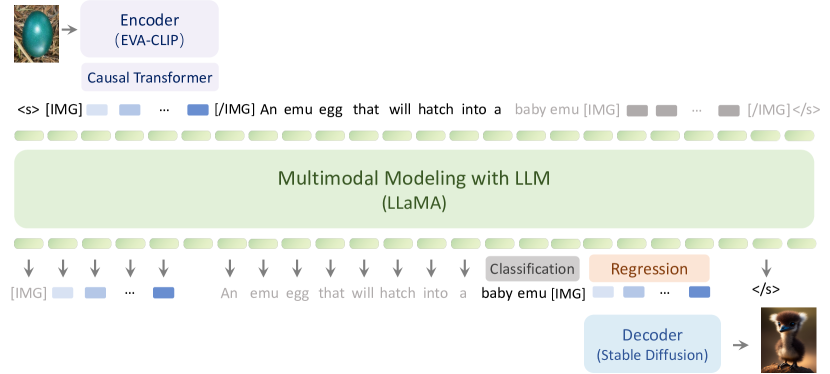
- Use a Visual Encoder (EVA-CLIP) to convert images to embeddings.
- Introduce a Causal Transformer to transform 2D visual signals into a 1D causal latent space for unified modeling.
- Construct a Multimodal Modeling LLM (initialized from LLaMA) to handle interleaved sequences of text and visual embeddings.
- Employ a Visual Decoder (latent diffusion model initialized from Stable Diffusion) to generate images from visual embeddings.
- Pretrain with a unified objective to maximize the likelihood of the multimodal sequence by predicting the next element, with cross-entropy for text tokens and L2 loss for visual embeddings.
- Train on diverse web-scale data: image-text pairs (LAION-2B/LAION-COCO), interleaved image-text (MMC4), video-text (WebVid-10M), and interleaved video-text (YT-Storyboard-1B).
- Apply multimodal instruction tuning using LoRA on the Multimodal Modeling LLM with datasets such as ShareGPT, Alpaca, LLaVA, VideoChat, and Video-ChatGPT.
Experimental results
Research questions
- RQ1Can Emu learn unified representations and generation capabilities from interleaved multimodal data including video, images, and text?
- RQ2Does a single autoregressive objective that includes both discrete text tokens and continuous visual embeddings improve zero-shot and few-shot multimodal tasks compared to prior LMMs?
- RQ3Can Emu serve as a generalist multimodal interface enabling image-to-text, text-to-image, and in-context multimodal generation, including instruction-tuned multimodal assistants?
Key findings
- Emu achieves strong zero-shot performance on image captioning and VQA tasks, e.g., zero-shot COCO captioning CIDEr score of 112.4.
- In zero-shot settings, Emu (14B) outperforms several larger multimodal models on VQA and VizWiz, with Emu-I (instruction-tuned) providing notable gains.
- In zero-shot text-to-image generation on MS-COCO, Emu achieves competitive FID of 11.66, approaching or surpassing several unimodal/multimodal baselines under certain conditions.
- Few-shot results show Emu with interleaved data and RICES example selection achieving improvements across VQAv2, VizWiz, MSVDQA, and MSRVTTQA compared to Flamingo-9B and Kosmos-1.
- Instruction tuning yields improved multimodal assistant capabilities, including multi-turn dialogue and instruction-following for images and videos.
Read this paper
Open the full text in the Nubint reader and ask about any passage as you read.
Read this paper on NubintThis review was generated by AI from the original paper. Please check the paper before citing it.