
[Paper Review] End-to-End Video Object Detection with Spatial-Temporal Transformers
This paper proposes TransVOD, an end-to-end video object detection framework based on a spatial-temporal Transformer architecture that eliminates hand-crafted components like optical flow and recurrent networks. By introducing a Temporal Deformable Transformer Decoder and a novel coarse-to-fine query aggregation strategy, TransVOD achieves a 3%-4% mAP gain over deformable DETR on ImageNet VID, demonstrating state-of-the-art performance with a clean, end-to-end pipeline.
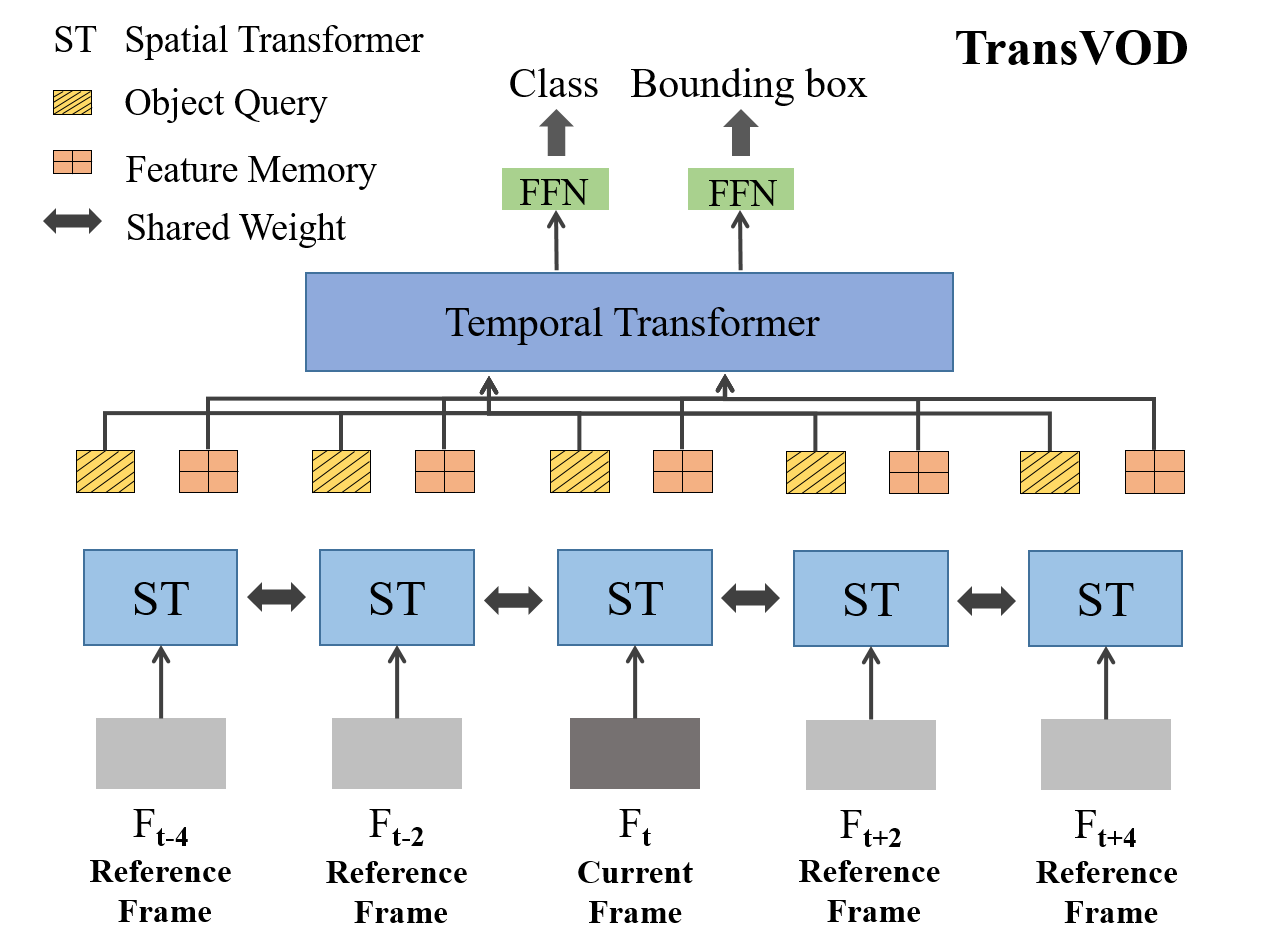
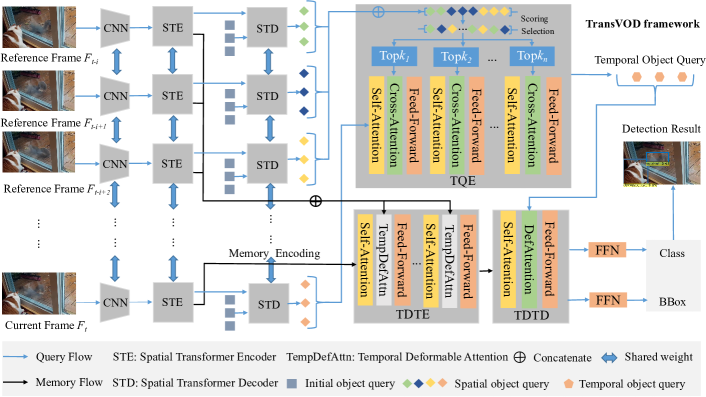
Recently, DETR and Deformable DETR have been proposed to eliminate the need for many hand-designed components in object detection while demonstrating good performance as previous complex hand-crafted detectors. However, their performance on Video Object Detection (VOD) has not been well explored. In this paper, we present TransVOD, an end-to-end video object detection model based on a spatial-temporal Transformer architecture. The goal of this paper is to streamline the pipeline of VOD, effectively removing the need for many hand-crafted components for feature aggregation, e.g., optical flow, recurrent neural networks, relation networks. Besides, benefited from the object query design in DETR, our method does not need complicated post-processing methods such as Seq-NMS or Tubelet rescoring, which keeps the pipeline simple and clean. In particular, we present temporal Transformer to aggregate both the spatial object queries and the feature memories of each frame. Our temporal Transformer consists of three components: Temporal Deformable Transformer Encoder (TDTE) to encode the multiple frame spatial details, Temporal Query Encoder (TQE) to fuse object queries, and Temporal Deformable Transformer Decoder to obtain current frame detection results. These designs boost the strong baseline deformable DETR by a significant margin (3%-4% mAP) on the ImageNet VID dataset. TransVOD yields comparable results performance on the benchmark of ImageNet VID. We hope our TransVOD can provide a new perspective for video object detection. Code will be made publicly available at https://github.com/SJTU-LuHe/TransVOD.
Motivation & Objective
- To simplify video object detection by removing complex, hand-designed components such as optical flow, RNNs, and relation networks.
- To extend the end-to-end detection paradigm of DETR to video by modeling long-range temporal dependencies via Transformers.
- To eliminate post-processing bottlenecks like Seq-NMS and tubelet rescoring through a unified attention-based architecture.
- To explore the effectiveness of temporal attention in fusing spatial object queries and feature memories across video frames.
- To establish a new, clean, and effective baseline for video object detection using self-attention mechanisms.
Proposed method
- Introduces a Temporal Deformable Transformer Encoder (TDTE) to encode multi-frame spatial features using deformable attention.
- Proposes a Temporal Query Encoder (TQE) that performs coarse-to-fine aggregation of spatial object queries across reference frames to generate temporal object queries.
- Employs a Temporal Deformable Transformer Decoder (TDTD) to generate current-frame detection results using both temporal object queries and feature memories.
- Uses a shared feed-forward network (FFN) to predict bounding boxes and class scores from the final decoder output.
- Leverages object query initialization from DETR to enable end-to-end training without NMS or post-processing.
- Applies deformable attention in both spatial and temporal encoders to efficiently attend to relevant features across frames and spatial locations.
Experimental results
Research questions
- RQ1Can a Transformer-based architecture effectively model long-range temporal dependencies in video object detection without hand-crafted components?
- RQ2How does the proposed coarse-to-fine query aggregation strategy in TQE improve feature fusion across frames?
- RQ3What is the optimal number of reference frames and encoder/decoder layers for temporal modeling in video detection?
- RQ4Can an end-to-end Transformer-based detector outperform strong two-stage baselines like deformable DETR on video benchmarks?
- RQ5Does the removal of post-processing steps like Seq-NMS and tubelet rescoring degrade performance when using a pure attention-based design?
Key findings
- TransVOD achieves a 3%-4% mAP improvement over the strong baseline deformable DETR on the ImageNet VID validation set.
- The optimal number of TDTE encoder layers is one, indicating that deeper temporal encoding does not improve performance.
- Only one decoder layer in TDTD is needed, suggesting that deep decoding is unnecessary for effective detection.
- The coarse-to-fine query aggregation strategy in TQE outperforms both coarse-to-coarse and fine-to-fine selection, achieving 79.8% mAP with 100 top-k queries in the deep layer.
- Performance stabilizes with 8 or more reference frames, with mAP peaking at 79.3% using 14 reference frames.
- The model achieves state-of-the-art performance on ImageNet VID without using optical flow, RNNs, or complex post-processing like tubelet scoring.
Read this paper
Open the full text in the Nubint reader and ask about any passage as you read.
Read this paper on NubintThis review was generated by AI from the original paper. Please check the paper before citing it.