
[Paper Review] End-to-End Video Text Spotting with Transformer
This paper proposes TransDETR, a novel end-to-end video text spotting framework based on Transformer architecture that jointly performs detection, tracking, and recognition by modeling long-range temporal dependencies through learnable 'text queries'. It achieves state-of-the-art performance with up to 11.3% improvement in ID-F1 on video text spotting and 7.6% on tracking, while eliminating hand-crafted components like NMS and matching heuristics.
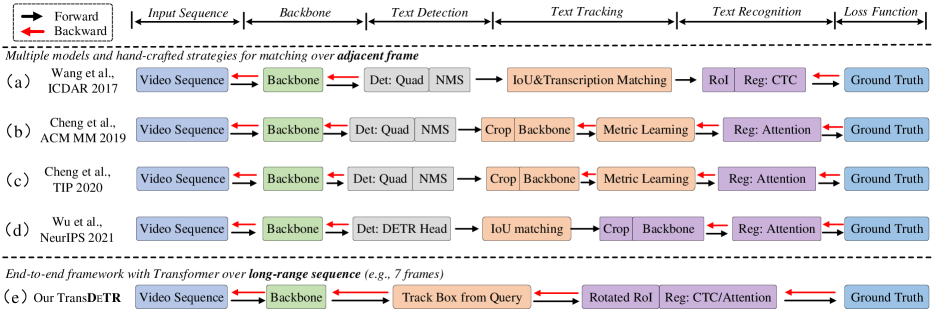
Recent video text spotting methods usually require the three-staged pipeline, i.e., detecting text in individual images, recognizing localized text, tracking text streams with post-processing to generate final results. These methods typically follow the tracking-by-match paradigm and develop sophisticated pipelines. In this paper, rooted in Transformer sequence modeling, we propose a simple, but effective end-to-end video text DEtection, Tracking, and Recognition framework (TransDETR). TransDETR mainly includes two advantages: 1) Different from the explicit match paradigm in the adjacent frame, TransDETR tracks and recognizes each text implicitly by the different query termed text query over long-range temporal sequence (more than 7 frames). 2) TransDETR is the first end-to-end trainable video text spotting framework, which simultaneously addresses the three sub-tasks (e.g., text detection, tracking, recognition). Extensive experiments in four video text datasets (i.e.,ICDAR2013 Video, ICDAR2015 Video, Minetto, and YouTube Video Text) are conducted to demonstrate that TransDETR achieves state-of-the-art performance with up to around 8.0% improvements on video text spotting tasks. The code of TransDETR can be found at https://github.com/weijiawu/TransDETR.
Motivation & Objective
- To address the limitations of existing three-stage video text spotting pipelines that rely on complex, non-differentiable matching heuristics between adjacent frames.
- To enable end-to-end training of video text spotting by unifying detection, tracking, and recognition into a single sequence modeling task.
- To improve long-range temporal modeling for text tracking and recognition, especially in the presence of motion blur and occlusions.
- To eliminate reliance on non-differentiable components such as NMS, IoU matching, and feature-based Re-ID in tracking.
- To achieve higher accuracy and faster inference than prior methods while maintaining a simple, unified architecture.
Proposed method
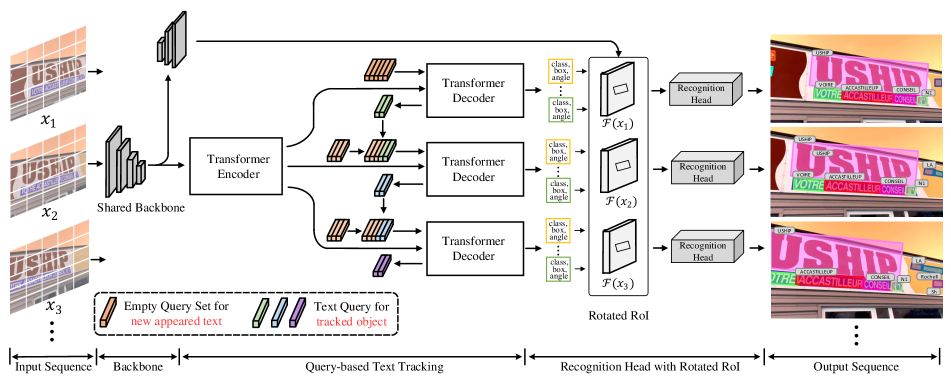
- The framework uses a Transformer-based encoder-decoder with learnable 'text queries' to implicitly model the entire trajectory and content of each text instance across long video sequences.
- Each text query is responsible for predicting the spatial bounding box, tracking ID, and recognized text content for a single text instance over time.
- A novel temporal tracking loss is introduced to enforce consistency of predictions across frames, enabling joint optimization of tracking and recognition.
- The recognition head employs rotated RoIs to handle arbitrary-oriented text, enabling end-to-end training with detection and tracking.
- The model processes video clips as input and outputs a sequence of detection, tracking, and recognition results directly, without post-processing or matching steps.
- The architecture avoids conventional components like anchor generation, NMS, and IoU-based matching, relying solely on attention mechanisms for sequence modeling.
Experimental results
Research questions
- RQ1Can a unified, end-to-end trainable framework based on Transformers effectively perform joint video text detection, tracking, and recognition without explicit matching between frames?
- RQ2How does long-range temporal modeling via text queries compare to adjacent-frame matching in terms of tracking robustness and accuracy?
- RQ3To what extent can eliminating hand-crafted components like NMS and IoU matching improve performance and inference speed?
- RQ4Does the proposed method generalize well across diverse video text datasets with varying video quality and text appearance?
- RQ5Can the model maintain high accuracy while achieving faster inference compared to multi-stage, non-end-to-end baselines?
Key findings
- TransDETR achieves a 7.6% absolute improvement in ID-F1 on the ICDAR2015 (video) tracking benchmark, outperforming the previous SOTA method.
- On the video text spotting task, TransDETR achieves 11.3% higher ID-F1 than the current SOTA method, with a 7.7% improvement in MOTA.
- The model reduces false negatives by up to 15.0% and significantly alleviates ID switching and object loss in tracking, as shown in visualizations.
- TransDETR achieves 16.7 FPS inference speed, which is faster than the SOTA method (9.0 FPS), despite higher accuracy.
- On ICDAR2013 (video), TransDETR improves MOTA by 7.4% and ID-F1 by 4.7% over YORO, while maintaining faster inference.
- The model generalizes well to YVT and Minetto datasets, achieving 1.7% and 2.4% MOTA gains respectively, without fine-tuning.
Read this paper
Open the full text in the Nubint reader and ask about any passage as you read.
Read this paper on NubintThis review was generated by AI from the original paper. Please check the paper before citing it.