
[Paper Review] Energy-Based Cross Attention for Bayesian Context Update in Text-to-Image Diffusion Models
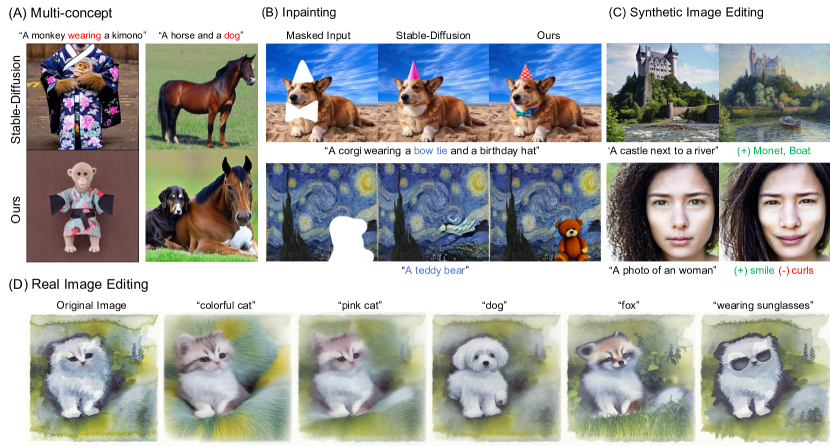
This paper proposes Energy-Based Cross Attention (EBCA), a training-free, Bayesian framework that improves semantic alignment in text-to-image diffusion models by adaptively updating context vectors through energy-based posterior estimation. By minimizing hierarchical energy functions in cross-attention layers, EBCA enables zero-shot compositional generation and significantly reduces semantic misalignment in multi-concept generation, inpainting, and image editing tasks without finetuning.
Despite the remarkable performance of text-to-image diffusion models in image generation tasks, recent studies have raised the issue that generated images sometimes cannot capture the intended semantic contents of the text prompts, which phenomenon is often called semantic misalignment. To address this, here we present a novel energy-based model (EBM) framework for adaptive context control by modeling the posterior of context vectors. Specifically, we first formulate EBMs of latent image representations and text embeddings in each cross-attention layer of the denoising autoencoder. Then, we obtain the gradient of the log posterior of context vectors, which can be updated and transferred to the subsequent cross-attention layer, thereby implicitly minimizing a nested hierarchy of energy functions. Our latent EBMs further allow zero-shot compositional generation as a linear combination of cross-attention outputs from different contexts. Using extensive experiments, we demonstrate that the proposed method is highly effective in handling various image generation tasks, including multi-concept generation, text-guided image inpainting, and real and synthetic image editing. Code: https://github.com/EnergyAttention/Energy-Based-CrossAttention.
Motivation & Objective
- To address semantic misalignment in text-to-image diffusion models, where generated images fail to reflect intended textual concepts.
- To improve context vector quality by modeling the posterior distribution $ p(\text{context} \mid \text{representations}) $, rather than relying on fixed, frozen text embeddings.
- To enable zero-shot compositional generation through the inherent compositionality of Energy-Based Models (EBMs).
- To provide a plug-and-play, training-free solution compatible with existing diffusion models like Stable Diffusion.
- To demonstrate effectiveness across diverse tasks including multi-concept generation, text-guided inpainting, and real/synthetic image editing.
Proposed method
- Formulates energy functions $ E(K_l; Q_{t,l}) $ in each cross-attention layer to model the posterior $ p(K_l \mid Q_{t,l}) $, where $ K_l $ is the key (context) and $ Q_{t,l} $ is the query (image representation).
- Derives the gradient of the log posterior of context vectors to enable iterative, adaptive updates that propagate through subsequent layers.
- Introduces a prior energy function $ \operatorname{E}(K) $ that adaptively regularizes the smooth maximum of $ \|k_i\| $, preventing over-penalization of context vectors.
- Uses a single-step context update with propagation to subsequent layers, balancing performance and computational cost.
- Enables zero-shot compositional generation via linear combination of cross-attention outputs from multiple energy-based context vectors.
- Applies the framework in inference only, without any model fine-tuning or additional training.
Experimental results
Research questions
- RQ1Can energy-based posterior estimation improve semantic alignment between text prompts and generated images in diffusion models?
- RQ2How does adaptive context updating through energy function minimization affect multi-concept generation and image editing?
- RQ3Can the proposed method enable zero-shot compositional generation without retraining?
- RQ4Does the adaptive prior energy function prevent over-suppression of salient context vectors compared to uniform regularization?
- RQ5How does the number of context updates affect image quality and semantic fidelity?
Key findings
- The proposed EBCA method significantly reduces semantic misalignment, as evidenced by improved generation quality in multi-concept tasks such as 'a lion and a crown'.
- With increasing regularization strength $ \alpha $, salient contextual elements (e.g., crown, lion) progressively vanish, confirming the adaptive penalization's effectiveness in preserving key concepts.
- Using the final timestep context vector $ C_T $ as a fixed embedding yields semantically accurate generations, demonstrating that the adaptive update preserves intended meaning.
- Multi-step context updates improve image quality but are computationally expensive, indicating that a single-step update is sufficient for optimal performance.
- The method enables effective real and synthetic image editing, including editing horses to zebras and cats to dogs, using only text prompts and no training.
- The framework supports zero-shot compositional editing by linearly combining cross-attention outputs from multiple energy-based context vectors, enabling flexible and intuitive manipulation.
Better researchstarts right now
From reading papers to final review, dramatically reduce your research time.
No credit card · Free plan available
This review was created by AI and reviewed by human editors.