
[Paper Review] Energy Extraction from Spinning Stringy Black Holes
This study performs the first 3D GRMHD simulations of magnetized plasma accretion onto spinning stringy black holes in the Kerr-Sen (dilaton-axion) spacetime, demonstrating that the Blandford-Znajek mechanism powers relativistic jets even in non-Kerr gravity. For non-spinning stringy black holes, energy extraction occurs via gravitational binding energy release, yielding outflows ~250% more powerful than in Schwarzschild black holes due to smaller horizons and stronger spacetime curvature.
We perform the first numerical simulations modeling the inflow and outflow of magnetized plasma in the Kerr-Sen spacetime, which describes classical spinning black holes (BHs) in string theory. We find that the Blandford-Znajek (BZ) mechanism, which is believed to power astrophysical relativistic outflows or ``jets'', is valid even for BHs in an alternate theory of gravity, including near the extremal limit. The BZ mechanism releases outward Poynting-flux-dominated plasma as frame-dragging forces magnetic field lines to twist. However, for nonspinning BHs, where the frame-dragging is absent, we find an alternate powering mechanism through the release of gravitational potential energy during accretion. Outflows from non-spinning stringy BHs can be approximately $250\%$ more powerful as compared to Schwarzschild BHs, due to their relatively smaller event horizon sizes and, thus, higher curvatures. Finally, by constructing the first synthetic images of near-extremal non-Kerr BHs from time-dependent simulations, we find that these can be ruled out by horizon-scale interferometric images of accreting supermassive BHs.
Motivation & Objective
- To investigate energy extraction mechanisms in spinning black holes within string theory gravity, specifically the Kerr-Sen (dilaton-axion) spacetime.
- To determine whether the Blandford-Znajek mechanism remains valid in non-general relativistic black hole spacetimes, especially near the extremal limit.
- To explore alternative energy extraction pathways in non-spinning stringy black holes where frame-dragging is absent.
- To construct synthetic horizon-scale images from time-dependent simulations to test against EHT observations.
- To assess the observability of non-Kerr black hole signatures through shadow size and morphology differences.
Proposed method
- Conducting 42 high-resolution, fully 3D general-relativistic magnetohydrodynamics (GRMHD) simulations of hot, magnetized accretion flows onto spinning non-Kerr black holes using the Kerr-Sen metric.
- Employing the Blandford-Znajek (BZ) power prescription, $ P_{\rm BZ} \propto \phi_{\rm H}^2 \Omega_{\rm max}^2 $, to quantify jet power in rotating black holes.
- Using the binding energy at the innermost stable circular orbit (ISCO) as a proxy for available accretion energy, especially in non-spinning cases.
- Computing time-averaged 230 GHz synthetic images from simulations to compare shadow diameters and brightness asymmetries with EHT observations.
- Analyzing magnetic and thermal pressure profiles to identify energy transfer mechanisms from viscous dissipation to outflows in advection-dominated accretion flows (ADAFs).
- Comparing simulated shadow sizes and morphologies with the EHT measurement of M87* ($ \delta = -0.01 \pm 0.17 $) to constrain non-Kerr models.
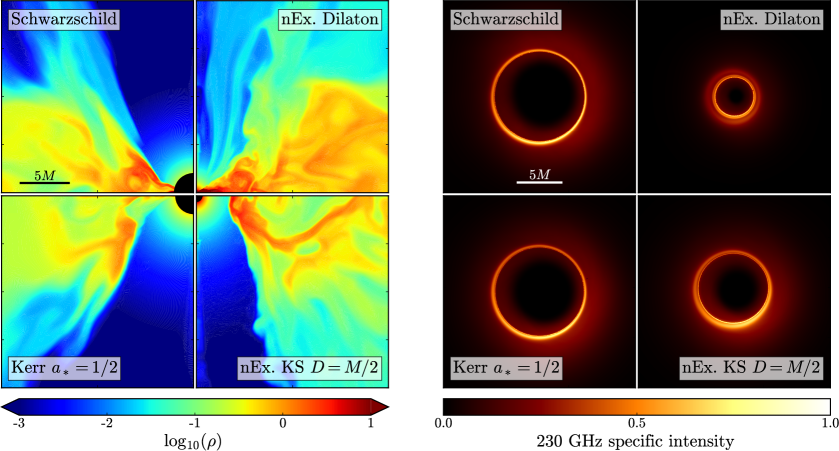
Experimental results
Research questions
- RQ1Does the Blandford-Znajek mechanism remain effective in spinning black holes described by the Kerr-Sen (stringy) metric, particularly near the extremal limit?
- RQ2What energy extraction mechanism powers outflows in non-spinning stringy black holes where frame-dragging is absent?
- RQ3How do smaller event horizon sizes in dilaton-axion black holes affect the binding energy and outflow power compared to Schwarzschild black holes?
- RQ4Can time-dependent GRMHD simulations of non-Kerr black holes produce synthetic images distinguishable from those of Kerr black holes using current EHT resolution?
- RQ5To what extent do magnetic and thermal pressure gradients contribute to jet launching in advection-dominated accretion flows around non-Kerr black holes?
Key findings
- The Blandford-Znajek mechanism remains active and effective in spinning stringy black holes described by the Kerr-Sen spacetime, even near the extremal limit.
- For non-spinning dilaton black holes, energy extraction occurs via the release of gravitational binding energy, resulting in outflows approximately 250% more powerful than those from Schwarzschild black holes.
- The reduction in event horizon size due to increasing dilaton charge leads to stronger spacetime curvature, enhancing the binding energy at the ISCO and thus increasing outflow power.
- Synthetic images from time-dependent simulations show that near-extremal non-Kerr black holes produce shadow diameters with fractional deviations $ \delta = -0.615 $, which are ruled out by EHT observations of M87* ($ \delta = -0.01 \pm 0.17 $).
- Magnetic and thermal pressures increase as $ A_{\rm H}^{-1.7} $ with decreasing horizon area, indicating significant energy transfer from viscous dissipation to magnetic and thermal energy in advection-dominated flows.
- The strong correlation between ISCO binding energy and outflow power confirms that accretion energy release, not rotational energy, drives winds in non-spinning stringy black holes.
![Figure 2: The Blandford-Znajek [BZ 52 ] mechanism predicts the correct jet power even for non general-relativistic BHs. We find that the total outflow power $\eta$ matches the predicted BZ power $\eta_{\rm BZ}=(k/4\pi)(\Omega_{\rm H}\phi_{\rm H})^{2}$ (see eq. 1 ) well when the jets dominate the out](https://ar5iv.labs.arxiv.org/html/2310.20040/assets/x2.png)
Better researchstarts right now
From reading papers to final review, dramatically reduce your research time.
No credit card · Free plan available
This review was created by AI and reviewed by human editors.